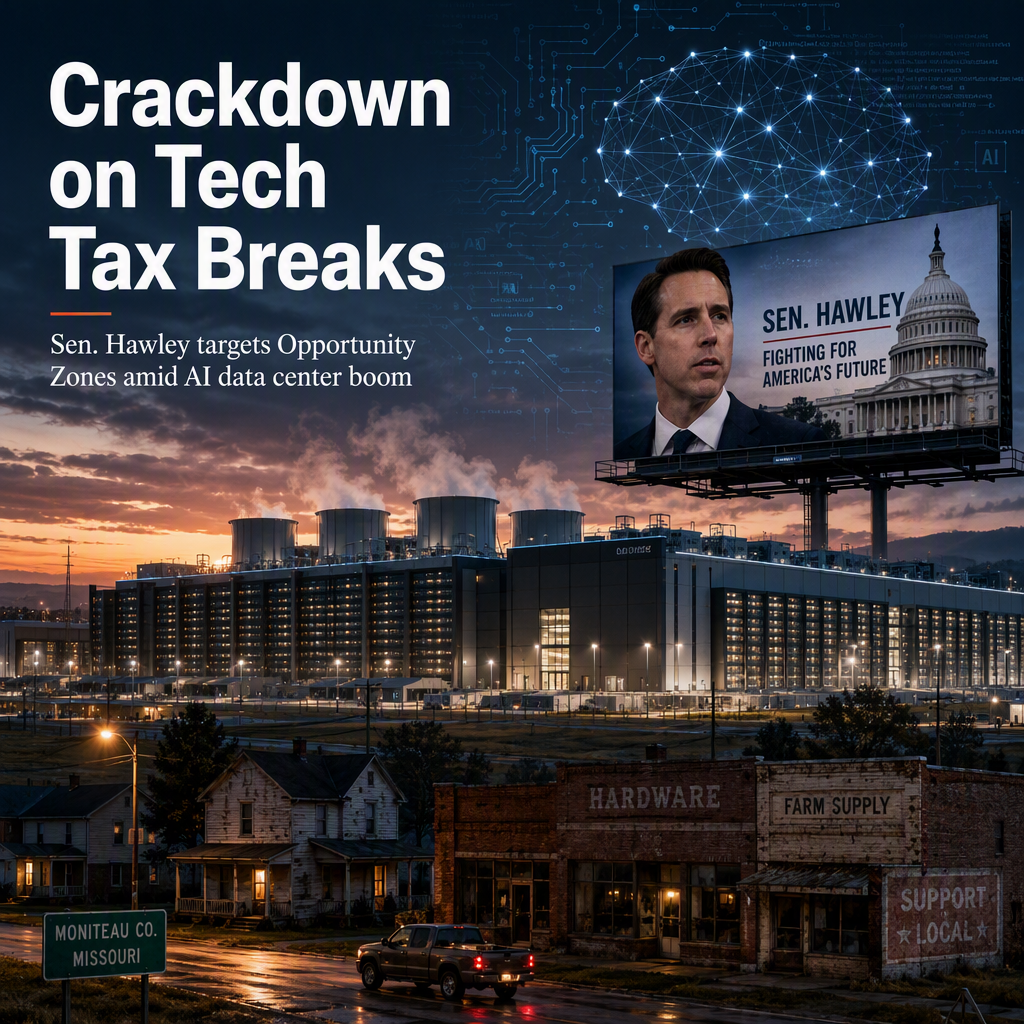
Sen. Josh Hawley, R-Mo., has announced plans to introduce legislation aimed at closing a tax loophole that he argues tech giants are exploiting to build data centers in low-income areas. The loophole, tied to Opportunity Zones, was first established as part of the Tax Cuts and Jobs Act of 2017, passed during President Donald Trump's first term, and was made permanent last year through subsequent legislation. Opportunity Zones were intended to spur investment in lower income or forgotten areas, but Hawley contends that tech companies are using them as 'corporate welfare' to defer, reduce, or eliminate corporate gains taxes on their investments in these zones [1].
According to the Department of Housing and Urban Development, there are 8,746 Opportunity Zones in the U.S., with just under half located in rural areas. Tech companies have increasingly targeted these rural zones for data center development. A report from the National Community Reinvestment Coalition found that 14% of all data centers are situated in Opportunity Zones, and over 17% of permitted, approved, and under-construction data center projects are in these zones [1].
Hawley's proposed bill would explicitly exclude data centers from accessing Opportunity Zone tax cuts, creating a new federal barrier to their rapid expansion. This legislative move comes amid heightened political debate over the role of data centers in supporting AI development, which has become a major wedge issue on the campaign trail. Congress is currently grappling with concerns about unchecked AI growth, and Hawley's initiative is positioned as a response to these anxieties [1].
Data center development is particularly robust in Texas, with North Texas emerging as a leading region for new projects. The market implications of Hawley's proposal could be significant for tech companies relying on these tax incentives to expand their infrastructure, especially in rural and low-income areas [1].
CONCLUSION
Sen. Hawley's planned legislation to restrict Opportunity Zone tax breaks for data centers signals growing political scrutiny of tech industry expansion and its ties to AI development. If enacted, the bill could slow data center growth in rural and low-income areas, impacting tech companies' investment strategies. The market is likely to watch closely for further Congressional action and its effects on the sector.