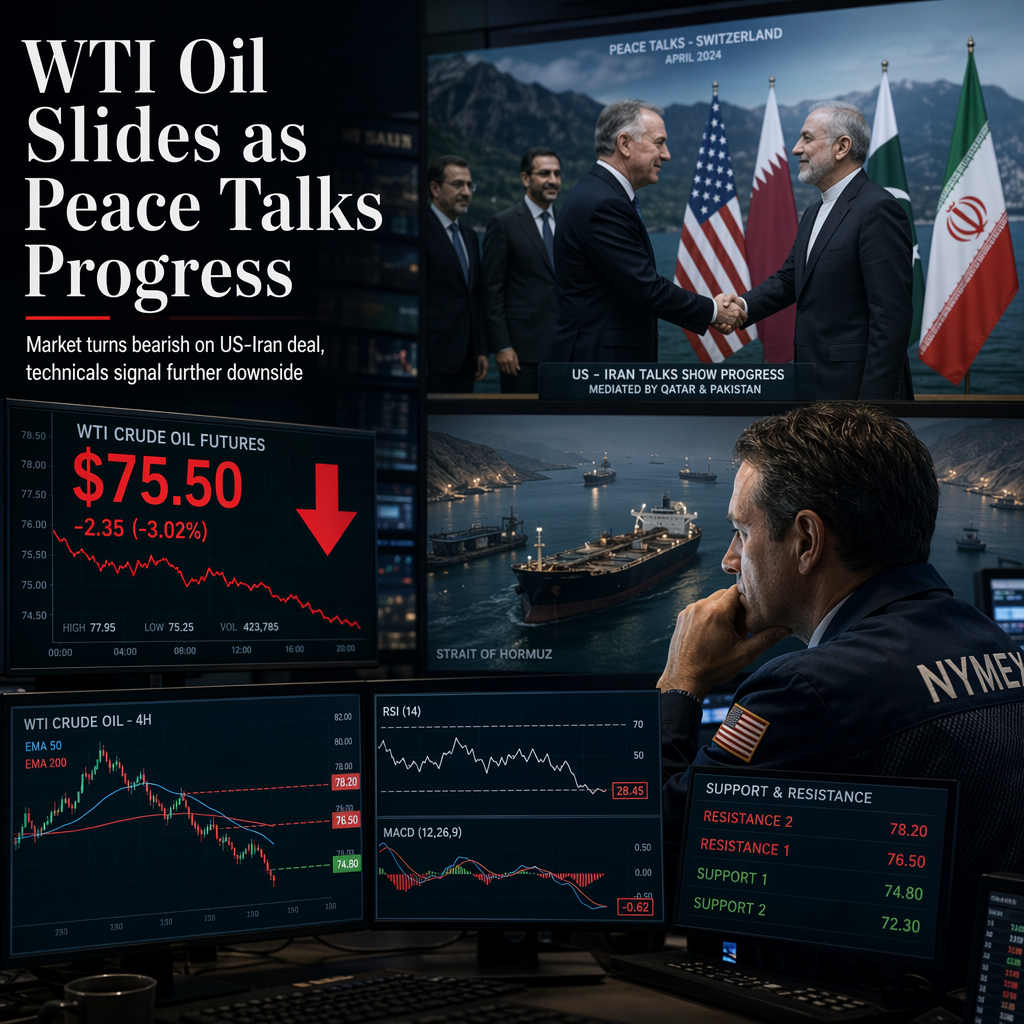
West Texas Intermediate (WTI) crude oil futures on NYMEX declined by 1.2% to trade near $75.50 during the Asian session on Monday, reversing earlier gains as both the United States and Iran reported progress in peace negotiations held in Switzerland over the weekend [1]. Iran's Foreign Minister Abbas Araghchi described the talks as achieving 'great progress,' highlighting waivers for oil and petrochemical exports, the lifting of the US naval blockade on Iranian seaports, the release of some frozen assets, and the initiation of a reconstruction and development plan, according to CNBC [1]. US Vice President JD Vance also echoed the sentiment of 'great progress' after meeting with Iranian negotiators [1].
Qatar and Pakistan, acting as mediators, confirmed significant advancements in the peace process, with a Pak-Qatar joint statement noting that a 'High Level Committee has agreed upon a roadmap towards reaching a final deal within 60 days, laying the foundation for the immediate commencement of further technical talks' [1]. Additionally, an Iranian Foreign Ministry spokesperson announced the successful arrangement of a formal transit mechanism to ensure the safe passage of commercial vessels through the Strait of Hormuz, a critical global oil chokepoint [1].
Despite the positive diplomatic developments, WTI oil prices turned negative, with technical analysis indicating a bearish near-term tone. WTI remains well below the 20-day Exponential Moving Average (EMA) at approximately $84.05, suggesting that any rallies are likely to be corrective rather than the start of a sustained recovery [1]. The Relative Strength Index (RSI) near 33 points to persistent downside pressure, with immediate resistance at the 20-day EMA and potential support at the June 18 low of $72.79. A further decline could see prices return to pre-war levels around $67.20 [1].
CONCLUSION
WTI oil prices declined as progress in US-Iran peace talks raised the prospect of increased Iranian oil exports and eased geopolitical tensions. Technical indicators point to continued bearish pressure, with key resistance and support levels in focus. The market is closely watching for further developments in the negotiations, which could significantly impact oil supply dynamics.