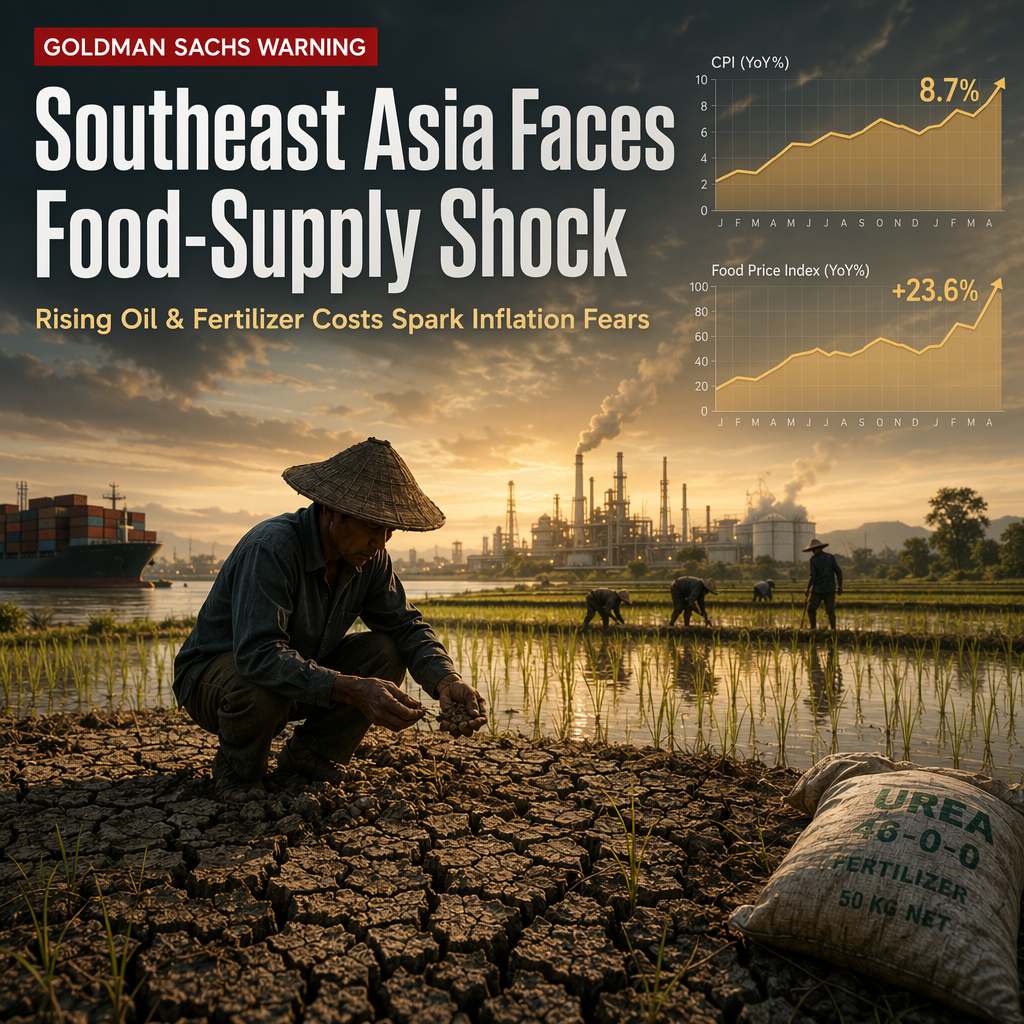
Goldman Sachs has issued a warning that Southeast Asia is likely to experience a significant food-supply shock, with food prices expected to rise due to a combination of higher oil and fertilizer input costs and the potential impact of a strong El Niño event later in 2026 [1]. The investment bank estimates that these combined effects could add 2.1 percentage points to existing food inflation over the next 12 months, with an average increase of 1 percentage point after six months and 2 percentage points after 18 months, before moderating [1]. Goldman clarified that these figures represent additional pressure on top of the usual food inflation trend, not forecasts of total food inflation [1].
The report highlights that the oil shock stemming from the Middle East conflict has already impacted fuel-sensitive consumer price index (CPI) items, and higher fertilizer prices are expected to further raise farm input costs [1]. This situation may force governments in the region to reconsider the tradeoff between food and fuel [1]. A potential strong El Niño event in late 2026 could exacerbate the food-supply shock just as oil and fertilizer pressures are being transmitted through the food chain [1].
Among Southeast Asian nations, Singapore and the Philippines are identified as the most directly exposed to shocks in global food prices due to their status as net food importers [1]. Malaysia and Indonesia, while appearing more insulated because of their palm oil industries, would also become net food importers if their palm oil sectors are excluded [1]. Thailand is particularly vulnerable, as more than 90% of its fertilizers are imported, making it susceptible to global food-price shocks via higher input costs [1].
The report also references findings from the London School of Economics and Political Science, which note that energy is a key production input and transportation cost for food commodities, meaning that fluctuations in oil prices are rapidly transmitted along the supply chain [1]. Additionally, the OECD warns that continued oil supply disruptions could further raise fertilizer prices from the Middle East and potentially affect their availability, impacting planting and harvesting seasons over 2026 and 2027, reducing yields, and potentially leading to higher food prices over time [1].
Economist Mohamed Faiz Nagutha points out that food consumption accounts for a large proportion of household spending in countries like Indonesia, the Philippines, and Vietnam, making these populations particularly sensitive to food inflation [1].
CONCLUSION
Goldman Sachs projects that Southeast Asia faces heightened food inflation risks due to rising oil and fertilizer costs and the potential for a strong El Niño event in late 2026. Countries most exposed include Singapore, the Philippines, and Thailand, with broader regional vulnerability due to high household food spending. The market implication is a likely increase in food prices, which could pressure both consumers and policymakers in the region.