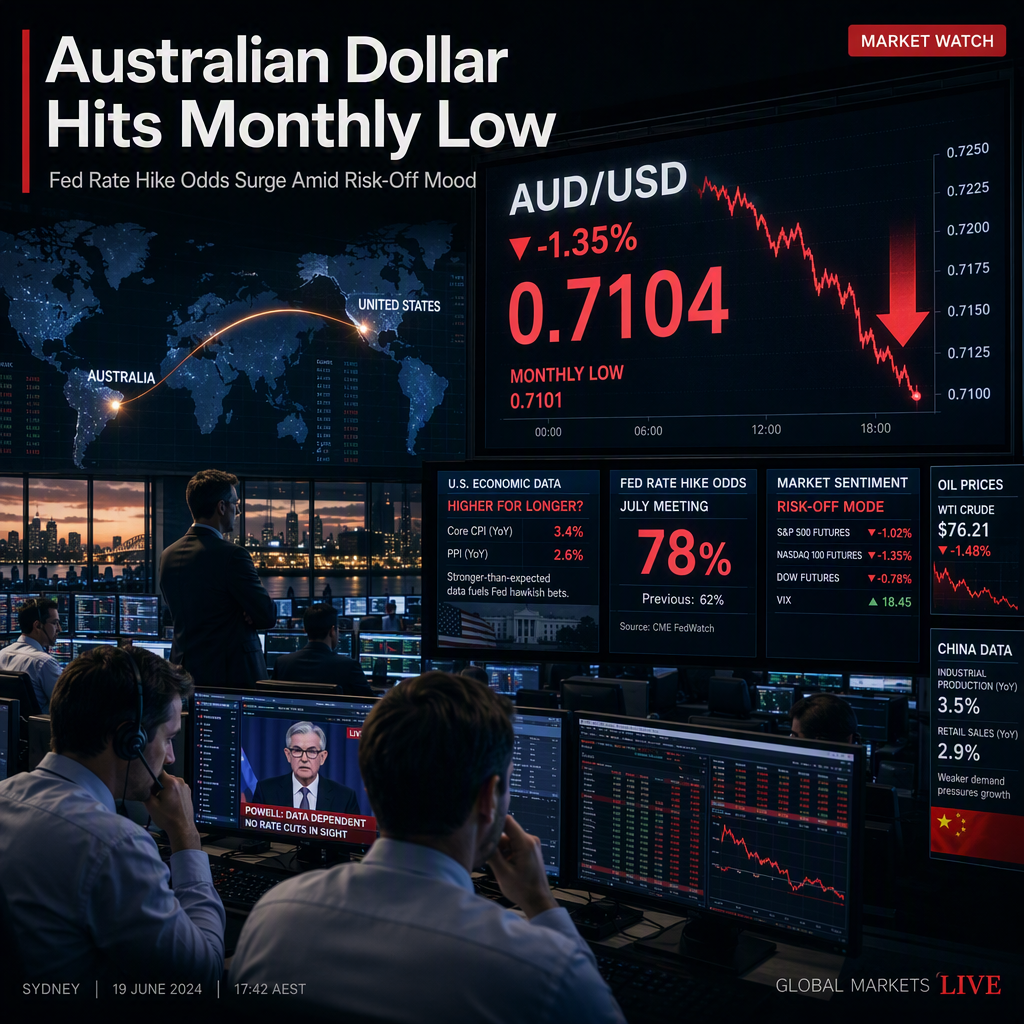
The Australian Dollar (AUD/USD) slipped to a new monthly low in the 0.7100s on Monday, following a series of strong United States economic data releases that have increased market expectations for a Federal Reserve (Fed) rate hike later this week [1]. The probability of a Fed rate hike has risen sharply, with markets now pricing in a 90% chance, up from approximately 60% a week ago, after firm Producer Price Index (PPI) and Consumer Price Index (CPI) figures were reported last Friday [1].
Despite higher oil prices, which typically support commodity currencies like the Australian Dollar, the AUD has continued to decline, as risk appetite has soured. US stock index futures are pointing sharply lower due to renewed concerns about AI-related stocks, and soft Chinese lending data has further dampened sentiment toward China-linked currencies [1].
China is set to release its August activity batch, with consensus expectations for Industrial Production to increase to 4.8% year-over-year from 4.5%, and Retail Sales to rise to 0.8% from 0.6% [1]. However, these anticipated improvements have not yet provided support for the AUD.
Technical analysis shows AUD/USD trading at 0.7119, extending its slide below both the 20-period and 100-period Simple Moving Averages (SMAs), which are capping the pair at 0.7177 and 0.7179, respectively, reinforcing a bearish near-term bias [1]. The 14-period Relative Strength Index (RSI) is in oversold territory near 22, suggesting that while downside pressure remains dominant, selling momentum may be stretched in the short term [1]. Immediate resistance levels are at 0.7125, 0.7131, and 0.7137, with support at 0.7108; a break below this support could extend the current bearish sequence [1].
CONCLUSION
The Australian Dollar has fallen to a monthly low amid heightened expectations for a Fed rate hike, driven by strong US economic data and risk-off sentiment. Technical indicators point to continued downside pressure, though selling momentum may be stretched. Market participants are closely watching upcoming Chinese economic data and the Fed meeting for further direction.