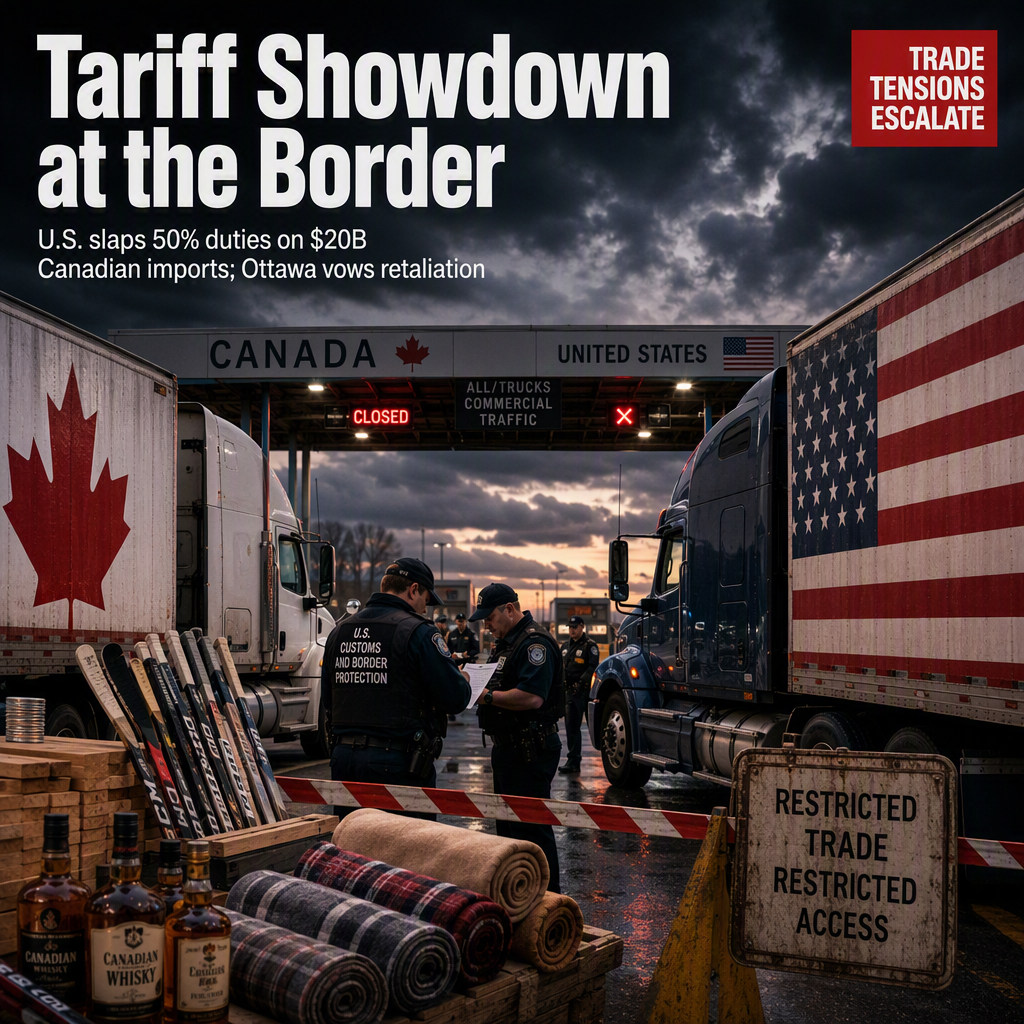
The United States announced steep new tariffs of 50% on approximately $20 billion worth of imports from Canada after trade negotiations between the two countries broke down late Friday, according to the U.S. Trade Representative’s Office [1]. Canadian Prime Minister Mark Carney criticized the tariffs as a 'miscalculation' and attributed the collapse of talks to what he described as the Trump administration’s 'uneconomic' and 'unfair' demands [1]. The new tariffs will impact a wide range of Canadian goods, including hockey sticks, building materials, liquors, and certain types of clothing [1].
In response, Prime Minister Carney stated that Canada would implement a 'focused response' by imposing tariffs on U.S. goods, specifically targeting sectors such as steel, dairy, appliances, agricultural equipment, pulp and paper, and electronics. These retaliatory duties are set to take effect on September 8 [1]. U.S. Trade Representative Jamieson Greer confirmed that there are no new talks planned with Canada and emphasized that the U.S. would 'respond to Canadian retaliation' [1].
The announcement of these tariffs and the breakdown in negotiations signal a significant escalation in trade tensions between the two countries. The market implications are potentially substantial, given the scale of the tariffs and the sectors affected. No specific market reactions or analyst opinions were provided in the article [1].
Additionally, the article notes that political controversy has arisen in the U.S. over the Trump administration’s decision to suspend tariffs on ground beef imports, with GOP lawmakers expressing concern about the impact on American farmers [1].
CONCLUSION
The imposition of 50% tariffs on $20 billion of Canadian imports marks a sharp escalation in U.S.-Canada trade tensions, with both sides preparing retaliatory measures. The affected sectors and lack of ongoing negotiations suggest significant market uncertainty ahead. No analyst forecasts or immediate market reactions were provided.