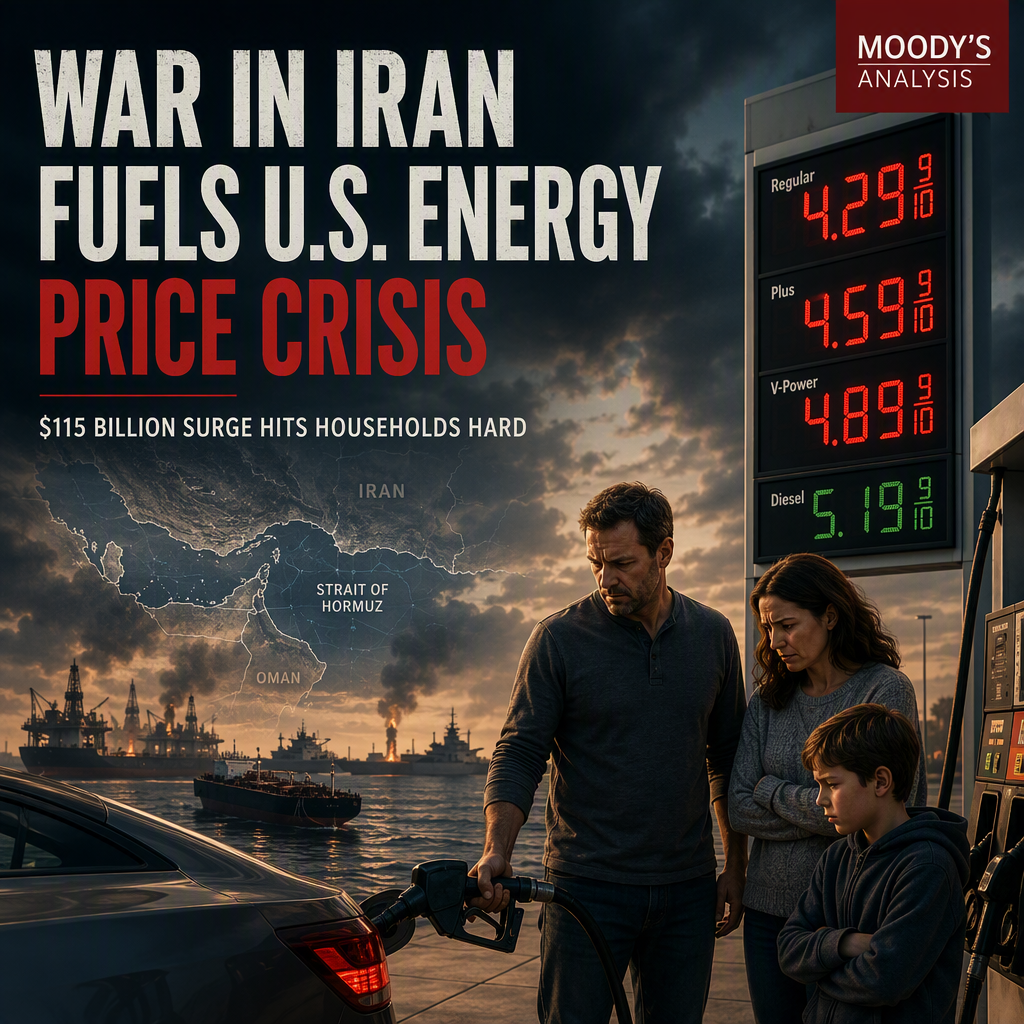
American households have faced a significant financial burden as a result of the ongoing war in Iran, with energy prices rising sharply and leading to over $100 billion in additional spending this year, according to Mark Zandi, chief economist at Moody's Analytics [1]. Zandi stated that the war has added approximately $115 billion in extra costs through higher gasoline, diesel, and jet fuel prices, translating to about $860 more per household compared to a scenario without the conflict [1].
The impact of these elevated energy prices has been particularly severe for lower- and middle-income Americans, whose after-inflation incomes have stagnated or even declined due to the war, while higher-income households have been better able to absorb the increased costs thanks to stable jobs, low-interest mortgages, and gains in stock values [1]. Zandi emphasized that the high cost of energy—over $4 per gallon at the pump—has been especially challenging for those with less financial flexibility, as they often lack significant stock holdings or home ownership and carry more debt [1].
Inflationary pressures, which have persisted since the COVID-19 pandemic, were exacerbated this year by the energy shock stemming from the Iran war. Zandi noted that larger tax refunds from the One Big Beautiful Bill Act helped households manage higher gas prices earlier in the year, but this relief has faded, leaving consumers to contend with sustained high energy costs [1].
The war has also disrupted oil flows through the Strait of Hormuz due to threats of Iranian attacks and sea mines, further contributing to the energy price surge [1].
CONCLUSION
The Iran war has imposed a substantial financial strain on U.S. households, with energy costs rising by an estimated $115 billion this year. Lower- and middle-income Americans have been hit hardest, and with earlier tax relief now spent, the pressure of high energy prices is likely to persist.