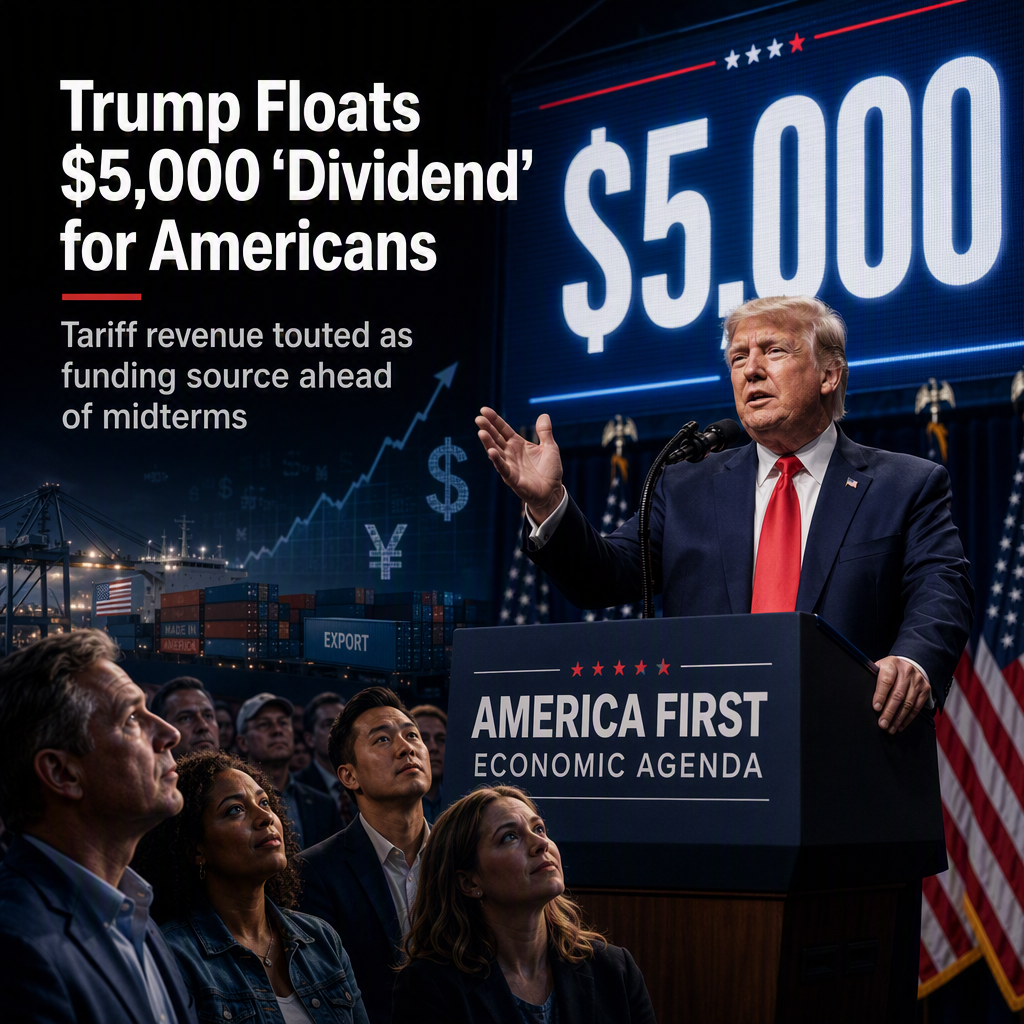
President Donald Trump announced a proposal to issue a $5,000 'Trump dividend' to every adult U.S. citizen, contingent upon Republicans retaining control of both the House of Representatives and the Senate in the upcoming midterm elections [1]. The payout would be funded by federal tariff revenue, which Trump described as generating record trade revenue and building long-term national wealth [1]. During an interview on 'The Ingraham Angle,' Trump emphasized the economic growth under Republican leadership, contrasting it with what he characterized as 'negative growth' under Democrats [1].
Trump claimed that the U.S. is 'taking in $21 trillion' in revenue, attributing this to tariffs, which he called 'beautiful' and asserted were four to five times higher than any other country [1]. He likened the proposed dividend to a cash distribution by a successful company to its shareholders, stating that the payment would need to be spent within the U.S. [1]. The announcement was made during the opening night of the Republican Party's midterm convention in Dallas, Texas, ahead of the November elections [1].
Republicans currently hold a narrow majority in the House with 218 seats compared to Democrats' 214, with one independent and two vacancies [1]. Trump reiterated that the dividend proposal is dependent on Republicans winning both chambers, arguing that Democrats would not be able to implement such a measure [1].
While Trump highlighted tariffs as the funding mechanism, the article notes that annual tariff revenue falls well short of the estimated cost of the $5,000 dividend proposal [1]. No market reactions or analyst opinions were discussed in the article.
CONCLUSION
Trump's $5,000 dividend proposal, funded by tariff revenue, is positioned as a major economic incentive tied to Republican control of Congress. However, the feasibility of funding such payouts with tariff revenue is questioned, as annual collections are noted to be insufficient for the estimated cost. The announcement may influence voter sentiment ahead of the midterm elections, but concrete market reactions or analyst perspectives were not provided.