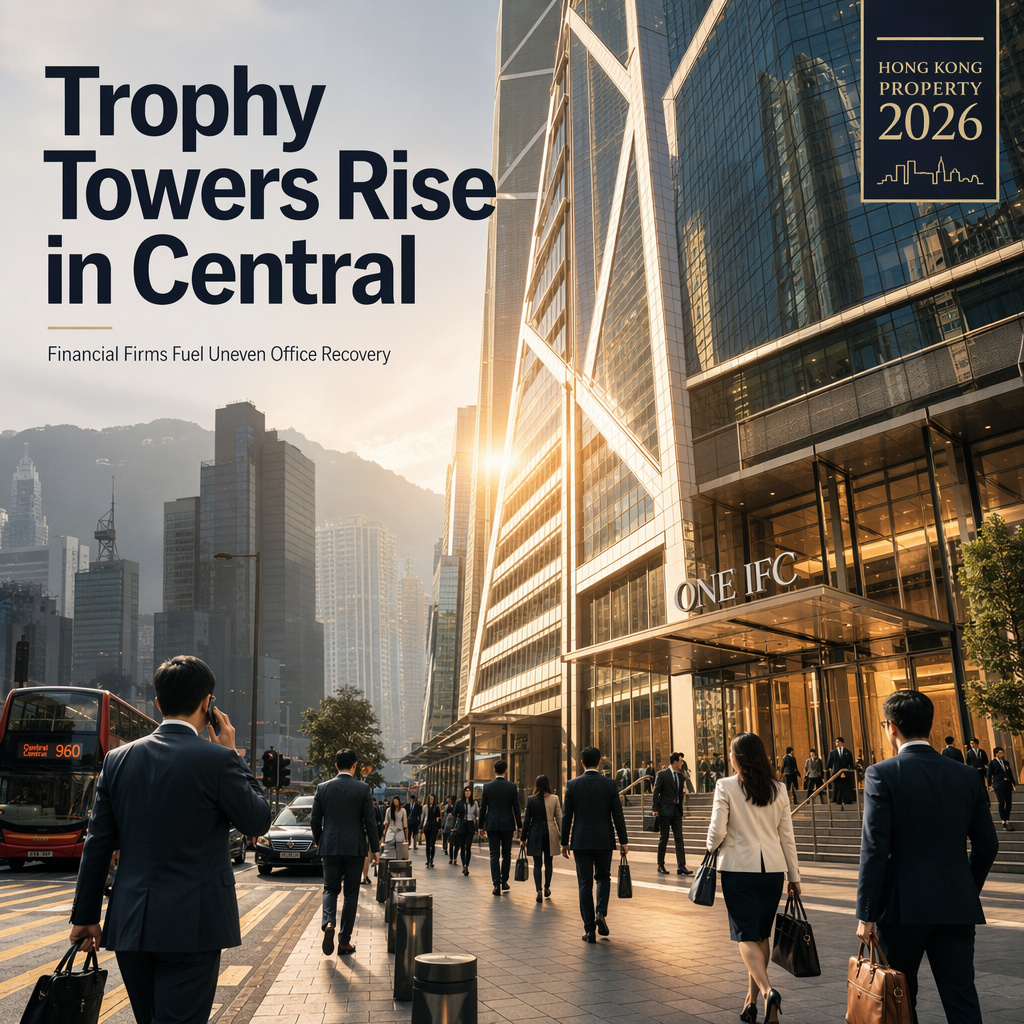
Hong Kong's premium office market, particularly in the Central district, is experiencing a robust recovery in the first half of 2026, driven primarily by financial firms seeking prestigious addresses to attract talent and signal financial strength [1]. Market analysts report that leasing activity in Central, home to international banks and global asset managers, has picked up significantly, with vacancy rates for Grade A offices dropping to their lowest level since the pandemic [1]. A local property consultant noted, "We're seeing a flight to quality," as financial institutions are willing to pay a premium for landmark buildings, fueling a rebound in prime rents [1].
In contrast, secondary office districts such as Kowloon East and Wong Chuk Hang continue to struggle, with elevated vacancy rates and subdued rents, as companies consolidate workspace and delay expansion plans amid ongoing economic uncertainties [1]. Landlords in these less central locations are offering longer rent-free periods and flexible terms to attract tenants, highlighting the uneven nature of the recovery [1].
Recent leasing deals in Central include a new lease by a major international bank and an expansion by a leading asset management firm, underscoring the strong demand for trophy offices in prime locations [1]. Analysts remain optimistic about the outlook for Central and Admiralty, but expect secondary markets to take longer to recover, with the gap between prime and non-prime rents likely to persist into the next year [1].
Investors and developers are closely monitoring the property market's trajectory, viewing Central's performance as a bellwether for the sector. Despite challenges in secondary districts, the sustained demand for trophy offices reaffirms Hong Kong's enduring appeal as a global financial hub [1].
CONCLUSION
The surge in demand for trophy offices in Hong Kong's Central district highlights a flight to quality among financial firms, driving a rebound in prime rents and lowering vacancy rates. However, secondary office markets remain subdued, with analysts expecting the divergence between prime and non-prime rents to persist. Central's performance is seen as a key indicator for the broader property sector.