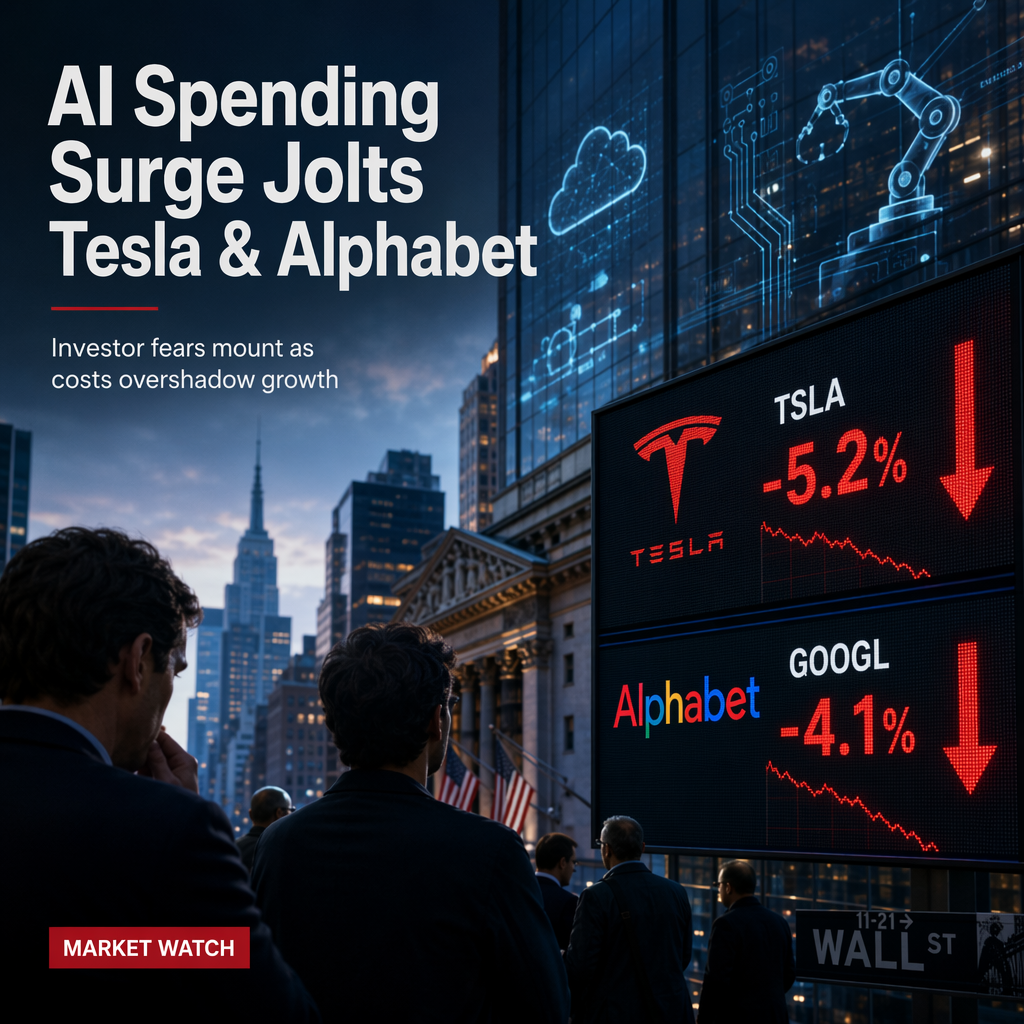
Tesla and Alphabet shares experienced significant declines in premarket trading on Thursday, following announcements from both companies signaling increased spending on artificial intelligence initiatives. Alphabet's shares fell approximately 4%, while Tesla's stock dropped over 5% after both firms reported negative free cash flow for the second quarter and outlined plans for higher capital expenditures [1].
Alphabet raised its capital expenditure forecast for 2026 to a range of $195 billion to $205 billion, up from its previous projection of $180 billion to $190 billion, and warned that figures could be even higher in 2027. The company attributed the spending increase to an acceleration in capacity delivery to meet growing AI demand. Despite these costs, Alphabet reported that Google's cloud revenue surged 82% year-on-year in the second quarter to $24.8 billion, surpassing forecasts [1].
Tesla reported a 142% year-on-year surge in capital expenditures for the second quarter, reaching $5.79 billion, and expects to spend more than $25 billion in capex this year. CEO Elon Musk sought to reassure investors, stating, 'This is a massive capex year. I'm confident that all the things that we're investing in will yield incredible returns. Really, maybe the best capex returns that we've ever seen.' Tesla highlighted investments in semiconductor production and its humanoid robot, Optimus, noting that first-generation production lines for Optimus are being installed and production will start soon. Tesla's core automotive business generated $20.52 billion in revenue, up 23% year-on-year [1].
Management at both companies attempted to calm investor fears regarding the increased spending, emphasizing the long-term potential returns and the necessity of these investments to meet AI-driven demand. However, the immediate market reaction was negative, with investors expressing concern over the mounting costs associated with the artificial intelligence boom [1].
CONCLUSION
Tesla and Alphabet's announcements of sharply higher AI-related spending led to notable share price declines, as investors weighed the risks of increased capital expenditures against the potential for future returns. Despite strong revenue growth in key segments, concerns over negative free cash flow and rising costs dominated market sentiment. Both companies emphasized confidence in their investment strategies and the long-term benefits of their AI initiatives.