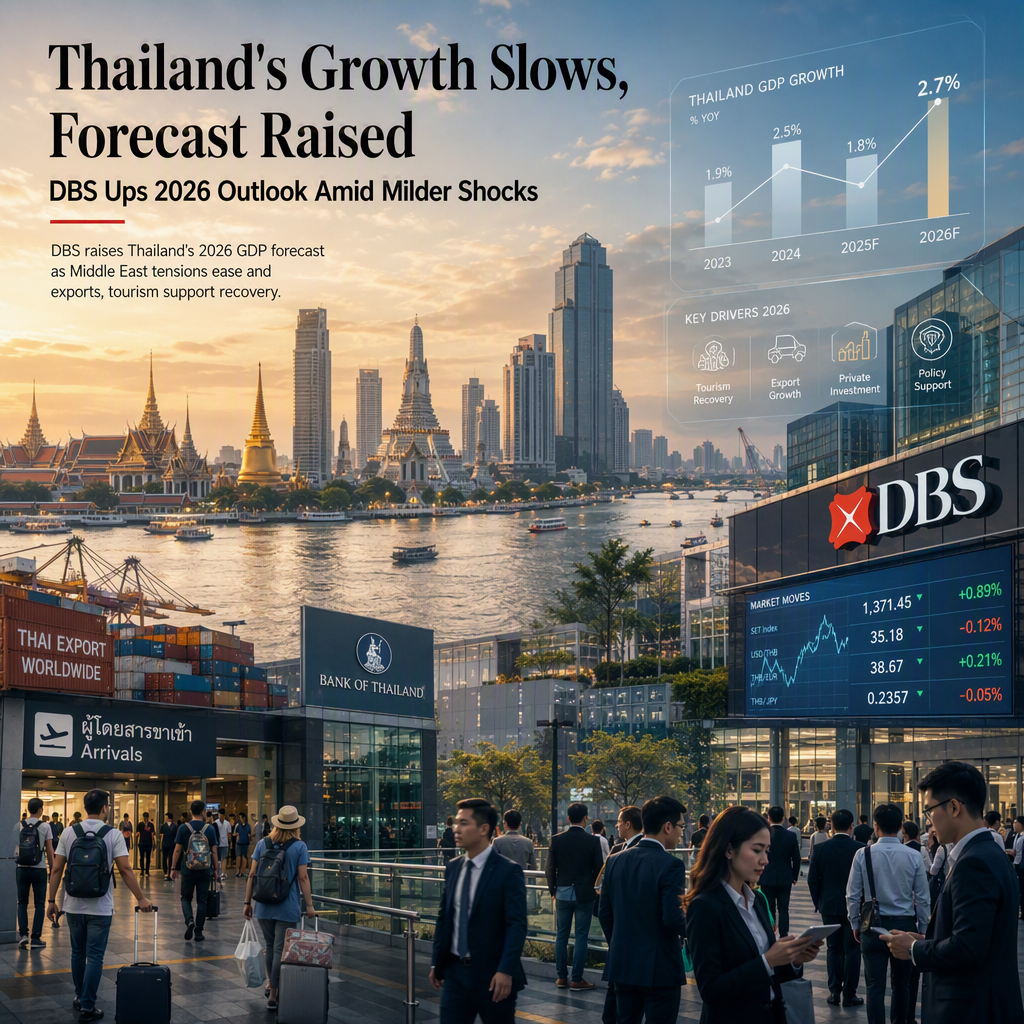
Thailand's Real Gross Domestic Product (GDP) growth decelerated to 1.9% year-on-year in the second quarter of 2026, down from 2.8% in the first quarter, resulting in a 2.4% growth rate for the first half of the year [1]. DBS Group Research economist Chua Han Teng has raised the 2026 GDP growth forecast to 2.1%, attributing this revision to a less severe Middle East shock, ongoing policy support, robust goods exports, and resilient private investment [1]. The slowdown in 2Q26 was primarily driven by weaker private and government consumption, although investment expansion remained strong, with growth sustaining momentum near its highest rate since the first quarter of 2015 [1]. Private consumption growth reached its lowest level since the end of 2021, but may be bolstered by government stimulus measures introduced from June 2026 [1]. Visitor arrivals rebounded in July 2026, and continued momentum into the year-end peak season is seen as crucial for supporting economic recovery [1]. Goods exports are performing well, aided by global artificial intelligence trends, and the investment upcycle remains intact [1]. DBS expects the Bank of Thailand (BoT) to maintain its policy rate at 1.00% for the remainder of 2026, citing low and uneven growth and an anticipated easing of inflation alongside energy prices [1].
CONCLUSION
Thailand's economy has shown resilience despite a slowdown in GDP growth, with DBS raising its growth forecast for 2026 due to milder external shocks and strong export performance. The Bank of Thailand is expected to keep its policy rate unchanged, focusing on supporting growth and monitoring inflation trends. Continued recovery in tourism and sustained investment are seen as key factors for economic momentum in the coming months.