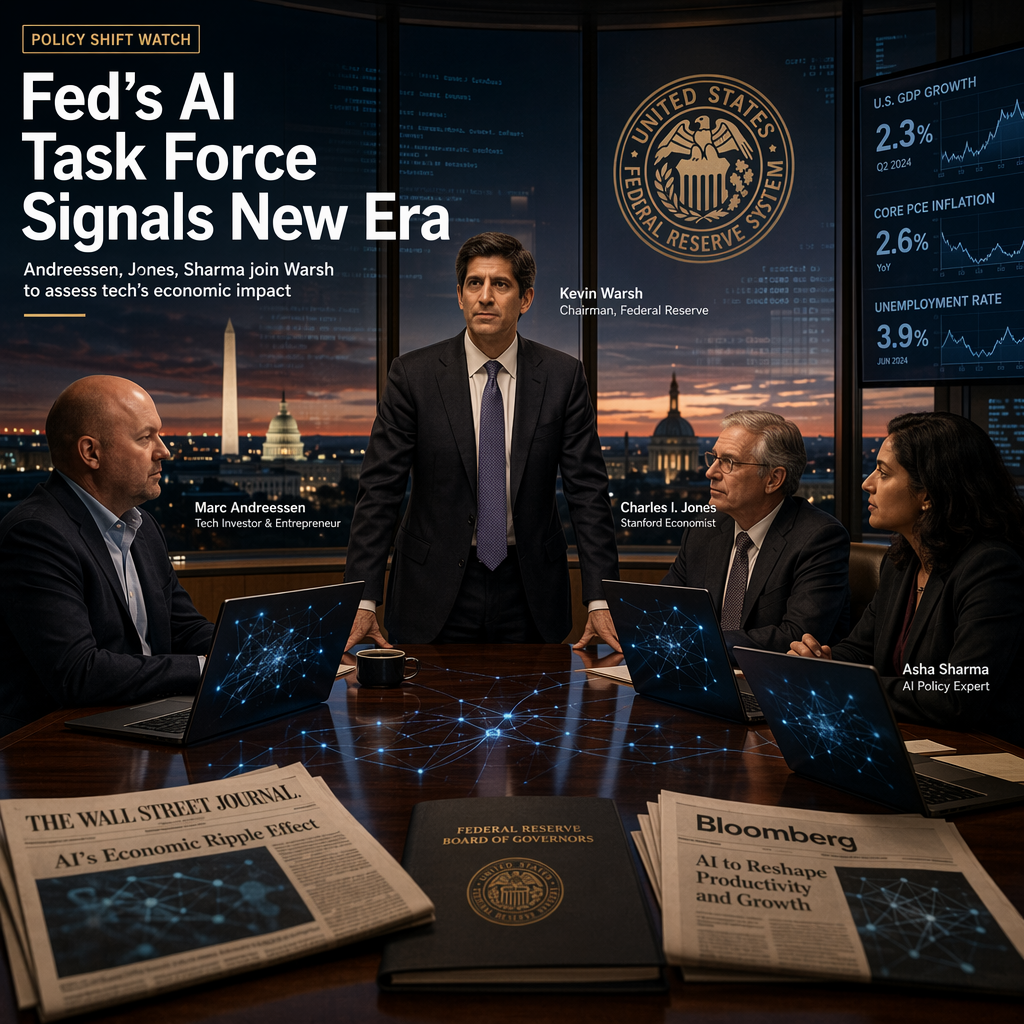
Federal Reserve Chairman Kevin Warsh announced the formation of five new task forces, including one dedicated to artificial intelligence (AI), to advise the central bank on policy and institutional changes. The AI task force will be led by three external advisors: venture capitalist Marc Andreessen, economist Charles I. Jones, and Xbox CEO Asha Sharma, all of whom share Warsh's optimistic outlook on the economic potential of AI [1]. The formal mandate of the task force is to 'assess the economic impact of new general-purpose technologies, including artificial intelligence, to inform the Federal Reserve's policy judgments' [1].
Warsh has been a vocal advocate for the transformative potential of AI, stating at his first press conference as chairman in June that AI's adoption is 'perhaps as important a change in the economy and business and households that we've had in my adult lifetime' [1]. In 2025, Warsh suggested that advancements in AI could justify interest rate cuts by the Fed, as AI-driven growth might not be accompanied by rising inflation [1].
Marc Andreessen has publicly championed AI, famously stating, 'We’ve turned sand into thought,' in reference to the silicon used in AI chips [1]. Economist Charles I. Jones has highlighted in his recent academic work that while U.S. per capita growth has historically averaged 2%, AI could accelerate growth rates to potentially exceed 5% per year if it automates away economic bottlenecks. Jones described AI as 'likely to be the most transformative technology of the modern era' [1]. Asha Sharma, while supportive of AI, has noted that Xbox console players are not enthusiastic about AI integration in gaming, though she affirmed her belief in AI's potential [1].
Despite the bullish stance from Warsh and the task force members, there is skepticism within the Federal Open Market Committee (FOMC). Minutes from the FOMC’s June meeting indicate that while some participants see AI as a potential productivity booster, there is 'considera'—the article is truncated and does not provide further details on the nature of this skepticism [1].
The three task force members and the Fed declined to comment further on the appointments [1].
CONCLUSION
The Fed's new AI task force, led by prominent advocates of artificial intelligence, signals a strong institutional focus on the technology's economic impact. While Chairman Warsh and the task force members are bullish on AI's potential to accelerate growth, some skepticism remains within the FOMC. The market is likely to watch closely for policy shifts as the task force begins its work.