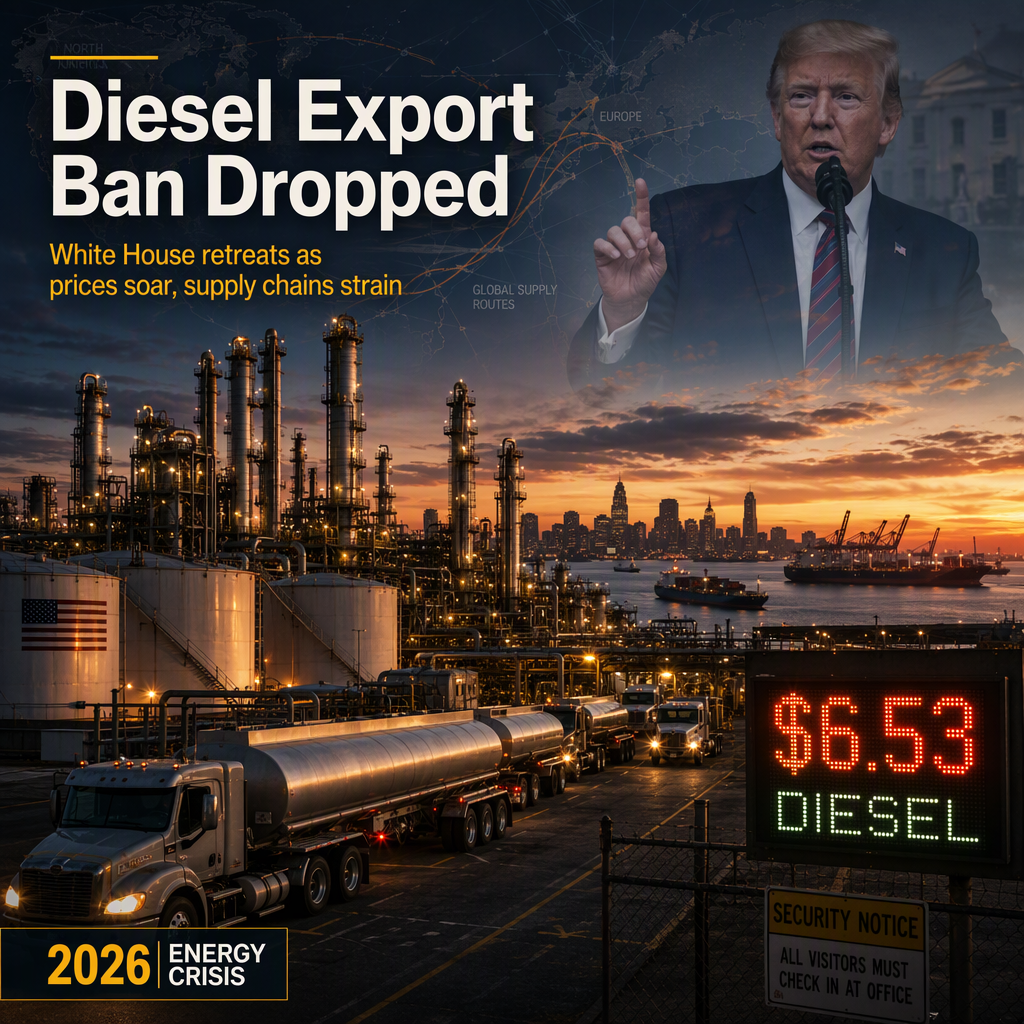
The Trump administration has decided not to pursue a proposed ban on diesel exports, a measure that was initially considered as a way to lower domestic fuel prices but ultimately raised concerns among economists and industry experts about potential negative consequences for American consumers and businesses [1]. President Donald Trump stated at the United Nations General Assembly in New York that he had urged his aides to consider retaining more diesel domestically, saying, "I've said let's not send out the diesel. We make a lot of diesel," and confirmed ongoing discussions within his administration [1]. Treasury Secretary Scott Bessent noted that the feasibility of a full or partial export ban was being evaluated, particularly in relation to overall refining capacity [1].
The context for this policy debate is a significant surge in diesel prices, with the national average reaching $6.53 per gallon for the week of September 21, 2026, compared to $3.75 during the same week the previous year, according to federal energy data [1]. This sharp increase is attributed in part to the ongoing war in Iran, which has disrupted shipping routes, including the critical Strait of Hormuz, and contributed to volatility in global crude and refined product markets [1].
Economists, such as Joe Brusuelas of RSM US LLP, warned that restricting diesel exports could have unintended inflationary effects. Brusuelas explained that diesel is essential for transportation services, agriculture, and industry, and that higher diesel prices can ripple through supply chains, ultimately raising costs for groceries, household goods, and even new homes [1]. He cautioned that while a ban might temporarily lower prices in some regions, the relief would likely be short-lived and could exacerbate inflation and strain consumer finances [1]. Brusuelas estimated that if a ban were implemented, consumers could see price increases within four to six weeks [1].
The decision to back away from the export ban comes as the administration faces political pressure ahead of the November midterm elections, with fuel prices and supply chain disruptions emerging as key issues for voters [1].
CONCLUSION
The Trump administration's decision to abandon a potential diesel export ban reflects concerns about exacerbating inflation and supply chain disruptions amid already record-high diesel prices. Economists warn that such a policy could have backfired, leading to higher costs for consumers and businesses. The ongoing conflict in Iran continues to impact global energy markets, keeping fuel prices and supply chain stability in focus.