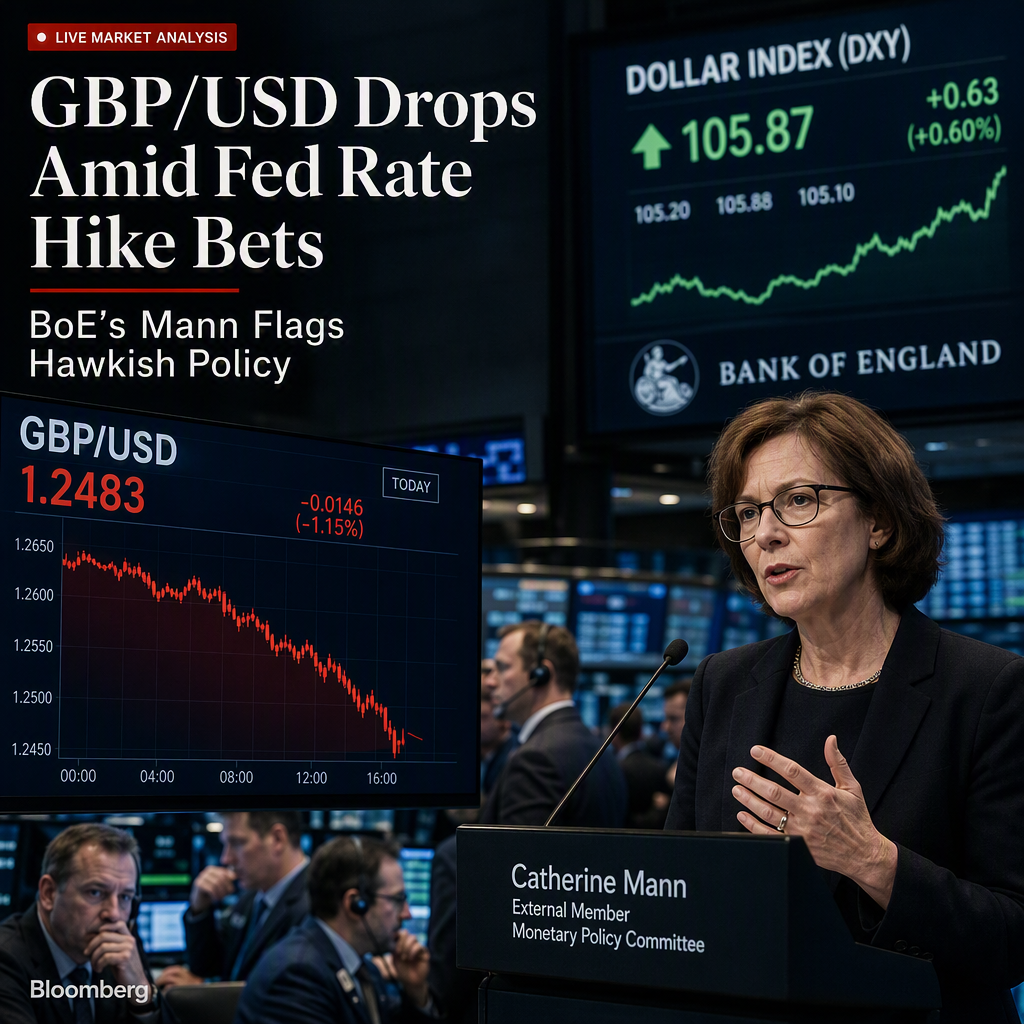
The British Pound (GBP) declined by 0.1% to trade near 1.3500 against the US Dollar (USD) during the European session on Wednesday, as the US Dollar extended its advance. This move comes amid market expectations for a 25 basis points (bps) interest rate hike by the Federal Reserve (Fed) at its upcoming policy meeting this month, with the CME FedWatch tool indicating a 67% probability of such an increase. At the time of reporting, the US Dollar Index (DXY) was up 0.13% to approximately 99.78, reflecting broad-based USD strength [1].
On the UK side, Bank of England (BoE) Monetary Policy Committee member Catherine Mann advocated for an early interest rate hike to address persistent inflation risks. Mann stated, 'The research is very clear. It's better (for interest rates) to be a little bit too high and then, of course, correct if necessary,' referencing her vote for a 25 bps hike at the last MPC meeting. Mann also noted 'somewhat stronger economic activity' since the last meeting, supporting a cautious approach to easing and highlighting ongoing upside risks to inflation [1].
Technically, GBP/USD remains below the 20-day Exponential Moving Average (EMA) at 1.3537, maintaining a mildly bearish bias. The Relative Strength Index (RSI) is around 48, indicating fading bullish momentum but not yet oversold conditions. Key support is seen near 1.3418, while resistance is at the 20-day EMA. A daily close above this level could trigger a corrective recovery [1].
The FXS Speechtracker assigned Mann's remarks a score of 8.4/10, slightly above her historical average, signaling a modestly hawkish tilt. This stance, combined with stronger economic data, suggests that downside for GBP may be limited in the near term, especially against lower-yielding currencies. However, the immediate market reaction remains cautious as traders await further clarity from both the Fed and BoE [1].
CONCLUSION
GBP/USD is under pressure as markets price in a likely Fed rate hike, while BoE's Mann signals a preference for keeping policy restrictive to combat inflation. Technical indicators point to a mildly bearish outlook, but stronger UK data and hawkish BoE commentary may limit further downside in the near term.