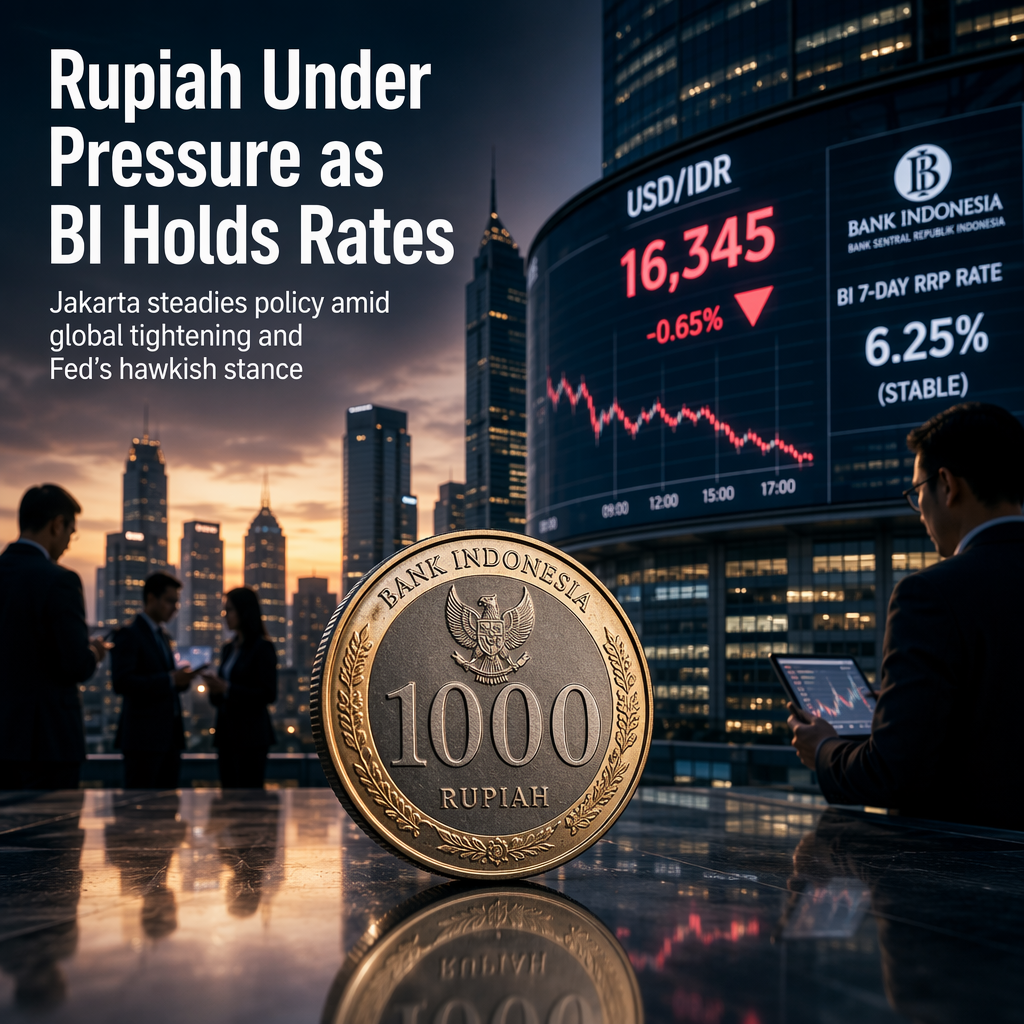
The Indonesian Rupiah (IDR) continued to hold losses against the US Dollar (USD), with the USD/IDR pair trading around 17,850 during European hours on Wednesday, marking the second consecutive day of declines for the Rupiah following Bank Indonesia's (BI) latest interest rate decision [1]. BI opted to keep its benchmark interest rate unchanged at 5.75%, citing that the rate hikes implemented in May and June were pre-emptive and forward-looking measures aimed at countering global economic developments [1]. The central bank emphasized that the current rate level is adequate for now and reiterated its commitment to fostering economic growth and supporting ongoing business momentum [1].
Global economic growth remains subdued in 2026, with projections steady at 3% and global inflation expected to average around 4% [1]. In this environment, monetary policy continues to tighten globally, with the potential for further US rate hikes. In contrast, Indonesia's domestic economic growth remains solid, prompting BI to reinforce measures to stabilize the Rupiah and optimize policy instruments to attract foreign capital inflows [1].
The downside for the USD/IDR pair may be limited as the US Dollar gains ground, supported by a hawkish policy outlook from the Federal Reserve (Fed). The Fed recently raised its benchmark interest rate by 25 basis points to a target range of 3.75%–4.00%, and policymakers have indicated that another rate hike remains possible before the end of the year [1]. Financial markets are actively pricing in this trajectory, with the CME FedWatch Tool showing an 89.2% probability of a December rate increase [1].
Strategists at ING noted that the Dollar continues to show resilience to lower energy prices and a risk-friendly environment, attributing this to the dominant Fed narrative and hawkish Fedspeak [1]. Richmond Fed President Thomas Barkin, who will become a voter in 2027, reinforced this message by stating that a single rate hike may not be sufficient to bring inflation under control, further underpinning demand for the USD despite more benign market conditions [1].
CONCLUSION
Bank Indonesia's decision to hold rates steady reflects a cautious approach amid ongoing global uncertainty and tightening monetary policy abroad. The Rupiah remains under pressure as the US Dollar is buoyed by expectations of further Fed rate hikes, with market participants closely watching upcoming US economic data for further direction.