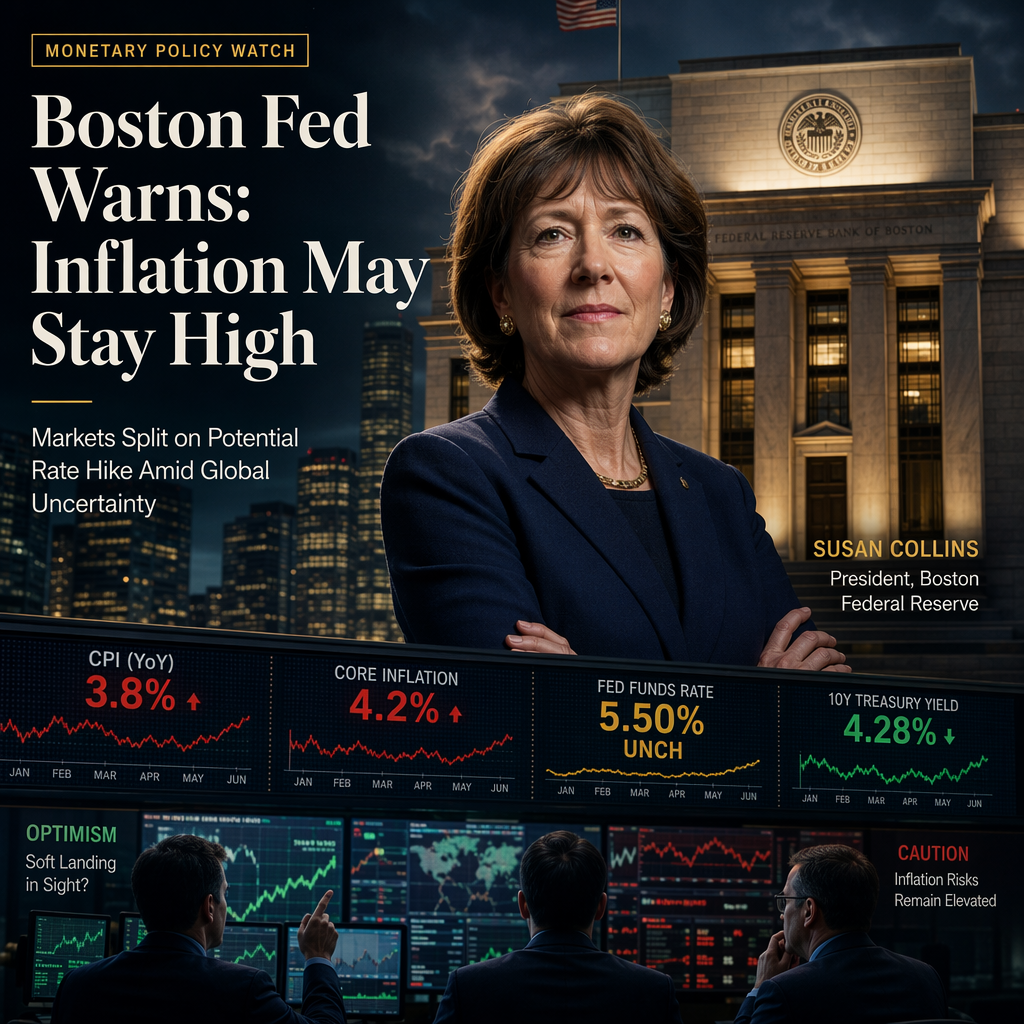
Boston Federal Reserve President Susan Collins has cautioned that there is an 'increased likelihood' that inflation will remain 'notably' above the Federal Reserve's 2% target, following her support for the Fed's recent quarter-point interest rate hike last week [1]. Collins explained in a LinkedIn post that maintaining a 'somewhat more restrictive federal funds rate will help ensure that inflation durably returns to target' [1]. While Collins participates in FOMC meetings and contributes to policy discussions, she is not currently a voting member; however, in 2025, she voted with the majority at all eight FOMC meetings, supporting a hold in July and quarter-point cuts in September, October, and December [1].
Collins noted that 'upside risks to inflation have increased,' but also observed that labor market conditions appear stronger overall, with the unemployment rate remaining low [1]. She emphasized that with the labor market on a better footing, monetary policy can focus on achieving a timely return to price stability, especially after an extended period of elevated inflation [1].
Market participants are divided on the prospect of another Fed rate hike at the upcoming FOMC meeting in October, with 53.1% currently expecting an additional 25-basis-point increase, according to CME Group's FedWatch tool [1].
Collins' concerns echo those of European Central Bank executive board member Philip R. Lane, who stated that a 'second wave of rising energy prices' could keep inflation 'higher for longer' in the eurozone [1]. Lane indicated that the ECB is forecasting upward pressure on food, energy, and goods prices, and noted that if the energy shock is larger and more persistent this autumn, it could restrain the eurozone economy [1]. Lane added that while the market expects some improvement in energy prices later this year, there remains significant uncertainty around this outlook [1].
CONCLUSION
Boston Fed President Collins' warning about persistent inflation above the 2% target, combined with market uncertainty over further rate hikes, highlights ongoing concerns about price stability. The alignment with ECB commentary underscores global inflationary pressures, particularly from energy markets. Investors remain cautious as policy direction and inflation trajectories remain uncertain.