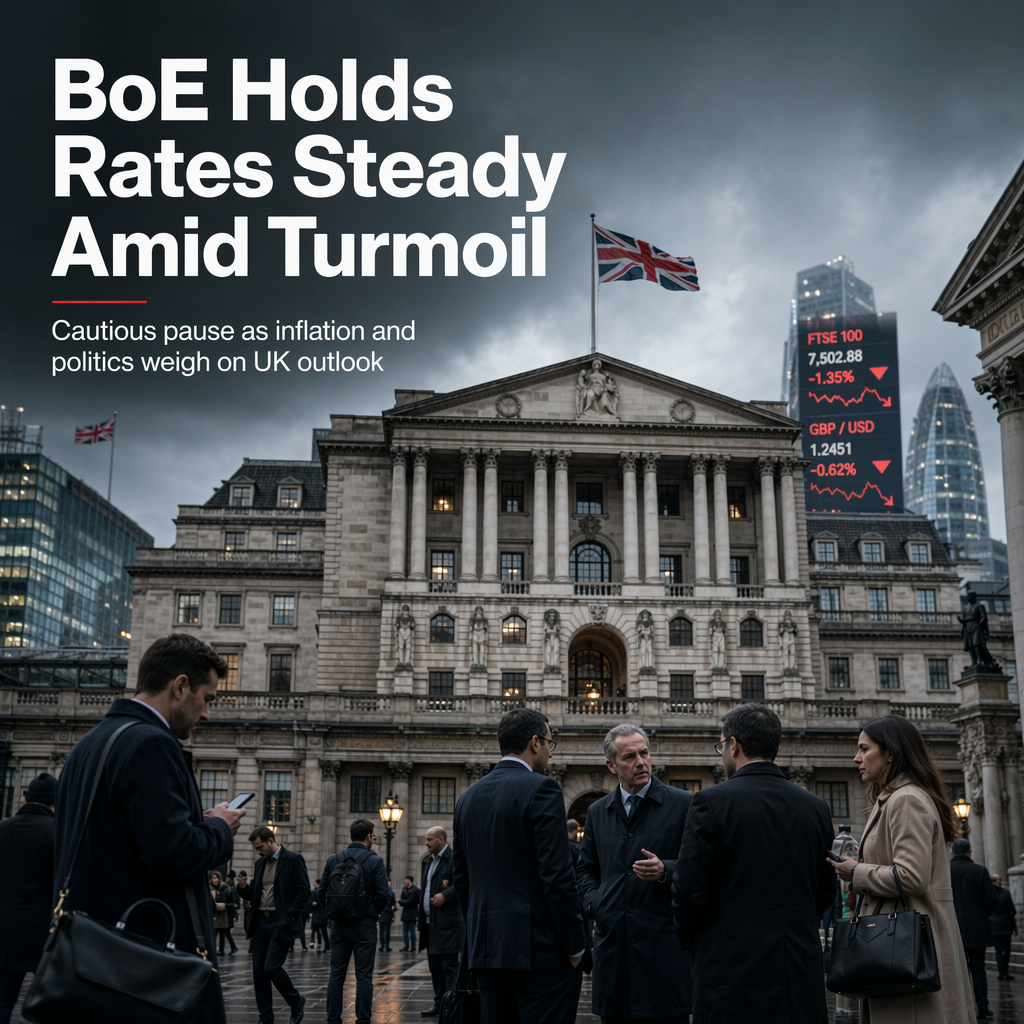
The Bank of England (BoE) maintained its policy rate at 3.75% for the fourth consecutive meeting, a decision that was widely anticipated by markets. The Monetary Policy Committee (MPC) voted 7-2 to keep rates unchanged, reflecting a cautious approach as policymakers remain alert to the risks of an energy-driven inflation shock, though the case for a near-term rate cut has weakened [1][2]. Rabobank analysts describe this as an 'active hold,' noting that the BoE's stance is effectively more restrictive than pre-war expectations, when markets had anticipated rate cuts this year. The unchanged rates in both the UK and US this week highlight diverging global monetary policy dynamics, with the European Central Bank and Bank of Japan recently opting to hike rates [1].
Rabobank further notes that UK economic conditions are not conducive to second-round inflation effects, and May's inflation data indicated a resumption of broad-based disinflation, which may help temper consumer inflation expectations. Governor Bailey signaled that most MPC members are willing to tolerate temporarily above-target inflation, leading Rabobank to forecast that the BoE will remain on hold through the end of the year [1].
On the currency front, GBP/USD has rebounded after holding above its March 31 low of 1.3159, but risks remain tilted to the downside. Brown Brothers Harriman (BBH) attributes this to stronger US growth prospects relative to the UK and heightened political uncertainty in the UK, including the possibility of a Labour leadership challenge following Andy Burnham's by-election victory in Makerfield. BBH suggests that a Burnham-led Labour government could result in increased spending and borrowing, potentially undermining UK fiscal credibility [2].
Market pricing reflects ongoing uncertainty, with the swaps curve indicating expectations for a 25 basis point BoE rate rise to 4.00% in November, despite the current policy hold [2].
CONCLUSION
The Bank of England's decision to keep rates unchanged underscores a cautious approach amid persistent inflation risks and political uncertainty. While inflation appears to be moderating, political developments and relative economic weakness continue to weigh on the British Pound. Market participants remain attentive to both monetary policy signals and the evolving UK political landscape.