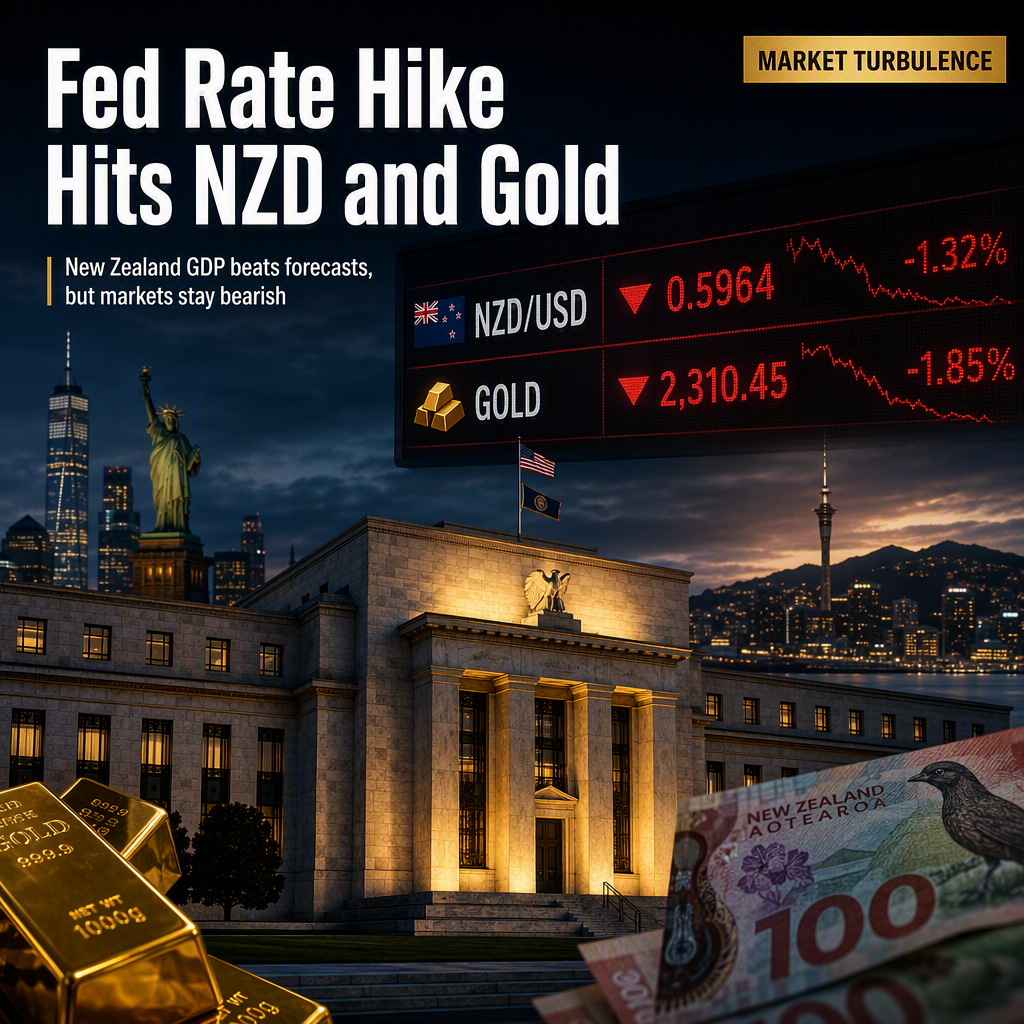
The US Federal Reserve (Fed) raised its benchmark interest rate by 25 basis points to a target range of 3.75% to 4.00% on Wednesday, marking the first rate hike since 2023 [1][2]. Fed Chair Kevin Warsh emphasized the central bank's commitment to fighting inflation, stating, 'Our predominant focus is on the price stability side of our mandate,' and flagged further increases in borrowing costs in the coming months [1][2]. This hawkish stance sent the US Dollar (USD) higher and weighed on risk assets, including the New Zealand Dollar (NZD) and gold [1][2].
Despite New Zealand's better-than-expected GDP data—0.2% quarter-on-quarter growth in Q2 2026 versus an expected 0.1%, and 2.6% annual growth compared to 2.3% forecast—the NZD/USD pair fell to near 0.5725 during the early Asian session on Thursday [1]. Statistics New Zealand spokesperson Jason Attewell noted that nine out of sixteen industries saw increases, but overall growth slowed from Q1's 0.9% expansion, with Middle East crisis impacts cited as a headwind [1]. ING analysts highlighted a dovish surprise from the Reserve Bank of New Zealand (RBNZ), which signaled only room for another 25bp hike to 3.0%, cautioning that elevated energy prices could prompt upward revisions by year-end [1]. ING sees scope for further NZD/USD weakness, but identifies 0.570 as a bottom with potential for a rebound towards 0.59 by year-end if Fed policy turns dovish [1].
Gold (XAU/USD) also came under pressure, falling to around $4,265 during the early Asian session after the Fed's rate hike [2]. Commerzbank analysts observed that higher Treasury yields and a stronger USD are offsetting safe-haven demand from geopolitical risks, limiting gold's ability to capitalize on risk-off sentiment [2]. Technical analysis shows gold remains capped below the 100-day moving average, with resistance at $4,325 and further barriers at $4,440 and $4,685, while the downside is cushioned by the lower Bollinger band [2]. The Relative Strength Index (RSI) at 42 points to lingering bearish pressure [2].
US President Donald Trump demanded the Fed slash rates to 1% or less, hours after the hike, highlighting ongoing friction between the White House and the independent Fed, which could boost safe-haven flows and help limit gold's losses [2].
CONCLUSION
The Fed's hawkish rate hike and commitment to fighting inflation have pressured both the New Zealand Dollar and gold, despite New Zealand's stronger-than-expected GDP growth. Analysts see further downside for NZD/USD and gold in the near term, with potential for rebounds if Fed policy shifts. Market sentiment remains bearish, and the impact is high as both currencies and commodities react to US monetary policy and global risk factors.