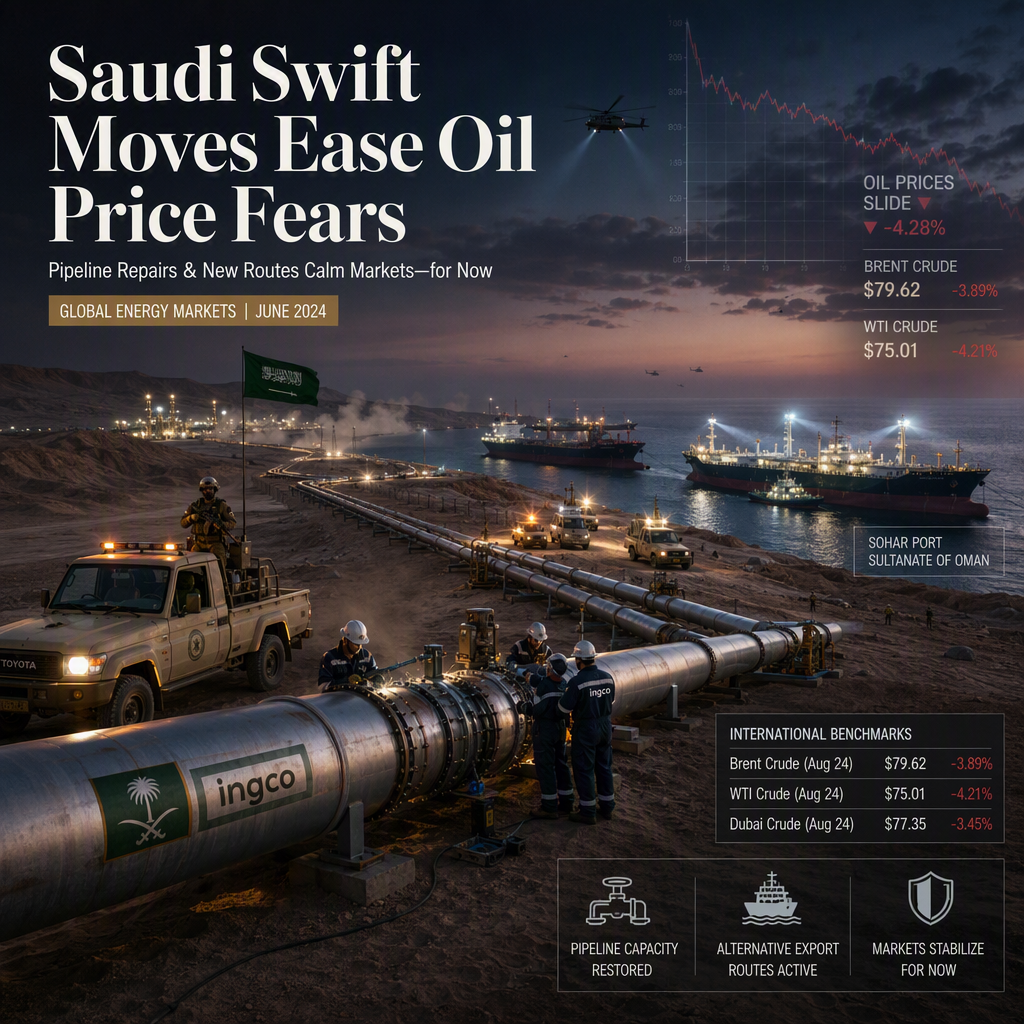
Oil prices continued to decline for the second consecutive day, with West Texas Intermediate (WTI) trading around $96.60 per barrel during Asian hours on Thursday, as Saudi Arabia moved to restore roughly half the capacity of its East-West pipeline within days and aimed for full operation within six weeks following recent drone attacks [1]. Brent futures, the international benchmark, were slightly lower at $105.81 per barrel, while U.S. crude oil was down 0.22% at $102.14 a barrel [2]. Saudi Arabia has also made additional crude cargoes available to Asian refiners through ship-to-ship transfers near Oman's Sohar port, helping to cushion the impact on global supplies from the pipeline disruption [2].
The US Energy Secretary Chris Wright confirmed that 18 million barrels of crude and petroleum products successfully passed through the Strait of Hormuz earlier this week, further easing supply concerns [1]. Wright also described the East-West pipeline outage as a "brief and temporary interruption" that "will be measured in days" [2]. Meanwhile, the US Energy Information Administration (EIA) reported a smaller-than-expected draw from domestic crude inventories, with stocks falling by approximately 640,000 barrels, significantly lower than the 1.62 million-barrel draw anticipated by energy analysts in a Reuters poll [1]. This suggests softer demand or higher supply buffers than market expectations had priced in [1].
Saudi Arabia's efforts to find alternative export routes, including ship-to-ship transfers and increased transport through the Strait of Hormuz with US military assistance, have reassured markets that some lost crude supply could return [1][2]. However, crude loadings at Saudi Arabia's Red Sea export terminal at Yanbu were halted earlier this week, and Riyadh canceled some shipments to European customers [2]. Yanbu has become a key route for Saudi oil exports since Iran began blockading the Strait of Hormuz following U.S. and Israeli attacks on Iran in late-February [2].
Analysts warn that the outlook remains highly dependent on developments in the Middle East. TD Securities noted that a less aggressive or supportive US military presence in the region would see an elevated geopolitical risk premium remain in markets, as Iran would likely seek to consolidate control over the Strait, reinforcing persistent supply-side anxiety [1]. Peter Massabni of XS.com cautioned that renewed escalation causing deeper disruptions to regional oil and gas production and exports would keep inflation risks elevated and put further upward pressure on bond yields. He added that uncertainty regarding escalation paths in the region, along with crude, gasoline, and diesel prices staying at high and critical levels, could fuel pessimism about the US Federal Reserve monetary policy path [2].
CONCLUSION
Saudi Arabia's swift restoration of pipeline capacity and alternative export routes have eased immediate supply concerns, contributing to a decline in oil prices. However, ongoing geopolitical risks in the Middle East and uncertainty about future disruptions continue to weigh on market sentiment and could impact inflation and monetary policy outlooks.