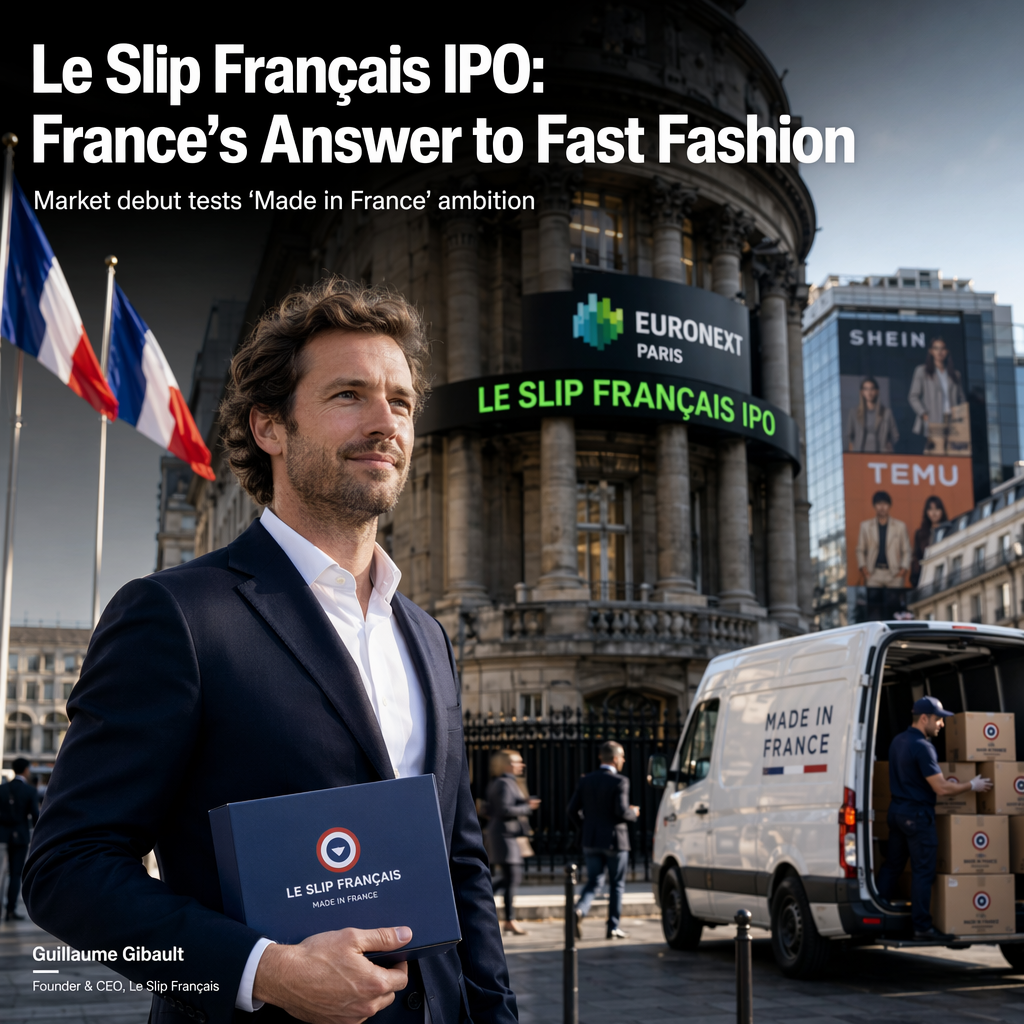
Le Slip Français, a French underwear and apparel brand founded in 2011 by Guillaume Gibault, made its initial public offering (IPO) on the Euronext Growth Paris exchange on Tuesday. The company is positioning itself as a premium, locally made alternative to ultra-cheap fast-fashion competitors such as Shein and Temu, which continue to exert significant pressure on the apparel market with their low prices [1].
The IPO follows a strong financial performance in 2025, with Le Slip Français reporting 21 million euros ($24.6 million) in revenue, 2.1 million euros in EBITDA, and net income of 700,000 euros. These results gave the company confidence to pursue a public listing, according to CEO Guillaume Gibault [1]. The IPO was priced at 14.80 euros per share, targeting a market capitalization of around 19 million euros. On its first day of trading, shares experienced volatility, briefly dipping below the IPO price before recovering to last trade at 15 euros [1].
Le Slip Français has invested in automation and its own factory near Paris, producing approximately 4,500 pieces of underwear daily. This investment has enabled the company to reduce the retail price of its underwear from about 40 euros to roughly 20 euros while maintaining profitability [1]. The company also plans to expand its business model by offering 'Made in France as a service,' manufacturing clothing for other brands seeking French production [1].
Looking ahead, Le Slip Français aims to double its revenue by 2030. CEO Gibault emphasized that global trade uncertainty is creating momentum for relocating textile production to France, and he sees opportunity in the current market environment [1].
CONCLUSION
Le Slip Français's IPO marks a significant step for the French apparel brand as it challenges fast-fashion giants with a focus on local production and automation. Despite a mixed market debut, the company is leveraging strong financials and strategic expansion plans to position itself for future growth. The market response was cautious but reflects interest in differentiated, locally made apparel offerings.