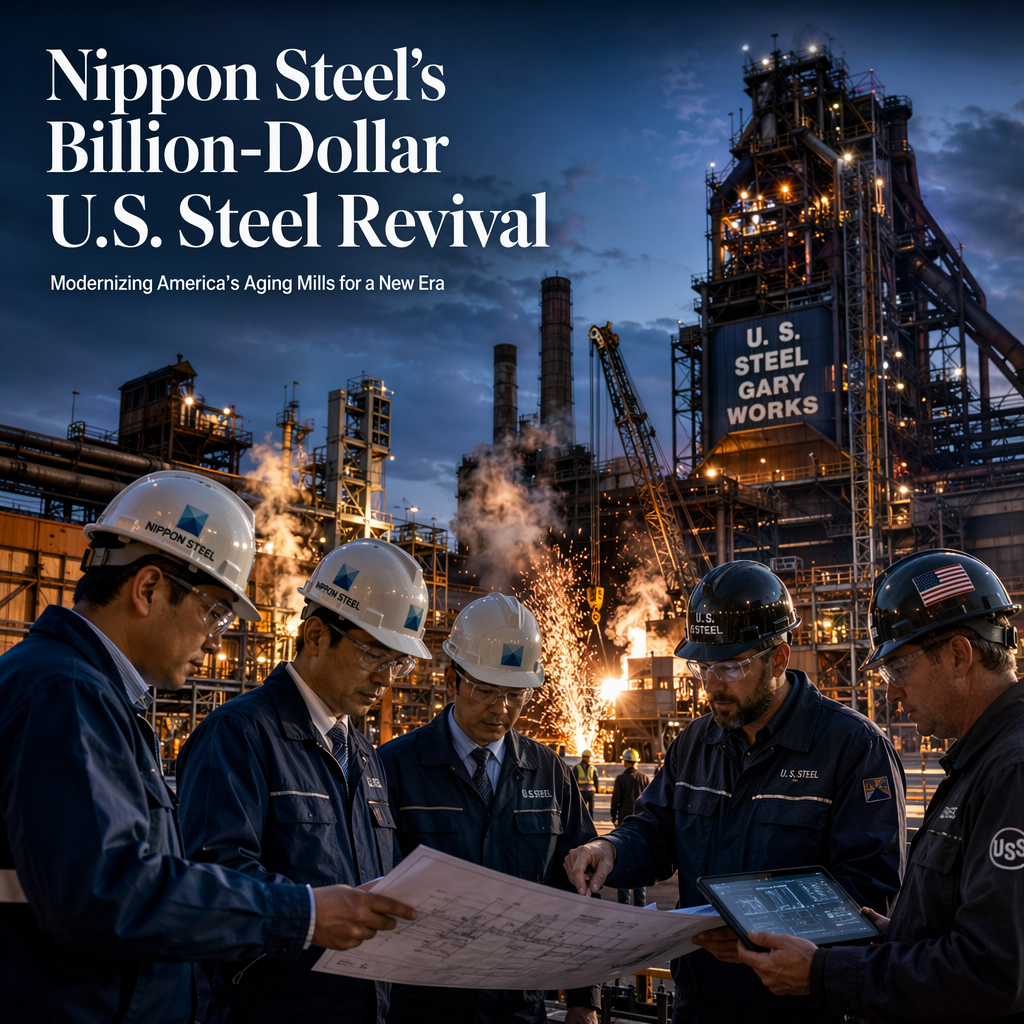
One year after Nippon Steel's acquisition of U.S. Steel, the Japanese steelmaker is confronting significant challenges related to aging equipment and subpar production quality at its newly acquired U.S. facilities [1]. Nippon Steel has dispatched over 100 engineers to overhaul manufacturing processes at U.S. Steel, with a commitment to invest billions of dollars across the company's plants, including the Gary Works in Indiana [1]. A notable portion of this investment, up to $2.5 billion, is earmarked for U.S. Steel's Pennsylvania complex as part of a broader modernization strategy [1].
The company is addressing equipment that is as old as 90 years, which has contributed to operational inefficiencies and production quality issues, with nearly half of output failing to meet standards [1]. Upgrades are focused on blast furnaces and other critical infrastructure, with the expectation that these improvements will significantly reduce the rate of substandard production and restore competitiveness in the U.S. market [1].
Nippon Steel faces additional hurdles such as high energy costs and fluctuating steel prices, which complicate the transformation efforts [1]. Despite these challenges, the company aims to bring production up to global standards and potentially exceed its own forecasts for a U.S. Steel turnaround [1]. Analysts are closely monitoring whether Nippon Steel can achieve the necessary operational improvements and capitalize on infrastructure demand in the United States [1].
CONCLUSION
Nippon Steel's substantial investment and engineering overhaul at U.S. Steel signal a high-impact effort to modernize aging facilities and improve production quality. While the company faces significant challenges, including outdated equipment and volatile market conditions, its commitment to modernization is seen as a positive step toward restoring competitiveness. The market is watching closely to see if Nippon Steel can deliver on its turnaround ambitions.