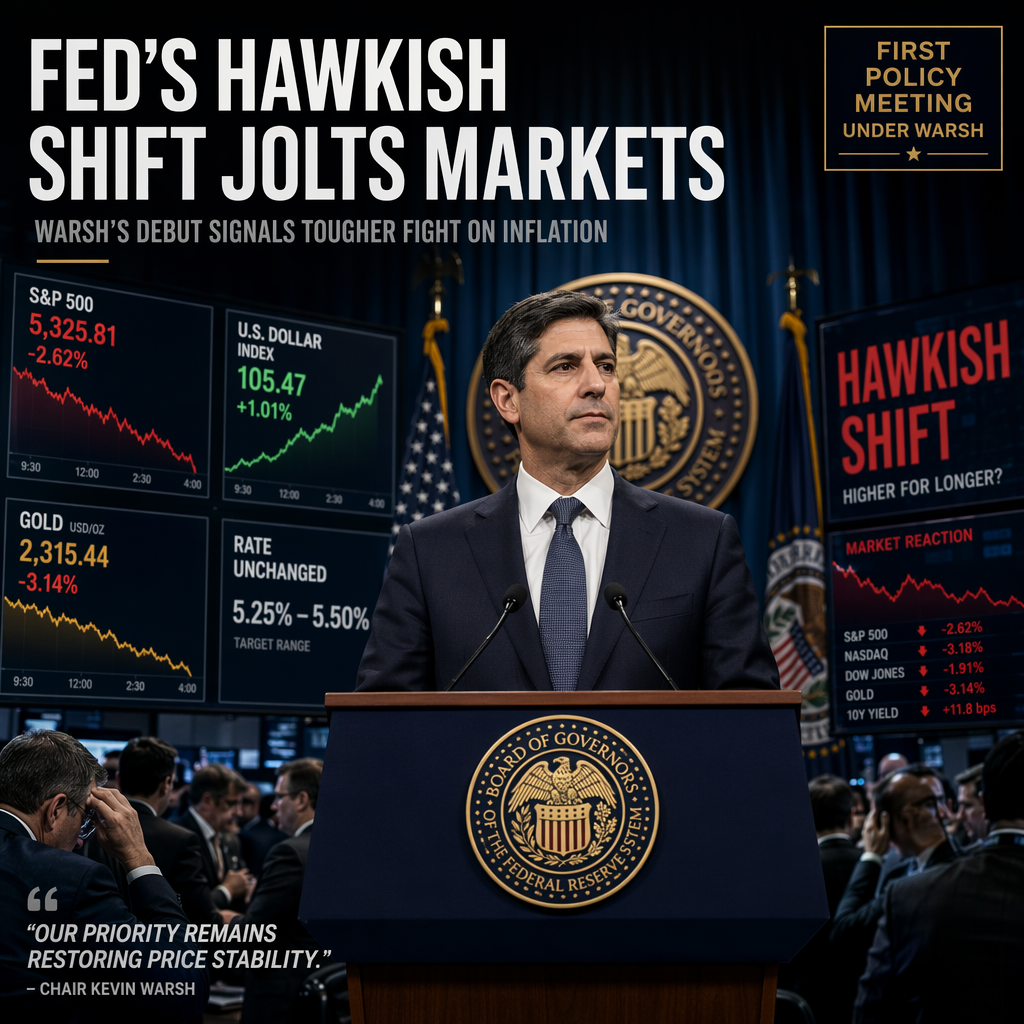
The Federal Reserve, in its first policy meeting under new Chair Kevin Warsh, left the federal funds rate unchanged at 3.50%-3.75% as widely expected, with the decision backed unanimously by a 12-0 vote—a notable shift from the previous 8-4 split in April [1][3][4][6]. The Fed's statement removed prior forward guidance and any reference to 'additional rate adjustments,' signaling a move toward a more cautious, data-dependent stance [1][2][3][4][5][6]. Warsh emphasized the Fed's commitment to restoring price stability, stating, 'the Committee will deliver price stability,' and acknowledged that inflation remains well above the 2% target, partly due to supply shocks and energy prices [2][3][4][5][8].
The updated Summary of Economic Projections (SEP) revealed a hawkish shift: the median 2026 federal funds rate projection rose to 3.8% from 3.4% in March, and the median 2026 Personal Consumption Expenditures (PCE) inflation forecast jumped to 3.6% from 2.7%, with core PCE at 3.3%—1.3% above the Fed's target [2][3][4][5]. The Fed expects US GDP growth of 2.2% in 2026, down from 2.4% previously, while the longer-run growth estimate remains at 2% [1][2][5]. Warsh did not submit his own dot plot projection and announced the formation of task forces to review Fed communications, balance sheet, data sources, productivity, jobs, and inflation frameworks [2][8].
Markets reacted sharply to the hawkish tone and projections. The US Dollar surged, with the USD/JPY rising to near 160.40 [1], the US Dollar Index (DXY) spiking above 100.00 [4], and the GBP/USD and EUR/USD both falling to multi-month lows—GBP/USD dropped over 1% below 1.3300 and EUR/USD fell nearly 50 pips to the 1.1550 region [2][3]. Gold (XAU/USD) declined, trading in a volatile $4,330-$4,280 range, as higher-for-longer rate expectations weighed on the metal [5]. US Treasury yields rose, with the 2-year note up 15 basis points to 4.20% [2].
Equity markets sold off, with the S&P 500 falling 1.2%—the worst 'Fed day' debut for a new chair since 1994—and the Dow Jones Industrial Average dropping 500 points [7]. Market participants interpreted Warsh's focus on price stability and the hawkish dot plot as reducing the likelihood of near-term rate cuts, with some traders now expecting a possible rate hike as soon as October [7]. DoubleLine Capital CEO Jeffrey Gundlach commented that Warsh's stance means 'we're not going to have such easy money policy as everybody thought,' and that Warsh has staked his credibility on bringing inflation down, making aggressive rate cuts less likely [7][8].
Looking ahead, the Fed reiterated its data-dependent approach and commitment to its dual mandate. Warsh's leadership marks a 'regime change' with a stiffer tone on inflation and a willingness to overhaul Fed operations, but the central bank remains poised to adjust policy as needed to support sustained growth and price stability [2][6][7][8].
CONCLUSION
Kevin Warsh's first meeting as Fed Chair delivered a hawkish surprise, with higher inflation and rate projections rattling global markets. The US Dollar strengthened, equities and gold fell, and expectations for rate cuts diminished as Warsh emphasized price stability. The Fed's new stance signals a tougher fight against inflation, with markets now bracing for the possibility of further tightening.