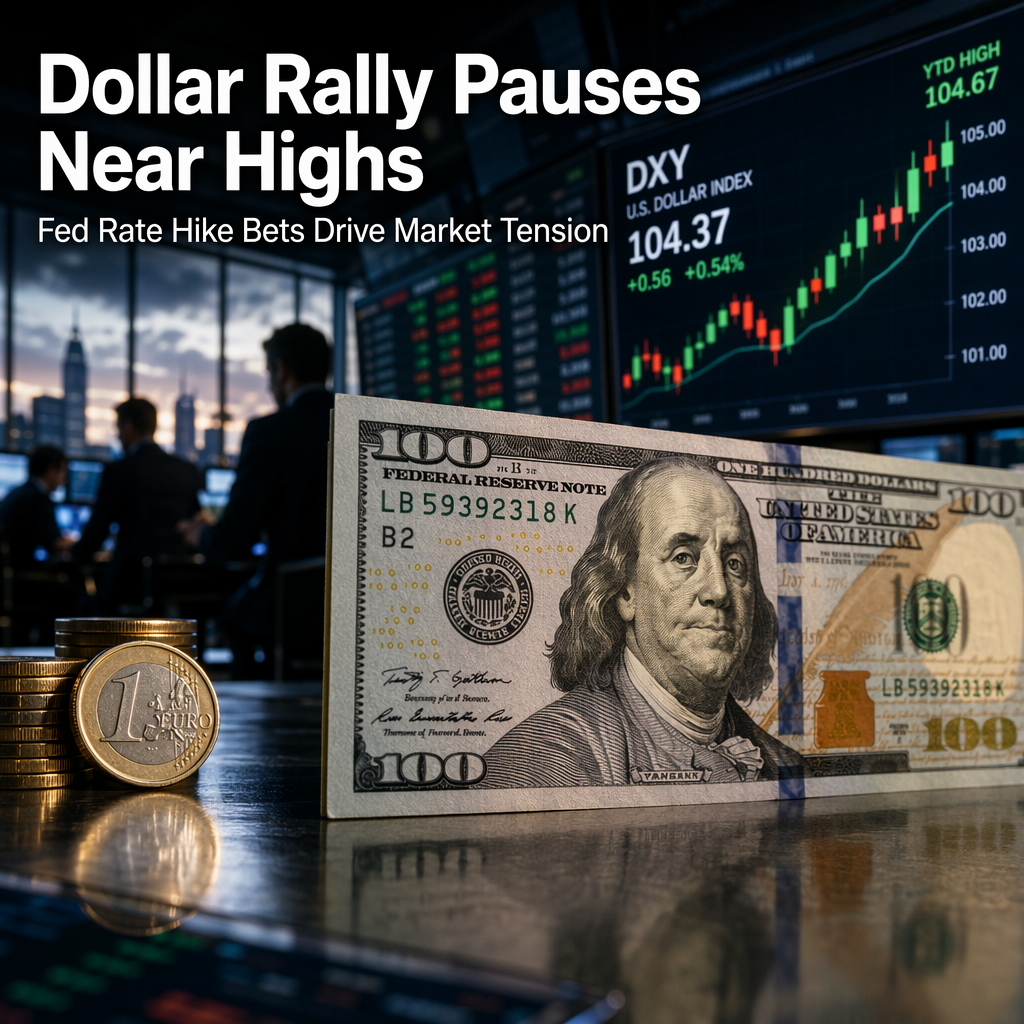
The US Dollar (USD) has paused its recent rally, with the Euro (EUR) trading nearly flat against the Greenback at 1.1460 after rebounding from three-month lows at 1.1420 on Friday. Despite this stabilization, the EUR/USD pair is still set for a 0.9% weekly decline, driven by increased expectations of Federal Reserve (Fed) rate hikes, which have propelled the USD higher across the board [1]. The US Dollar Index (DXY) retreated from one-year highs above 101.00 during Friday’s European session, remaining steady above 100.75 and on track for a 1% weekly gain [2]. The market slowdown is attributed to the Juneteenth bank holiday in the US, with investors also considering the implications of the US-Iran peace deal and declining oil prices [1][2].
Fed policy remains the central market driver, with the Fed leaving interest rates unchanged earlier in the week. Nearly half of the committee members anticipate at least one rate hike this year, and new Chairman Kevin Warsh has reaffirmed his commitment to bringing inflation to target, reinforcing expectations of further monetary tightening [1][2]. The Fed’s latest statement removed references to an easing bias and emphasized improvements in economic activity and the labor market [2]. Futures markets have responded strongly: the probability of at least one rate hike before October has surged to 77% from 40% a week earlier, and the odds for a hike before year-end have climbed to 90% from 55%, according to CME Group’s Fed Watch Tool [2].
On the macroeconomic front, US data continues to show resilience. US Retail Sales exceeded expectations in May, and the Philadelphia Fed Manufacturing Survey indicated a strong recovery in June [1]. In the Eurozone, the German Producer Prices Index (PPI) rose 2.2% year-on-year in May, up from 1.7% in April but below the expected 2.5%. The monthly increase slowed to 0.3% from 1.2% in April, suggesting the energy shock’s impact may be diminishing [1].
Market participants are closely watching the Fed’s next moves, with the hawkish stance and strong US economic data underpinning the USD’s strength. The Euro remains under pressure, as lower energy prices are seen as reducing the need for further European Central Bank rate hikes [1].
CONCLUSION
The US Dollar remains near yearly highs, buoyed by rising Fed rate hike expectations and robust US economic data. Market sentiment is positive for the USD, while the Euro struggles to recover amid easing energy pressures and a less hawkish ECB outlook. Investors are focused on upcoming Fed decisions, which are likely to drive further market moves.