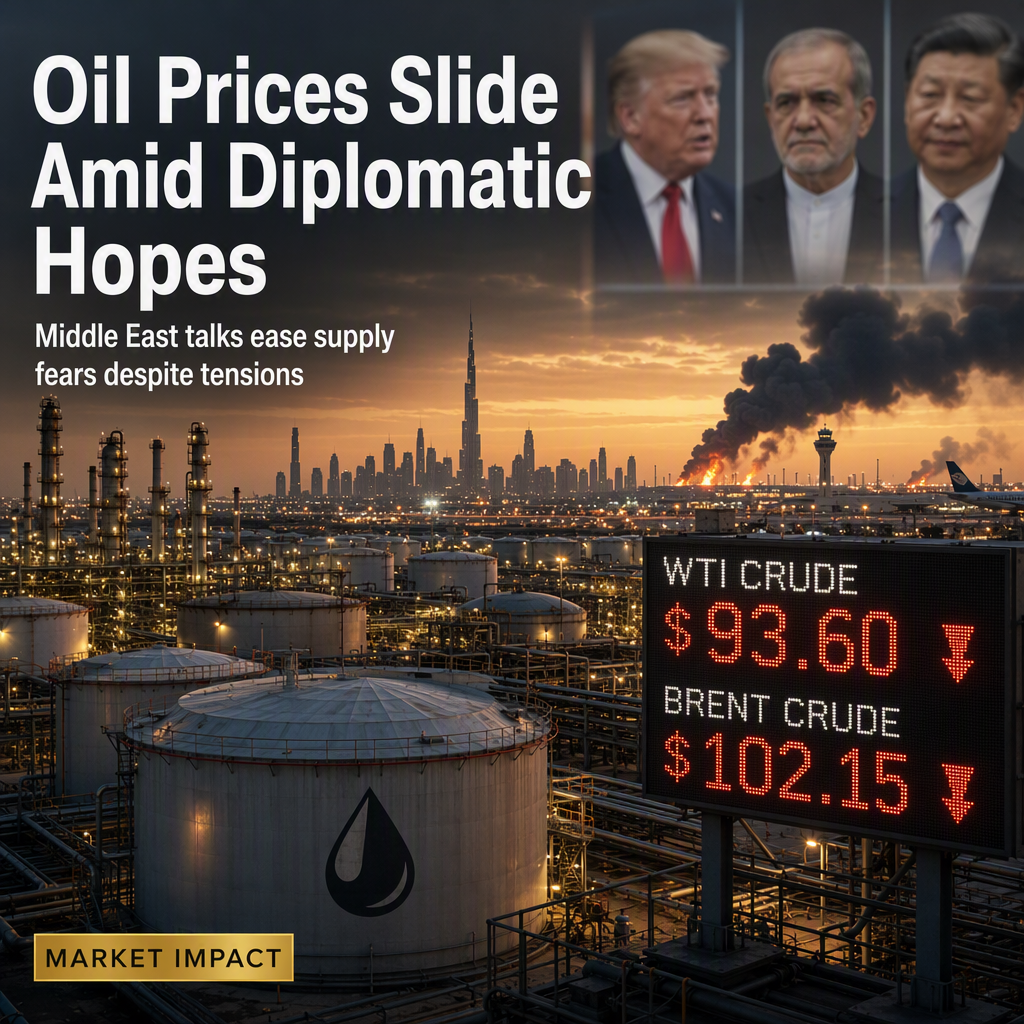
West Texas Intermediate (WTI) oil prices continued their decline for the fourth consecutive day, trading around $93.60 per barrel during Asian hours on Monday, while U.S. WTI futures for October dropped 1.83% to $98.46 per barrel and Brent crude for November delivery fell 1.66% to $102.15 a barrel [1][2]. The drop in crude prices is attributed to growing optimism that increased diplomatic efforts could help resolve the Middle East conflict and stabilize energy flows from the region [1]. US President Donald Trump indicated he would 'probably' be open to meeting Iranian President Masoud Pezeshkian at the United Nations General Assembly in New York this week, and may also meet with other Persian Gulf leaders and Chinese President Xi Jinping [1]. Qatari Prime Minister Sheikh Mohammed bin Abdulrahman Al-Thani called for Gulf states to cooperate in restoring regional stability, and active messages are reportedly being exchanged between the US and Iran [1].
Despite recent attacks by Iran-backed Houthis on Saudi Arabia with missiles and drones on Saturday, which targeted 'sensitive' locations in Riyadh and caused visible flames and smoke near the main airport, Middle East oil flows have remained 'surprisingly strong,' according to JPMorgan analysts [1][2]. The total oil flows averaged 17.1 million barrels per day in the past 10 days, which is 6.1 million bpd below the 2025 average, but still robust given the circumstances [2]. US Central Command chief Admiral Brad Cooper reported that oil and liquefied natural gas shipments through the Strait of Hormuz over the past two weeks have reached their highest level in six months [1].
However, the downside for oil prices may be limited due to ongoing geopolitical risks. Ukraine launched a large-scale drone and missile assault on Moscow, striking a major oil refinery and a residential building, while Yemen’s Houthis claimed responsibility for further attacks on Saudi Arabia [1]. U.S. President Trump stated he is in a 'deciding mode' regarding the US-Iran war, warning, 'My question is, if and when do I blow the entire nation up? They better behave,' suggesting that the situation remains volatile [2].
Economists at Royal Bank of Canada noted that the recent rise in energy prices has not yet led to a broad-based inflation surge, stating that 'evidence of pass-through to broader inflation has been limited so far,' and they expect the impact in coming months will remain constrained as higher fuel costs erode margins across business supply chains before reaching final consumer prices [1]. Daniel Takieddine, co-founder and CEO of Sky Links Capital Group, commented that oil prices are likely to remain closely tied to the pace of export normalization and diplomatic progress, warning that any setback or renewed deterioration in shipping conditions would tighten the physical market and restore upward pressure on prices [2].
CONCLUSION
Oil prices have declined amid hopes for diplomatic progress in the Middle East, even as regional tensions and attacks persist. Market participants remain cautious, with analysts highlighting that any disruption in shipping or setbacks in diplomacy could quickly reverse the current downward trend in prices. The overall market impact is high, with ongoing geopolitical risks keeping traders alert.