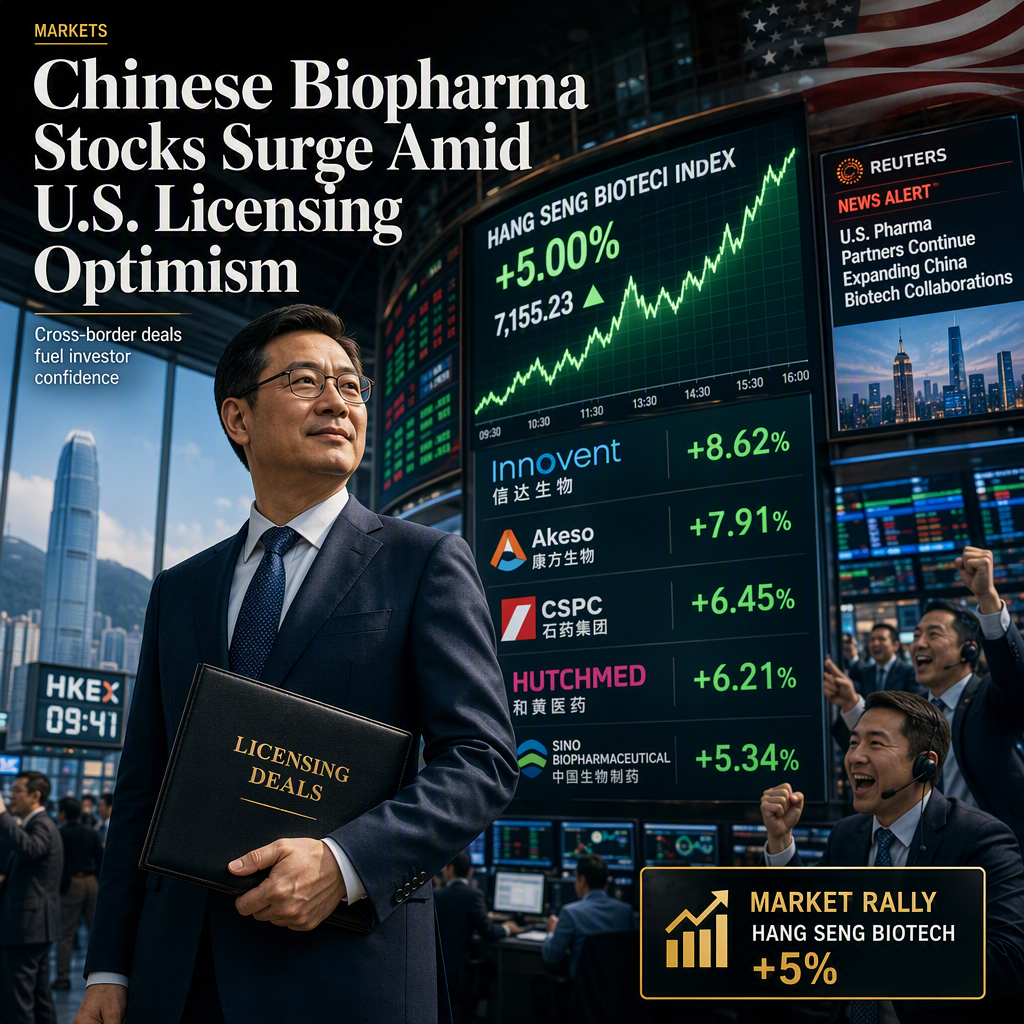
Chinese biopharma stocks experienced significant gains on Monday following reports that the U.S. may permit most drug licensing deals with Chinese firms to continue, diverging from the stricter approach taken with sectors such as artificial intelligence and semiconductors [1]. Innovent Biologics saw its shares jump between 6% and 7%, Akeso surged 8%, CSPC Pharmaceutical Group gained more than 6%, HUTCHMED climbed 3%, and Sino Biopharmaceutical added 8%. The Hang Seng Biotech Index also rose by more than 5% [1].
The market rally was triggered by a Reuters report indicating that the U.S. Treasury Department is drafting rules likely to allow American pharmaceutical companies to invest in promising new drugs from Chinese firms, with exceptions for drugs related to pathogens or biotechnology that could be weaponized. These rules are not yet finalized and remain subject to change [1].
Data cited in the article highlights the growing importance of Chinese firms in the global pharmaceutical landscape. Nearly half of U.S. overseas drug licensing deals in 2025 were with Chinese companies, and China completed a record 81 out-licensing deals worth a combined $110 billion in the first half of 2026. Notably, Pfizer announced a partnership worth up to $10.5 billion with Innovent in May, covering the research and development of 12 oncology programs [1].
Nomura analysts noted that investors appear 'largely immune' to intermittent geopolitical concerns in the sector, attributing this resilience to the strong value proposition of Chinese companies in novel drug development. Furthermore, China has prioritized globalization for its pharmaceutical and biotech companies under its 15th five-year plan, and Nomura expects China-U.S. out-licensing deals to 'ride on a high tide' going forward [1].
CONCLUSION
The prospect of continued U.S.-China drug licensing deals has driven a strong rally in Chinese biopharma stocks, reflecting investor optimism and the sector's resilience to geopolitical tensions. With substantial deal activity and supportive policy signals, analysts anticipate ongoing momentum in cross-border pharmaceutical collaborations.