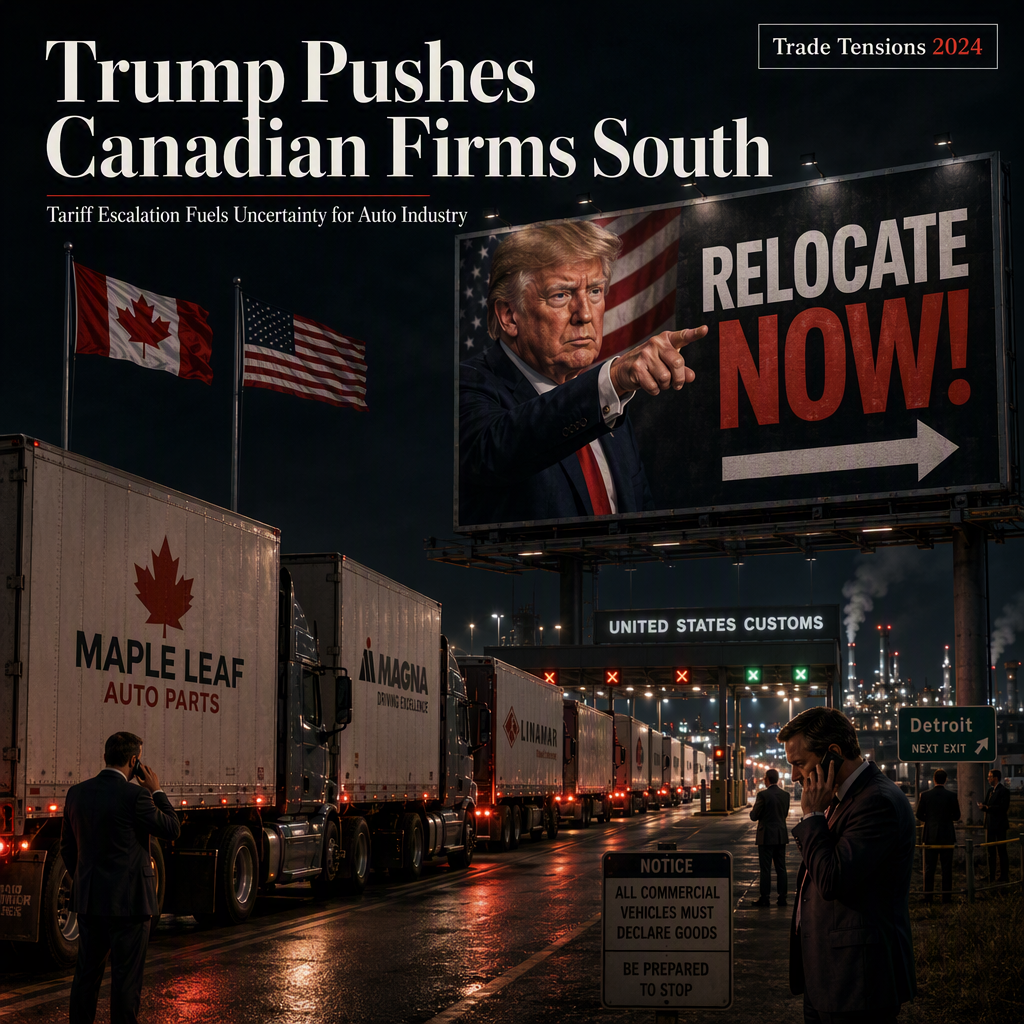
President Donald Trump escalated his criticism of Canada on Sunday, accusing the country of 'ripping' the U.S. off 'for decades' and defending his tariff policies as a means of strengthening the U.S. auto industry and manufacturing sector [1]. Trump claimed that his tariff actions were responsible for keeping American manufacturing plants open, specifically citing Ford's Detroit factory, which he said is now 'running 24/7' and has become 'one of the most profitable Car Plants in the World' [1]. He further asserted that similar positive outcomes have occurred for Ford, General Motors, and other companies, stating, 'I’ve revived, and indeed saved, the Automobile Business in our America. That’s because of what I’ve done with TARIFFS' [1].
Shifting focus to Canada, Trump described the country as one of the U.S.'s 'worst' trade offenders and declared, 'I don’t want Canadian cars, I don’t want Canadian parts, I don’t want Canadian anything. They’ve been ripping us off for decades, and it’s going to stop' [1]. He urged Canadian companies that do business with the U.S. to relocate their operations to the United States immediately, promising, 'When you move back, there are no TARIFFS!' [1].
These comments come amid escalating trade tensions between the two countries. U.S. tariffs of 50% on about $20 billion worth of Canadian goods took effect on August 22 after trade talks collapsed, and Canada is set to retaliate with tariffs on roughly $20 billion in U.S. imports effective September 8, according to Reuters [1]. The White House, Canadian Prime Minister Mark Carney’s office, Ford Motor Co., and General Motors did not immediately respond to requests for comment [1].
The ongoing tariff dispute and Trump's public statements signal significant uncertainty for cross-border trade and the North American auto industry, with potential implications for companies such as Ford and General Motors [1].
CONCLUSION
President Trump's remarks and the imposition of steep tariffs mark a significant escalation in US-Canada trade tensions, particularly impacting the auto sector. The situation introduces considerable uncertainty for Canadian companies operating in the U.S. market and for major automakers like Ford and General Motors. Market participants are likely to closely monitor further developments and official responses from both governments.