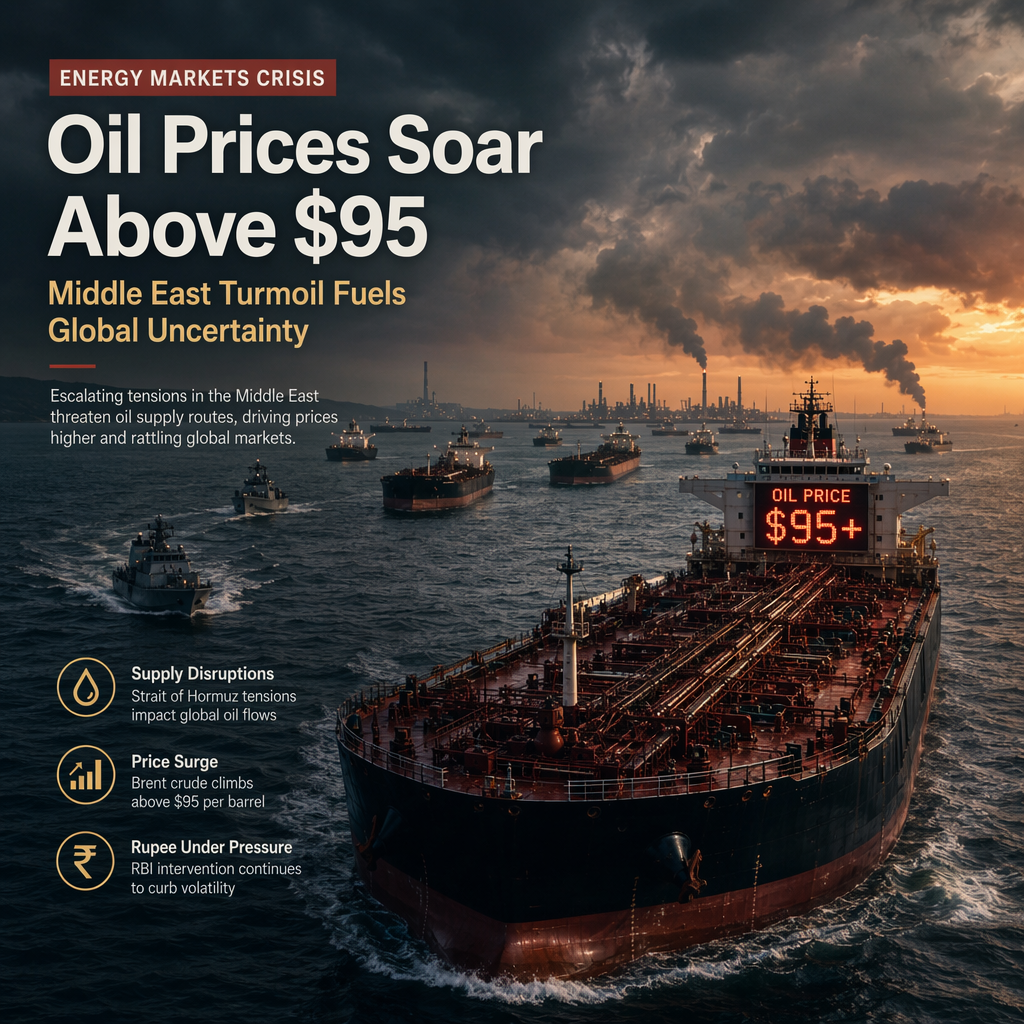
Oil prices surged nearly 5% on Wednesday, with international Brent crude rising above $95 per barrel for the first time in almost six weeks, driven by escalating supply disruptions in the Middle East and Black Sea regions [3]. U.S. crude oil also climbed more than 4% to over $88 per barrel, while national average gasoline prices in the U.S. increased to $4.06 per gallon, up 4 cents from Tuesday [3]. Since the start of the month, oil prices have gained 30% and are now up more than 55% since the start of the year, erasing the drop that followed the U.S.-Iran memorandum of understanding in mid-June [3]. President Donald Trump declared the tentative deal aimed at ending the war and reopening the Strait of Hormuz "over" on July 8 [3].
Multiple sources highlight mounting risks to oil supply, including renewed tensions in the Persian Gulf, attacks on vessels in the Strait of Hormuz, and a maritime blockade announced by Iranian-backed Houthi rebels in Yemen targeting Saudi Arabia [2][3]. The Bab el-Mandeb Strait, a critical transit route for global oil supplies, has seen deteriorating risk conditions, with several tankers changing direction in the Red Sea to avoid the area [2][3]. ING strategists note that risks to Saudi crude exports via the Red Sea, halted Kazakhstan flows through Russia’s CPC terminal, and ongoing disruptions could mean Brent at just over $91/bbl is undervalued if these issues persist into August [2]. They emphasize that supply tightness will only ease with normalization of oil flows from the Middle East and a reduction in Ukrainian attacks on Russian refineries [2].
The Indian Rupee (INR) has come under pressure as rising energy costs threaten external balances and FX volatility, prompting intervention by India’s central bank (RBI) [1]. BNY's Geoff Yu notes that INR is currently underheld compared to earlier in the year, and while it could benefit from carry returning, elevated oil prices are generating a balance-of-payments discount for the currency [1]. Brent’s climb above $95 has triggered intervention, with higher crude prices pushing governments and central banks into defense mode [1]. The pressure is particularly acute for energy importers, resulting in weaker current accounts, imported inflation, and fragile FX [1].
U.S. officials have downplayed the prospect of new peace talks with Iran after an 11th consecutive night of strikes, with Secretary of State Marco Rubio stating that Iran is targeting global shipping and demanding control over international waterways, which the U.S. will not accept [3]. Traffic in the Strait of Hormuz remains extremely low, with only 13 ships crossing on Monday and 9 on Tuesday, according to MarineTraffic data [3].
CONCLUSION
Escalating geopolitical tensions and supply disruptions in key oil transit routes have driven Brent crude above $95, prompting defensive interventions by energy-importing countries such as India. The surge in oil prices is exerting pressure on currencies like the Indian Rupee and raising global fuel costs, with analysts warning that continued disruptions could keep prices elevated. Market sentiment remains negative, reflecting heightened risk and uncertainty in energy markets.