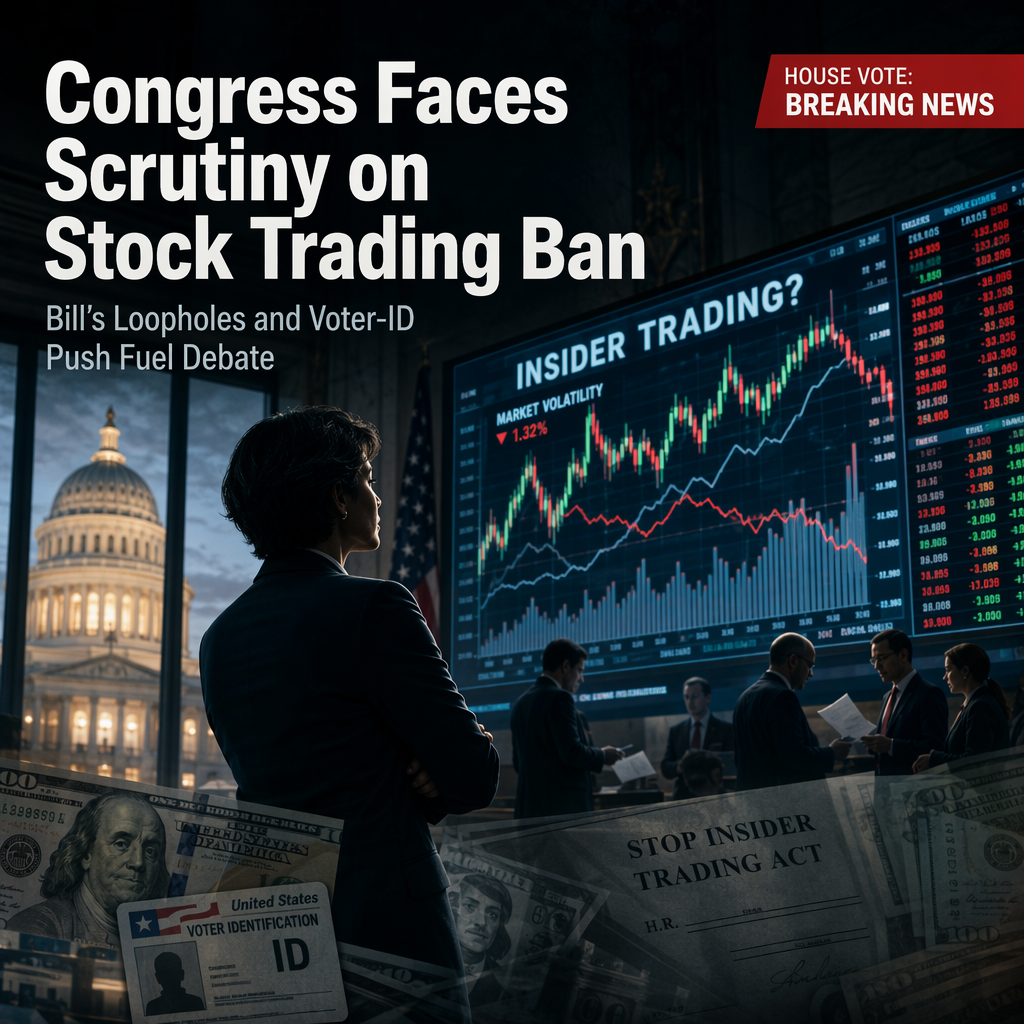
The U.S. House of Representatives is scheduled to vote on the Stop Insider Trading Act, a bill aimed at prohibiting members of Congress from purchasing individual stocks while in office, in response to longstanding public concerns over potential insider trading and ethics violations among lawmakers [1]. The legislation, introduced by Rep. Bryan Steil, R-Wis., would prevent members from buying individual stocks but does not require them to divest existing holdings. It would allow members to sell portions of their portfolios, provided they publicly disclose their intent to sell at least seven days in advance [1].
The bill also seeks to strengthen penalties for failing to properly disclose stock sales, raising fines to $2,000 or 10% of the transaction value, whichever is greater, compared to the current $200 penalty for first-time offenders [1]. Despite these measures, critics argue the bill is insufficient. Rep. Seth Magaziner, D-R.I., described it as a "weak bill" that still permits stock trading, falling short of the comprehensive ban advocated by some lawmakers and ethics watchdogs [1].
The legislation's prospects are further complicated by the inclusion of a voter-identification provision, which has led to strong opposition from Democrats and reduced the likelihood of bipartisan support. President Donald Trump has been urging Congress to pass the SAVE America Act, which would impose voter-ID and proof of citizenship requirements nationwide, but this measure currently lacks the necessary support to pass Congress [1]. If the stock trading bill, with the voter-ID mandate, advances to the Senate, its fate remains uncertain due to the 60-vote threshold required to overcome a filibuster [1].
A 2012 federal law already prohibits members of Congress from trading on inside information, but enforcement has been weak and penalties minimal. The current bill is seen by proponents as a step toward restoring public trust, with Rep. Steil stating, "Let's remove even the appearance of impropriety that any given trade is based on any inside information an individual may gain while serving in Washington" [1].
CONCLUSION
The House is set to vote on the Stop Insider Trading Act, which aims to curb stock trading by lawmakers but faces criticism for not going far enough and for including controversial voter-ID provisions. The bill's future is uncertain, with significant opposition from Democrats and unclear prospects in the Senate.