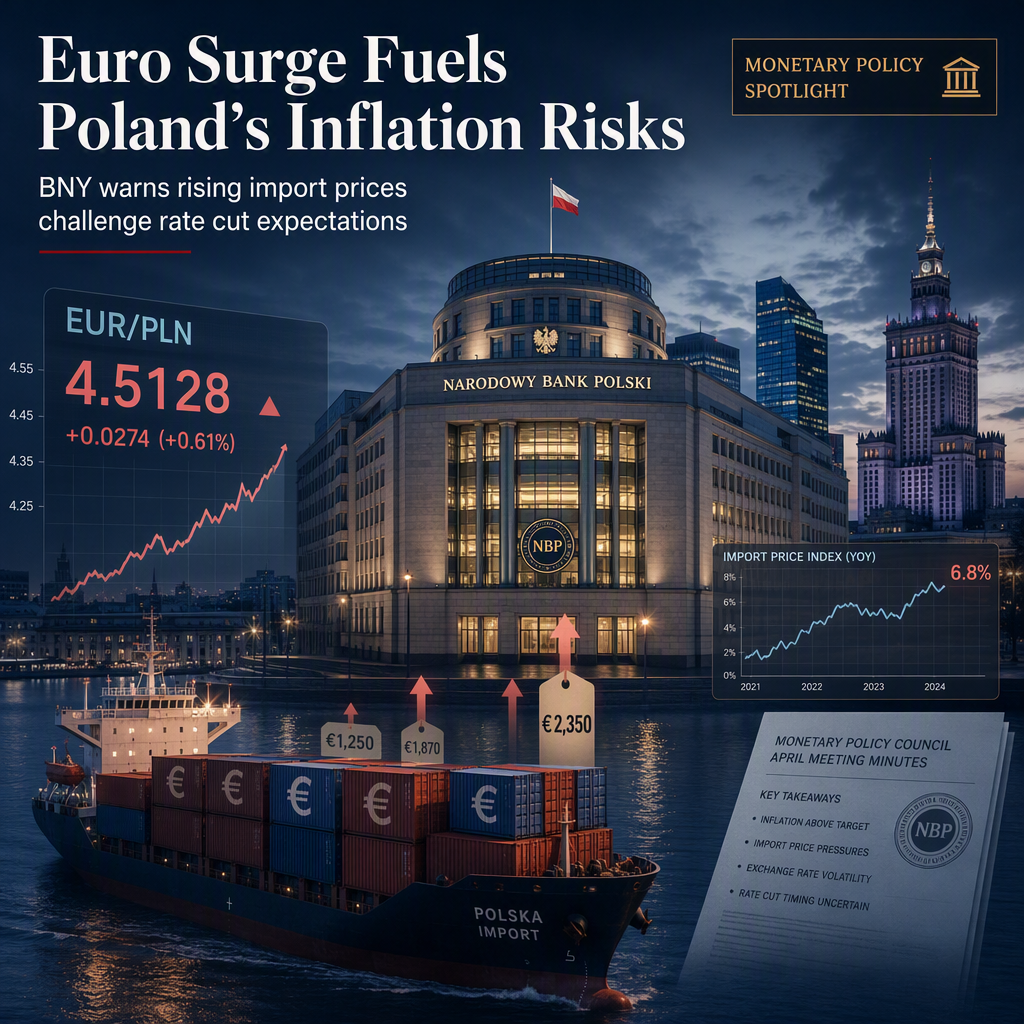
BNY's Geoff Yu highlights that the strengthening euro is amplifying import price pass-through risks for Poland, with recent gains in EUR/PLN contributing to higher import prices in the country [1]. According to Yu, the Monetary Policy Council's current guidance suggests no change in interest rates for the remainder of the year, which contrasts with market pricing that anticipates a return to rates above 4% [1].
Yu notes that Poland faces the clearest hawkish risk in Central and Eastern Europe, making expectations for rate cuts increasingly vulnerable [1]. He points out that between March and May, import prices in Poland have increased materially, even without significant upward moves in EUR/PLN, and the risks of further gains through Q3 are stronger as EUR/PLN has made significant gains [1].
The report also mentions that the fiscal impulse in Poland remains strong, which could amplify domestic demand and further complicate the inflation outlook in a rising import price environment [1]. Yu argues that, at a minimum, rate cuts should be taken off the agenda entirely, and suggests positioning for greater vigilance from the National Bank of Poland (NBP) and the Riksbank, favoring earlier tightening by the latter [1].
Much of the future policy direction will depend on the European Central Bank (ECB), and while a precautionary move in June may be manageable for the NBP, the risk of a more sustained tightening cycle could require a catch-up in policy [1].
CONCLUSION
BNY's analysis underscores heightened inflation risks for Poland due to euro strength and rising import prices, challenging the likelihood of near-term rate cuts. Market participants are advised to anticipate greater vigilance from the NBP, with rate cuts likely off the table for now.