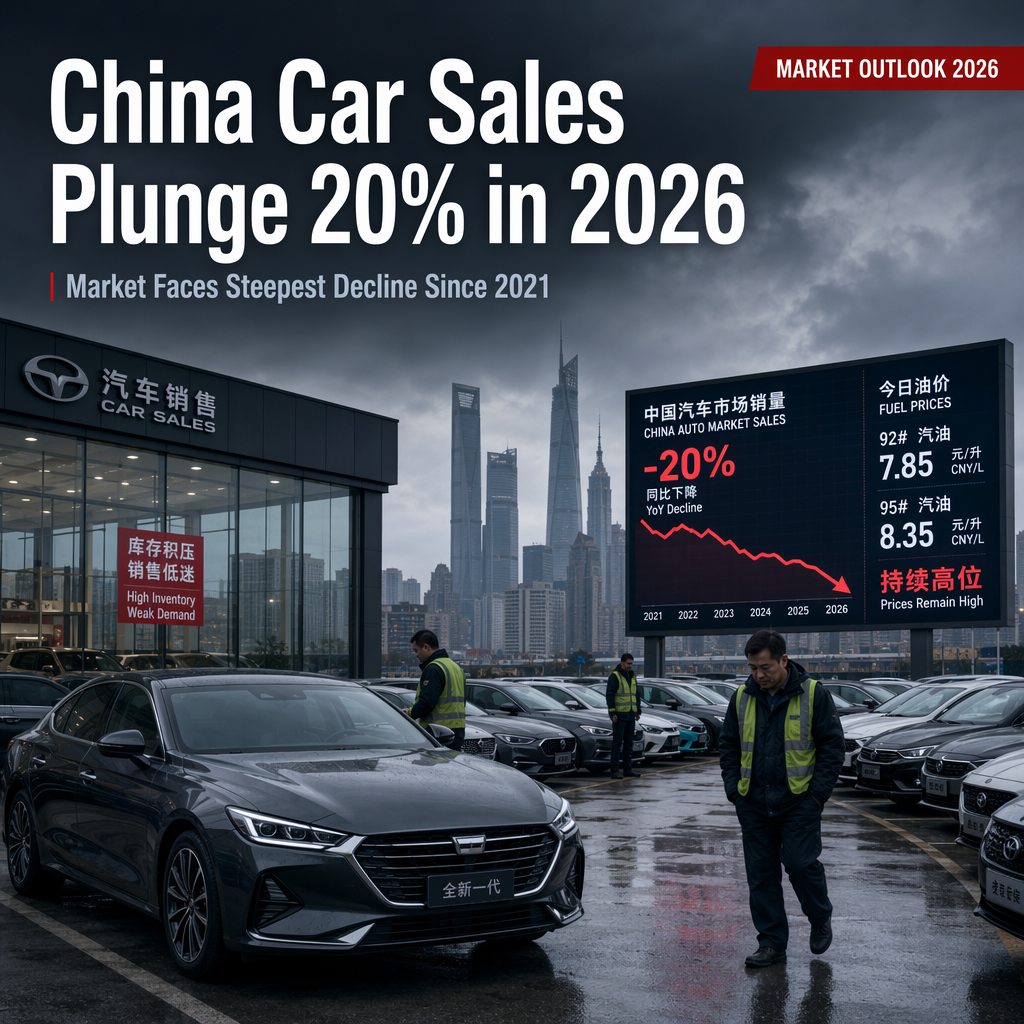
China's passenger car market is experiencing its worst downturn since 2021, with sales plunging 20.2% year-on-year in the first half of 2026, according to the China Passenger Car Association (CPCA) [1]. The CPCA has revised its 2026 sales growth forecast to -14%, down from an earlier projection of flat growth, and now expects full-year retail sales to reach 20.4 million units, a significant drop from the record 23.7 million units sold in 2025 [1]. Cumulative sales for the first half of 2026 stand at 8.7 million units [1].
The market decline is attributed to soaring fuel costs, which rose 15.3% year-over-year in June, and a reduction in new energy vehicle (NEV) subsidies, both of which have dampened consumer demand [1]. Retail sales of internal combustion engine (ICE) vehicles fell 39% year-on-year in June, with pure gasoline models down 42%, accounting for 78% of the total decline in passenger vehicle sales that month [1]. High production costs, particularly for battery-related inputs like lithium and memory chips, have further squeezed automakers, leading to a drop in industry-wide profit margins to 3.4% between January and May 2026 and a 20% year-on-year fall in industry profits [1].
Analysts offer a grim outlook for the remainder of the year. Xiao Feng, head of Hong Kong/China Industrials Research at Citic CLSA, projects a full-year sales decline of 20%, which is even more pessimistic than the CPCA's forecast [1]. However, Feng is slightly more optimistic about NEVs, expecting their sales to decline by only 5% to 6% year-on-year [1]. Tu Le, founder of Sino Auto Insights, described 2026 as a "brutal year" for the industry, citing intense competition among original equipment manufacturers as they vie for shrinking demand [1].
Looking ahead, analysts anticipate a potential recovery in 2027, driven by export growth, but caution that the current slump may be a result of frontloaded demand from the previous year's record sales [1].
CONCLUSION
China's car market is undergoing a severe contraction in 2026, with both consumer demand and industry profits sharply down due to high fuel costs, reduced subsidies, and rising production expenses. While analysts foresee a possible rebound in 2027, the immediate outlook remains challenging, especially for traditional ICE vehicles. The market's recovery will likely depend on export growth and stabilization of input costs.