
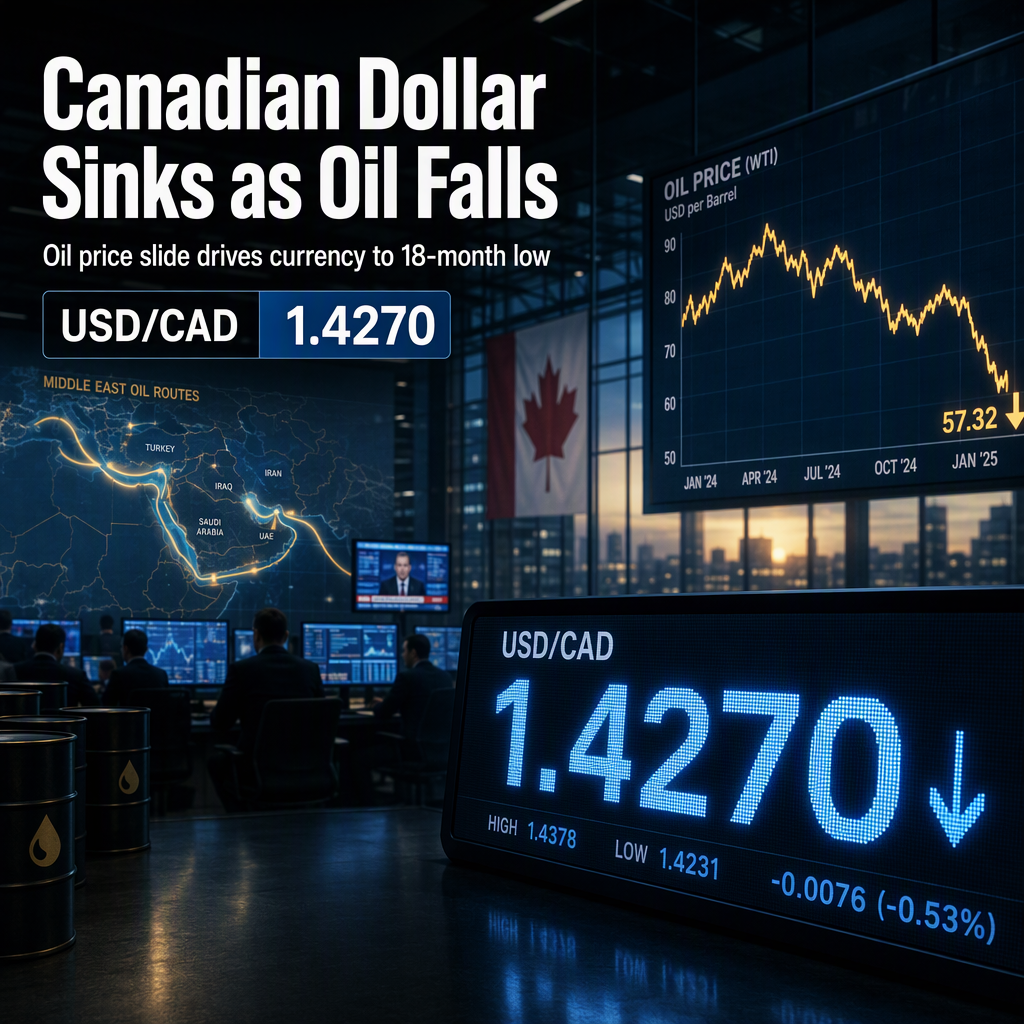
The Canadian Dollar (CAD) has fallen to near 18-month lows against the US Dollar (USD), with the USD/CAD pair extending its gains for the third consecutive day and trading around 1.4270 during European hours on Tuesday [1]. This decline in the CAD is closely linked to falling crude oil prices, as the commodity-linked currency faces pressure from a loosening global oil market. According to JPMorgan, Middle East crude shipments have rebounded to 17.5 million barrels per day, representing roughly 98% of pre-war volumes, while refined product flows such as diesel and gasoline have reached 3 million barrels per day, or 58% of normal capacity [1]. Gulf producers are increasing supply through the Strait of Hormuz, with Iraq seeking extra vessels for transport and Kuwait reporting its oil production has returned to approximately 75% of pre-conflict levels [1]. Additionally, Saudi Arabia has sharply reduced official selling prices for its flagship crude grade to Asian buyers, signaling increased physical availability and a progressively loosening oil market [1].
The decline in oil prices has alleviated inflation concerns and reduced pressure for monetary policy tightening. This is reflected in market expectations, with the CME FedWatch Tool indicating that traders are pricing in more than a 78% probability that the Federal Reserve will keep interest rates on hold at its upcoming meeting [1]. Despite the bullish momentum in USD/CAD, the US Dollar faces some headwinds due to softer US employment data, which has dampened expectations for a Fed interest rate hike in October [1].
From a technical perspective, USD/CAD is trading at 1.4270 with a clear bullish near-term bias, as the price remains above both the nine- and 50-period Exponential Moving Averages (EMAs) [1]. The 14-day Relative Strength Index (RSI) is at 78.96, indicating overbought conditions and suggesting the rally may be stretched, though strong upside momentum persists [1]. The FXS FedSentiment Index is elevated at 137.58, hinting that broader policy expectations continue to support demand for the pair [1]. Key resistance is identified at 1.4794, while initial support lies at the nine-period EMA at 1.4202 and a deeper floor at the 50-period EMA near 1.4022 [1].
CONCLUSION
The Canadian Dollar's sharp decline is primarily driven by falling oil prices and a loosening global oil market, while technical indicators suggest the USD/CAD rally may be overextended but remains supported by strong momentum. Market sentiment points to a high probability of the Federal Reserve holding rates steady, further influencing currency dynamics. Overall, the market impact is significant, with traders closely watching oil market developments and central bank policy signals.