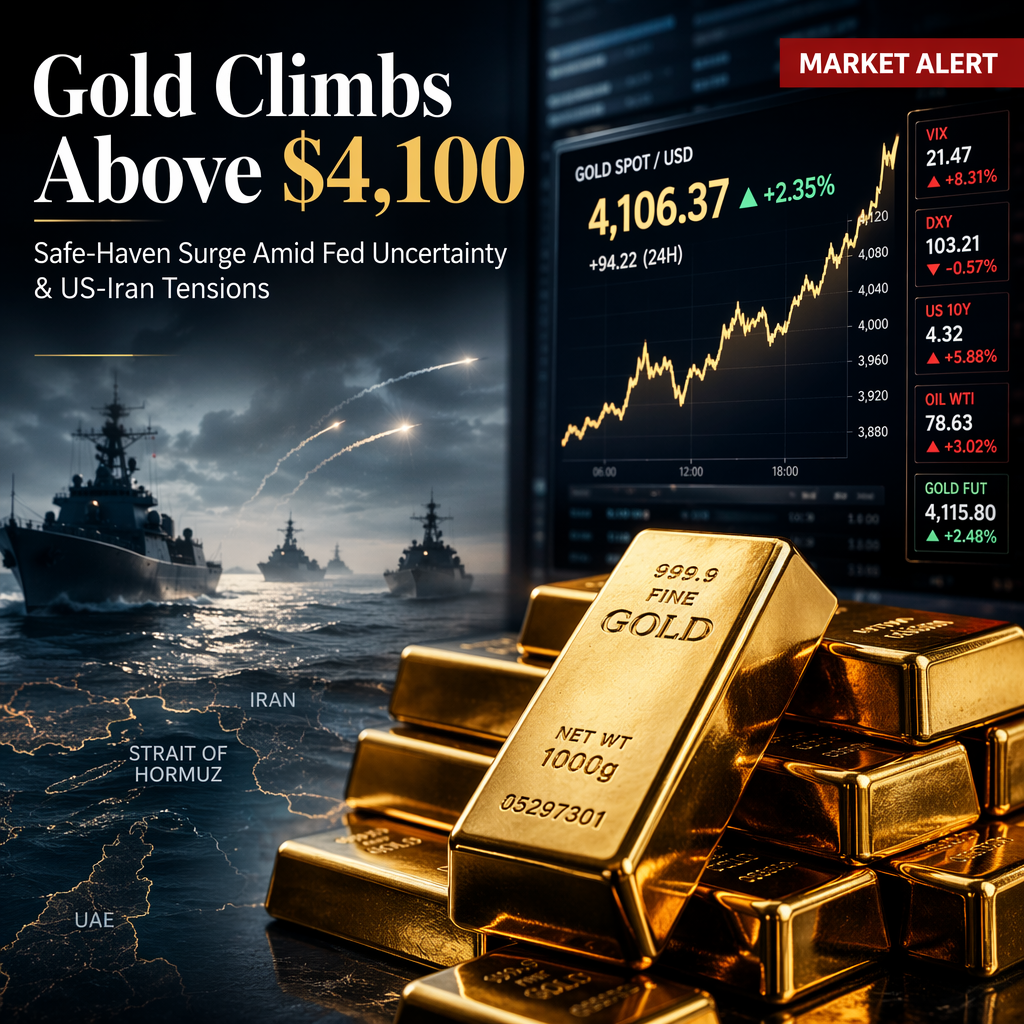
Gold prices (XAU/USD) rebounded to approximately $4,120 during the early Asian session on Friday, as traders responded to renewed geopolitical tensions in the Middle East following recent US-Iran conflict developments [1]. The White House reaffirmed its commitment to the memorandum of understanding with Iran, despite US President Donald Trump’s statement earlier in the week that the framework deal to end the Iran war was 'over' after Tehran launched strikes against vessels in the Strait of Hormuz and neighboring countries [1].
Uncertainty remains elevated, with President Trump warning that strikes would 'get much worse' if Tehran attacked ships in the strait again. On Thursday, Iran targeted US bases in Bahrain, Kuwait, and Qatar, while Jordan intercepted eight Iran-launched missiles, according to Axios [1]. These escalating tensions have the potential to push crude oil prices higher, which could stoke inflation fears and influence the Federal Reserve’s monetary policy stance [1].
The minutes from the Federal Reserve’s June meeting, the first under Chairman Kevin Warsh, revealed a divided central bank. Some participants indicated that the appropriate level of the federal funds rate would be within or slightly below the current target range by year-end, while others believed it should be above the current target range [1]. This division underscores the uncertainty facing markets as they assess the impact of geopolitical risks and inflationary pressures on future Fed policy.
Gold’s rise is consistent with its role as a safe-haven asset during periods of geopolitical and economic uncertainty. The ongoing conflict and the Fed’s indecision are prompting investors to seek refuge in gold, which is also seen as a hedge against inflation and currency depreciation [1].
CONCLUSION
Gold’s climb above $4,100 reflects heightened market anxiety over US-Iran tensions and uncertainty regarding the Federal Reserve’s rate trajectory. Investors are turning to gold as a safe-haven asset amid geopolitical risks and inflation concerns. The market will likely remain sensitive to further developments in the Middle East and signals from the Fed.