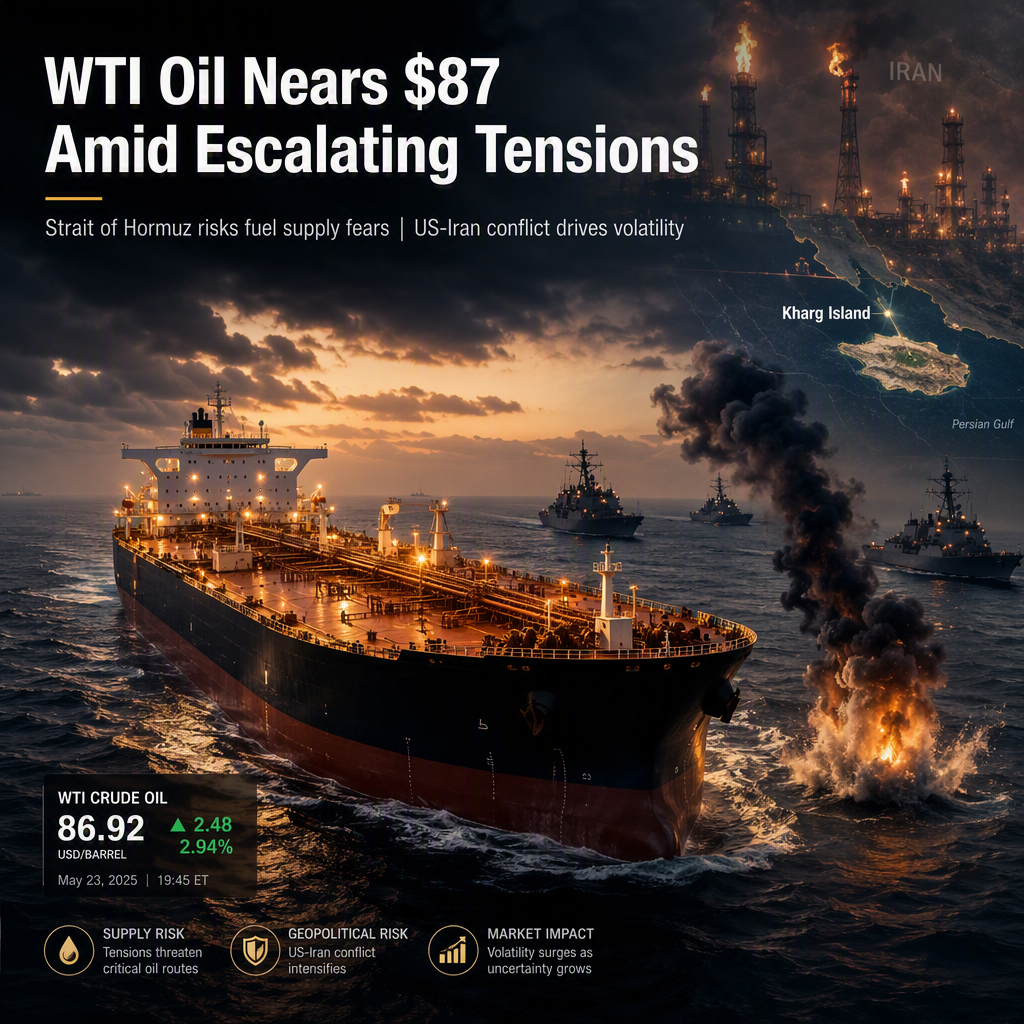
West Texas Intermediate (WTI) US Oil extended its rebound for a second consecutive day on Tuesday, rising 1.76% to trade around $86.95 at the time of writing, as renewed geopolitical risk premiums drove prices higher [1]. The increase was triggered by escalating hostilities between the United States and Iran, with US forces striking two Iranian rocket launchers on Larak Island in the Strait of Hormuz on Sunday—the first US attack since late July [1]. Tehran responded by targeting US facilities in Jordan, and US President Donald Trump warned of possible further military action, threatening to 'hit Iran hard' [1].
Market concerns intensified due to threats against Kharg Island, a central hub for Iranian oil exports. Any disruption to these facilities could impact global supply volumes, maintaining an elevated risk premium for WTI [1]. The Strait of Hormuz remains a focal point, especially after a supertanker caught fire following a collision with naval mines. Despite these incidents, oil flows through the strait have not completely halted, as major Gulf producers—including Saudi Arabia, the United Arab Emirates, Kuwait, and Iraq—continue to ship part of their volumes [1].
Additional supply concerns stem from Ukrainian drone and missile attacks on Russian refineries, which have reduced Russian refining capacity. Combined with Middle Eastern risks, these factors are supporting refining margins and intensifying worries about the global availability of fuels [1].
Analysts at Deutsche Bank noted that the recent rise in yields was primarily driven by the weekend escalation in the Middle East, marking the first exchange of strikes between the US and Iran since late July. President Trump attempted to temper perceptions of a broader conflict, emphasizing that US strikes against Iran would be limited and describing the situation as 'a relatively little war for us' [1].
Looking ahead, developments in the US-Iran conflict and the security of the Strait of Hormuz are expected to remain the main short-term drivers for WTI. Any further escalation threatening Iranian oil infrastructure or causing additional disruption to maritime traffic could sustain upward pressure on crude oil prices [1].
CONCLUSION
WTI oil prices have surged on heightened geopolitical tensions and supply risks, with the market closely watching developments in the US-Iran conflict and the security of key shipping routes. Analysts expect continued volatility, as any further escalation could keep prices elevated and impact global fuel availability.