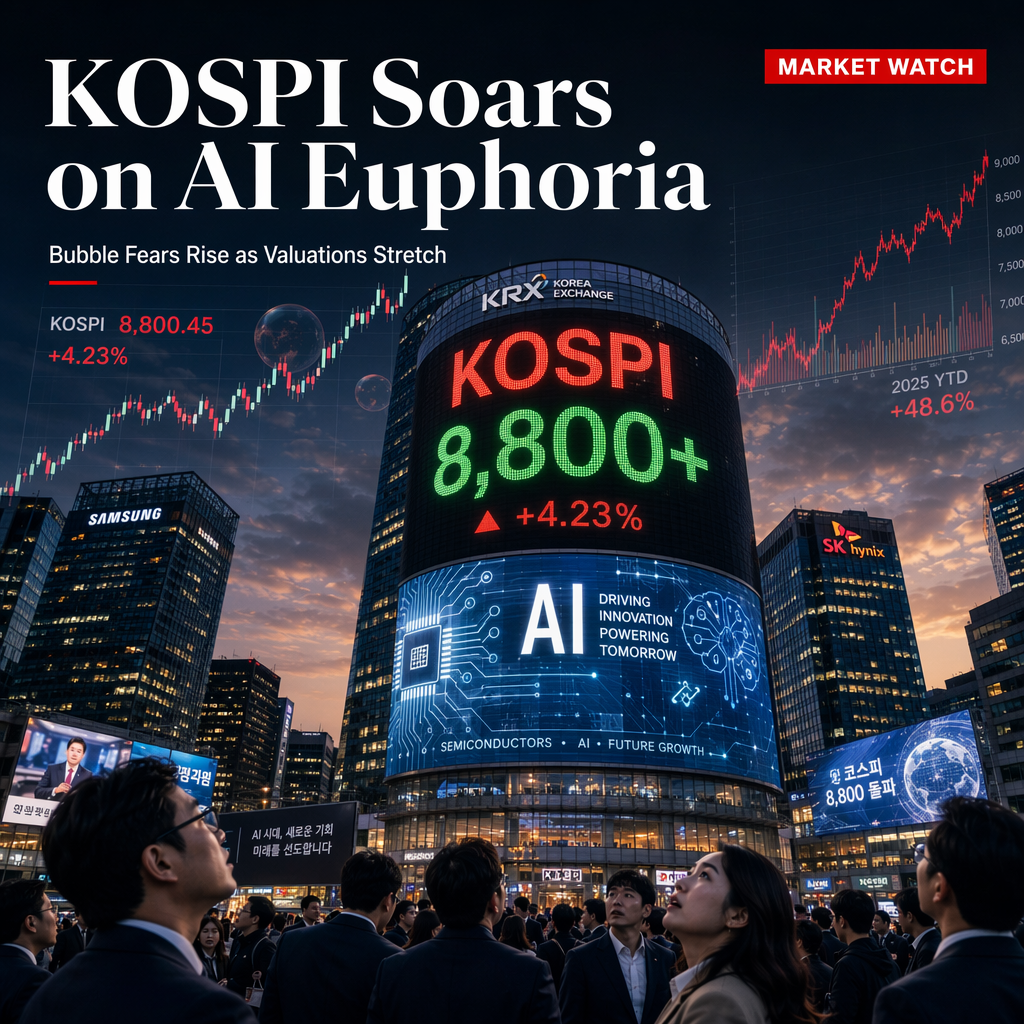
South Korea's stock market has experienced a dramatic rally, with the KOSPI index climbing above the 8,800 mark, a move that is attracting significant global attention and debate over whether this surge represents genuine economic strength or a speculative bubble driven by artificial intelligence (AI) optimism [1]. The rally is closely linked to South Korea's national strategy centered on AI technology, with tech exports—especially semiconductors—playing an increasingly pivotal role in the country's economic outlook. Investors are heavily betting on South Korea's potential to lead the next wave of AI innovation [1].
Despite the optimism, there are notable warning signs. The rapid rise in stock prices has outpaced earnings growth for many companies, particularly in the technology sector, leading to stretched valuations reminiscent of previous market bubbles [1]. Some market participants are cautious, warning that a correction could occur if lofty expectations are not met. A Seoul-based fund manager commented, "Korea is putting a lot of eggs in one basket. If the AI boom is real and sustainable, these valuations could be justified. But if not, the risk of a painful adjustment is high" [1].
Technical analysts have highlighted the KOSPI's break above key psychological resistance at 8,000 and its strong momentum up to 8,800. There is some support in the 8,000-8,200 range, but a drop below these levels could trigger a broader selloff as traders reassess risk [1]. The South Korean government has actively supported the AI sector through incentives for research and development and export promotion, further fueling market optimism but also increasing vulnerability should global AI demand weaken or competition intensify [1].
Currently, the market is characterized by a wave of euphoria, but the distinction between a sustainable boom and a speculative bubble remains thin, especially as South Korea's economic prospects become increasingly tied to the success of its AI sector [1].
CONCLUSION
South Korea's KOSPI index has soared above 8,800, driven by AI optimism and strong government support for the technology sector. While the rally reflects investor confidence in the nation's AI ambitions, stretched valuations and concentrated risk raise concerns about a potential market correction if expectations are not met.