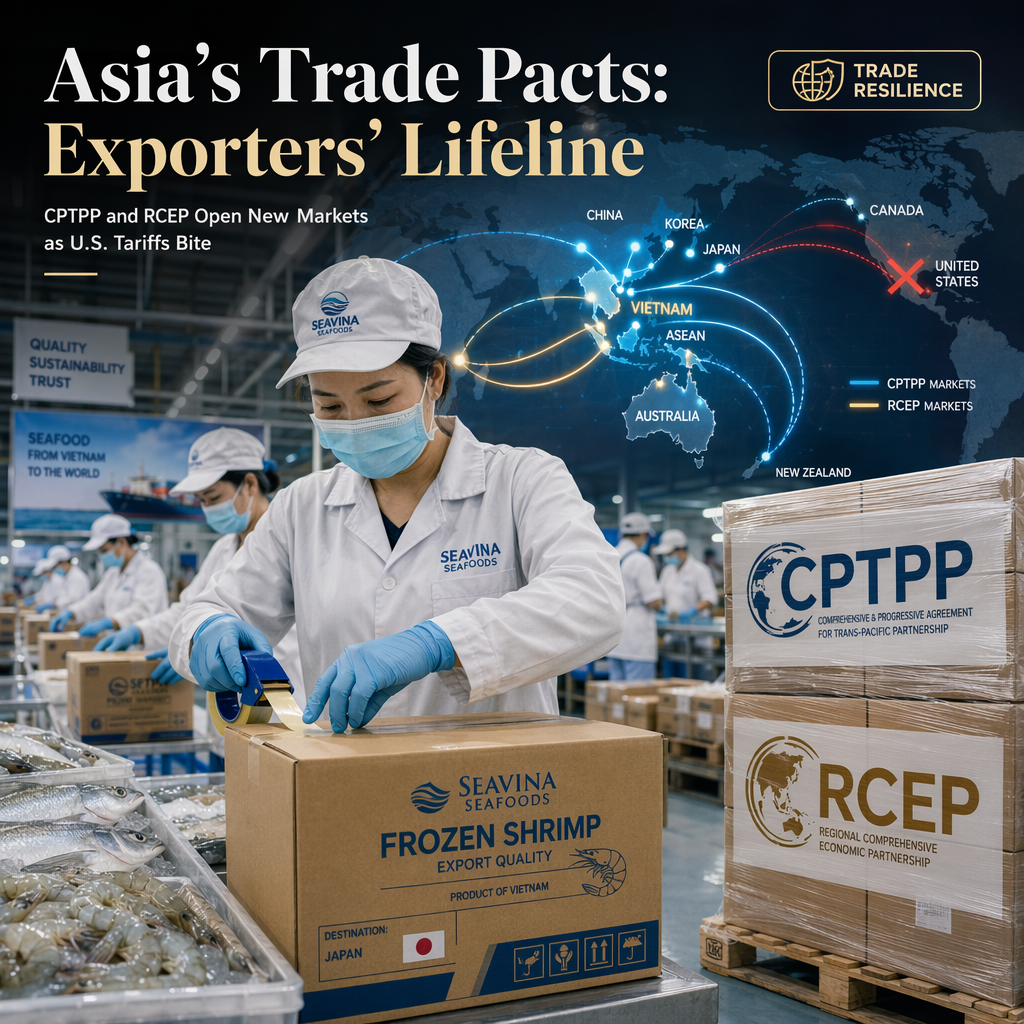
The gradual implementation of tariff reductions under Asia's major free trade agreements, the Comprehensive and Progressive Agreement for Trans-Pacific Partnership (CPTPP) and the Regional Comprehensive Economic Partnership (RCEP), is helping to mitigate the effects of tariffs imposed by the Trump administration on Asian exports, particularly in sectors such as seafood and manufacturing [1]. Vietnamese seafood exporters, who have long relied on the U.S. market, are among those benefiting from the alternative export destinations and supply chain resilience provided by these trade pacts [1].
While the financial benefits of CPTPP and RCEP are not uniform across all industries and countries, the continued opening of Asian markets is offering exporters new opportunities to diversify and adapt to U.S. protectionism [1]. The phased reduction of tariffs is described as a 'lifeline' for certain sectors, with industry analysts suggesting that exporters who leverage these agreements are likely to see steady gains even if U.S. tariffs persist [1].
Long-term market analysis indicates that as more tariff lines are reduced or eliminated under these agreements, member countries' industries will gain competitive advantages and improved market access, partially offsetting losses from restricted access to the U.S. market [1].
CONCLUSION
The CPTPP and RCEP are providing Asian exporters with alternative markets and greater resilience against U.S. tariffs. While benefits are uneven, the ongoing tariff reductions are expected to strengthen competitive positions and support steady growth for adaptable industries.