
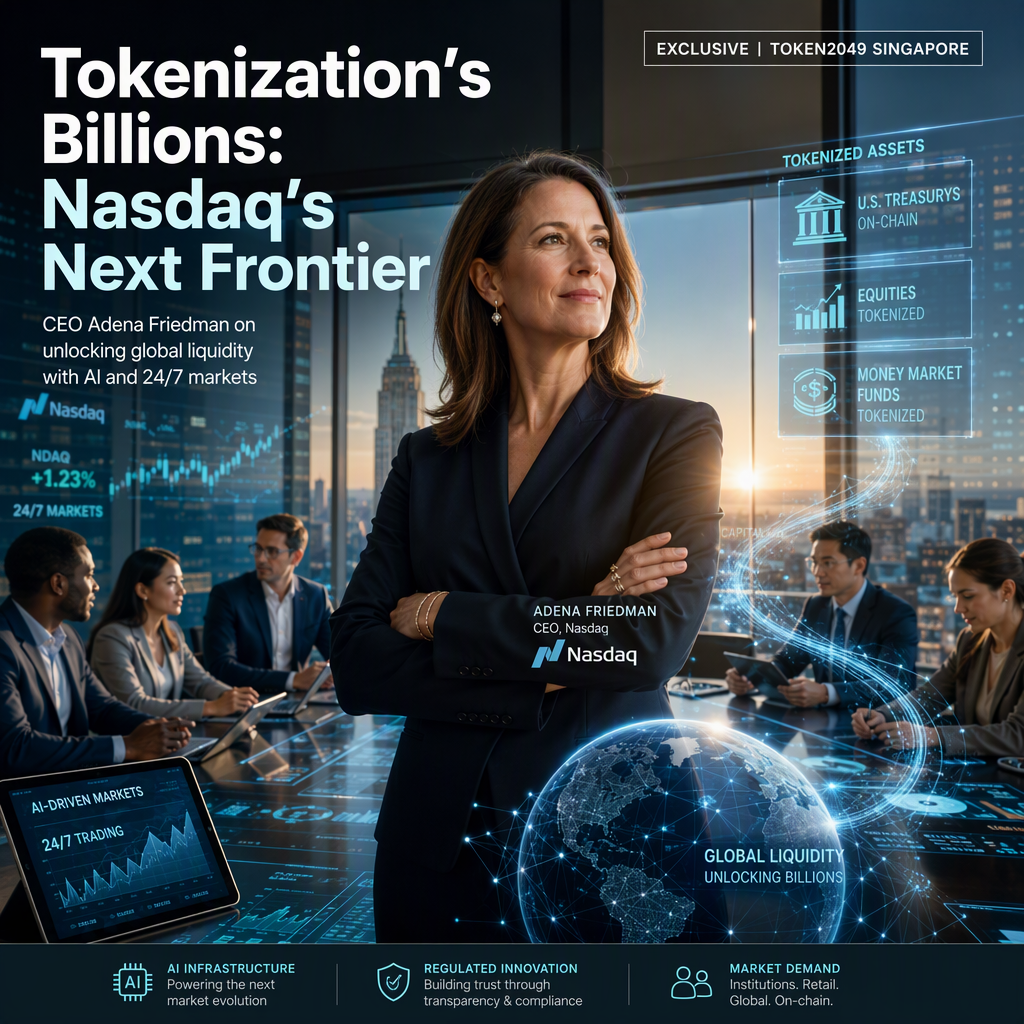
Nasdaq CEO Adena Friedman stated that tokenization could free up tens of billions of dollars in capital currently tied up as collateral across the global financial system. Speaking at the TOKEN2049 conference in Singapore, Friedman explained that tokenizing assets such as Treasurys, equities, and money market funds, along with the flow of money, could make collateral significantly more liquid. She emphasized, 'If you tokenize all those instruments along with the flow of money, then the collateral becomes very fluid' [1].
Friedman noted that institutional interest in tokenization has increased over the past year, citing the passage of the Genius Act in the U.S., which established a regulatory framework for stablecoins. She suggested that the ability to tokenize money could pave the way for tokenizing the flow of capital as well. This growing institutional interest is converging with longstanding demand from retail investors for 24/7 trading, with Friedman observing that the retail ecosystem 'has been about 10 years ahead' in this regard [1].
Transitioning to a fully 24/7 market would be a significant challenge for the financial industry, according to Friedman. While the exchange infrastructure is the 'easiest part,' she highlighted that continuous risk and collateral management would be required, with all processes needing to operate in real time. Friedman identified artificial intelligence as a critical tool for managing this transition, noting that Nasdaq has already launched digital agents within its risk management platform to provide recommendations, with the potential for banks to use these agents for more direct actions in the future [1].
Arjun Sethi, co-CEO of cryptocurrency exchange Kraken, added that companies outside the U.S. are showing interest in tokenization and accessing American capital markets. He referenced a company generating roughly $25 million in revenue exploring capital market access, as well as larger international firms interested in tokenization and U.S. public listings. However, Friedman cautioned that not every asset is liquid enough to support a 24/7 trading environment, though she acknowledged that greater connectivity could expand access to assets globally [1].
CONCLUSION
Nasdaq CEO Adena Friedman and industry leaders see significant potential for tokenization to unlock billions in trapped capital and drive greater liquidity in financial markets. While the transition to 24/7 trading and real-time risk management presents challenges, advancements in AI and regulatory frameworks are paving the way for broader adoption. The market impact is medium, with growing institutional and international interest signaling a shift toward more accessible and efficient capital markets.