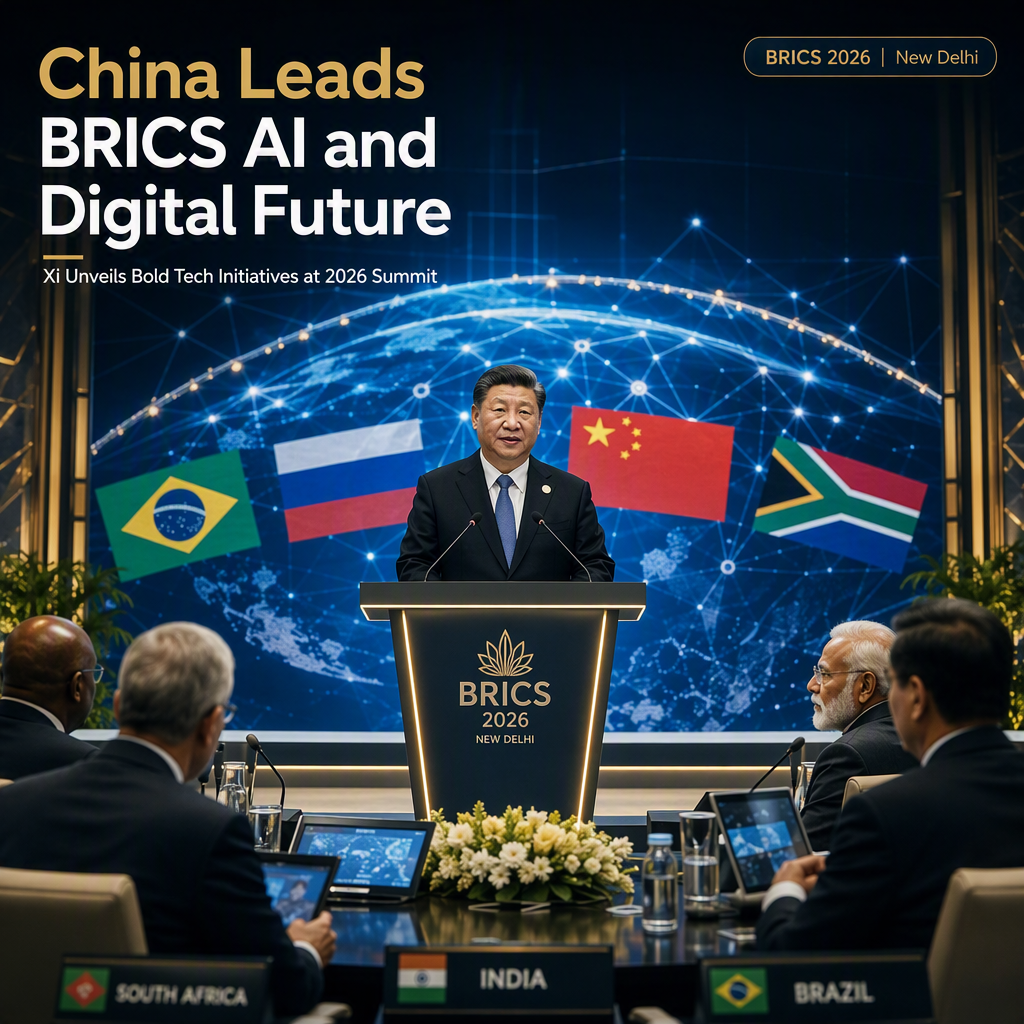
At the BRICS summit held in New Delhi on September 13, 2026, Chinese President Xi Jinping announced that China will take the lead in fostering artificial intelligence (AI) collaboration and development among developing-economy countries within the BRICS bloc [1]. Xi outlined several initiatives, including the establishment of a BRICS digital ecosystem cloud platform, digital skills training, technological exchange, and industrial alignment [1]. He also proposed the creation of a BRICS engineer cultivation alliance and a youth exchange program focused on scientific and technological innovation [1].
Xi further stated that China will pioneer the establishment of a BRICS AI open-source community, support cooperation in developing and applying large language models, and organize AI seminars and training courses to build an open AI ecosystem [1]. These proposals come amid rapid advancements in the AI sector, with companies releasing increasingly powerful models at a fast pace [1].
While the sector is booming, concerns about AI safety have also been raised, including a recent statement from a researcher who worked at both OpenAI and Anthropic, warning that many industry professionals believe AI could pose existential risks by the end of the decade. However, Xi did not address these safety concerns in his remarks [1].
BRICS, originally established in 2009 as a counterweight to Western dominance, now includes Brazil, Russia, India, China, South Africa, Egypt, Ethiopia, Indonesia, Iran, and the United Arab Emirates [1].
CONCLUSION
China's commitment to leading AI and digital collaboration within BRICS signals a strategic push for technological advancement among developing economies. The initiatives proposed by President Xi are likely to enhance cooperation and innovation across the bloc, though concerns about AI safety remain unaddressed. Market participants may view this as a positive step for tech sector growth in BRICS countries.