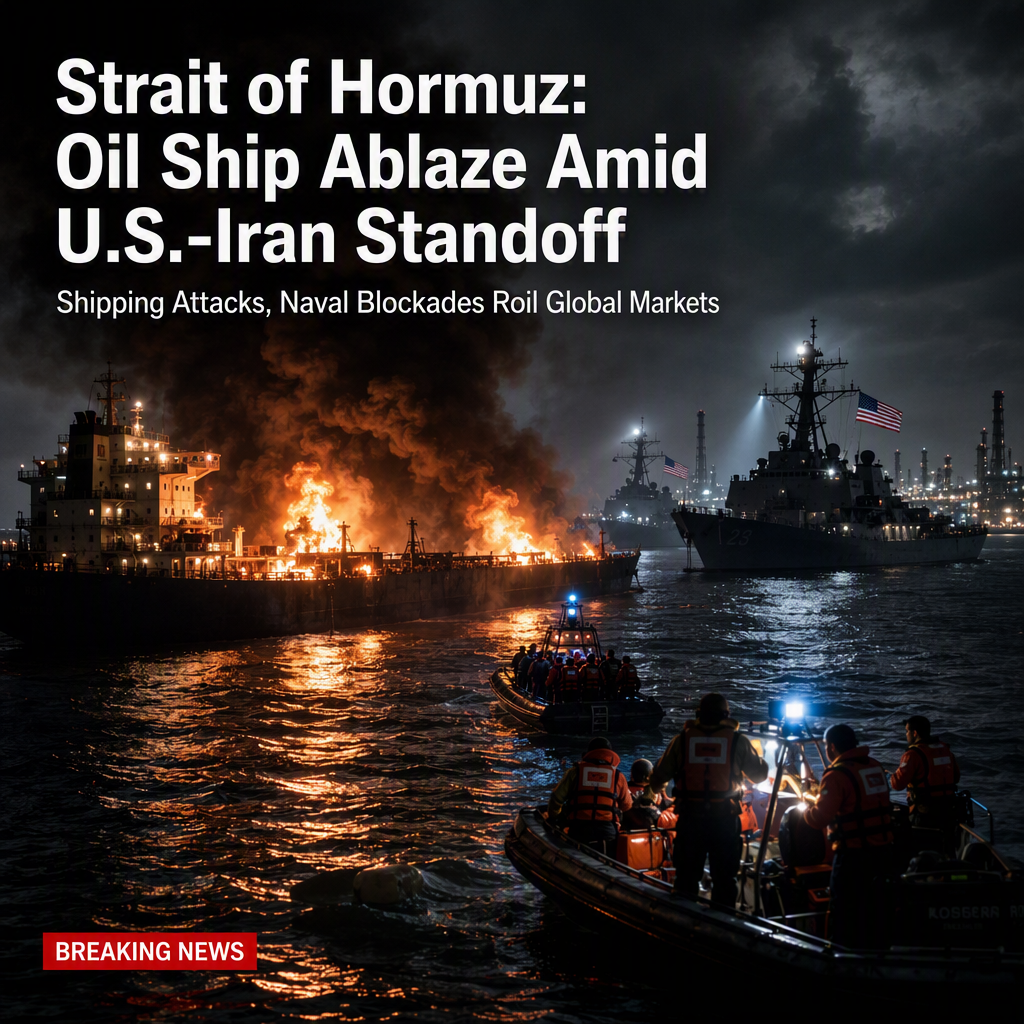
A vessel transiting the Strait of Hormuz was struck by an unknown projectile, resulting in a fire and the evacuation of its crew, according to the United Kingdom Maritime Trade Operations Centre (UKMTO) [1]. The incident occurred late Saturday, with local authorities responding to assist the crew [1]. This attack is the latest in a series of tit-for-tat strikes on shipping in the region, which has seen repeated disruptions and a U.S. naval blockade that has kept oil prices elevated [1].
Diplomatic efforts between the U.S. and Iran remain stalled, with direct negotiations showing no signs of resuming [1]. Ebrahim Azizi, head of the Iranian parliament's national security committee, stated, 'No negotiations. Until Iran's terms are met, talks are futile,' emphasizing Iran's current stance against engaging with the U.S. [1]. However, Iran is set to meet with Gulf countries in Muscat, Oman, to sign an agreement establishing a new Iran-Oman shipping route through the Strait of Hormuz, according to officials from both sides [1].
Iranian President Masoud Pezeshkian reiterated his country's defiance at the BRICS Summit in New Delhi, declaring, 'Iran has successfully stood against Israel and the U.S.' and asserting that Iran 'will not yield in front of bullying arrogance' [1]. These comments followed U.S. President Donald Trump's remarks that U.S. military action prevented Iran from attacking Israel, the Middle East, and U.S. cities [1].
U.S. Central Command (CENTCOM) reported destroying 10 Iranian tankers in the preceding week and stated that, since resuming the naval blockade, it has redirected 100 commercial vessels over the past 60 days, with 'ZERO ships' passing through without U.S. authorization [1]. The ongoing disruptions in the Strait of Hormuz continue to impact global shipping and energy markets [1].
CONCLUSION
The latest attack in the Strait of Hormuz underscores persistent security risks and heightened tensions between the U.S. and Iran, with no diplomatic breakthrough in sight. Ongoing shipping disruptions and the U.S. naval blockade are keeping oil prices elevated, signaling continued market volatility in the region.