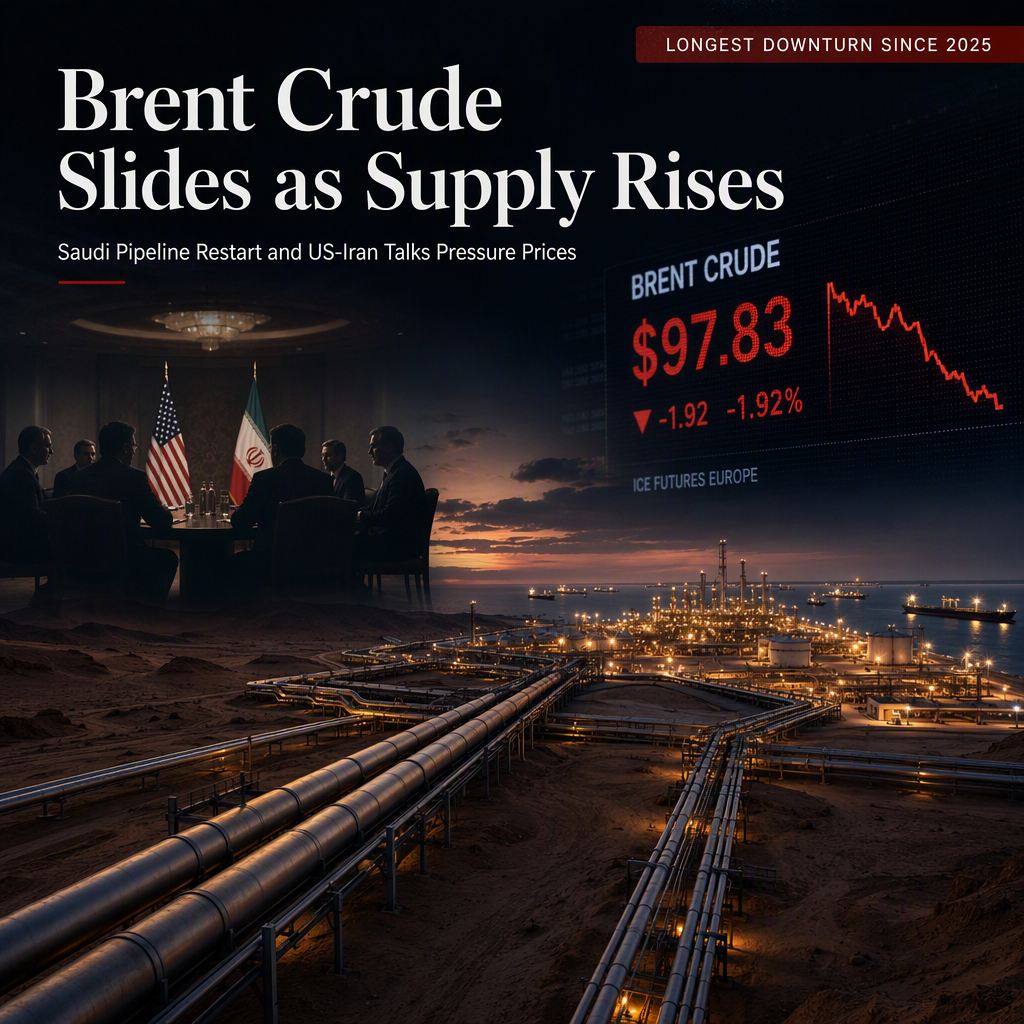
Brent crude prices continued their downward trajectory, trading near USD 98 per barrel after six consecutive sessions of declines, marking the longest losing streak since August 2025 according to Danske Bank research [1]. The primary catalyst for this price slide is the restart of Saudi Arabia's East-West pipeline, which has increased supply expectations in the market [1]. Additionally, signs of progress in US–Iran talks have further pressured Brent prices, as the potential for increased Iranian oil exports weighs on global risk sentiment and fixed income markets [1].
Danske Bank notes that oil was the dominant intraday driver, with Brent dipping to around USD 99 per barrel, reflecting the market's reaction to these supply-side developments [1]. The US and Iranian officials held their first talks since June through mediators on the sidelines of the assembly, though no agreement was reached. Both sides, however, anticipate further discussions, which could influence future supply dynamics [1].
Political rhetoric also played a role, with President Trump warning in his UN speech that he could "annihilate the Islamic Republic" if no deal is reached, and suggesting that a peace agreement is unlikely before the November mid-terms [1]. Meanwhile, Tehran stated its willingness to reopen the Strait of Hormuz within seven days if the US lifts its blockade on Iranian ports, but for now, prospects for normalizing traffic through the Strait remain limited [1].
The combination of increased supply from Saudi Arabia and the potential for renewed Iranian exports has led to a negative market sentiment, with oil prices acting as a key driver for broader market movements [1].
CONCLUSION
Brent crude's extended decline is driven by Saudi Arabia's pipeline restart and the possibility of increased Iranian exports amid ongoing US-Iran talks. Market sentiment remains negative, with oil prices exerting significant influence on broader financial markets. The outlook hinges on further diplomatic developments and supply-side actions.