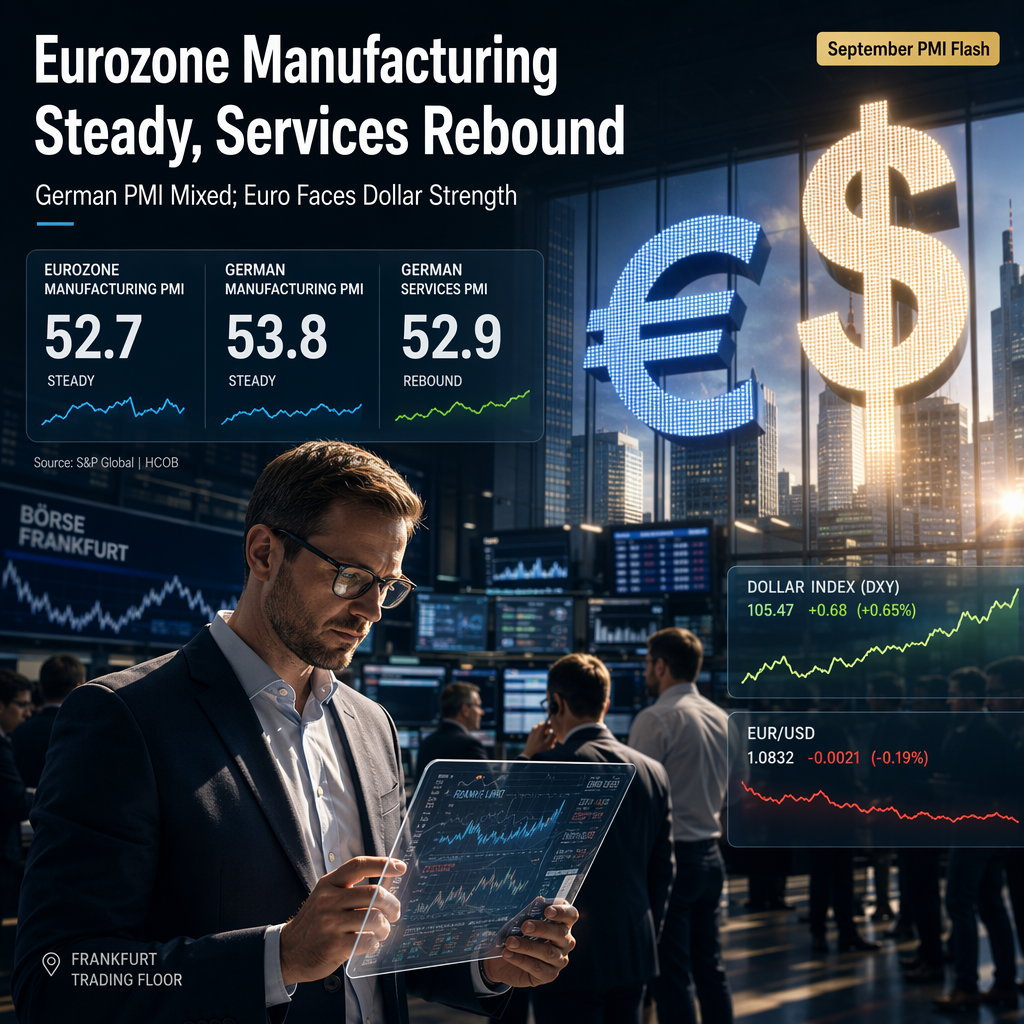
The latest flash Purchasing Managers’ Index (PMI) data for September indicate that the Eurozone manufacturing sector remains stable, with the preliminary HCOB Manufacturing PMI holding steady at 52.7, matching both the previous month and market consensus expectations [1][4]. This reading, above the 50.0 threshold, signals continued expansion in Eurozone manufacturing activity [1]. Meanwhile, the Eurozone services sector was anticipated to edge up to 51.7 from 51.6 in August, suggesting moderate expansion, though the actual figure is not provided in the sources [4].
In Germany, the flash HCOB Manufacturing PMI for September unexpectedly dropped to 53.8, below both the consensus estimate of 54.5 and the previous reading of 54.3 [2][3]. Despite this slowdown in manufacturing, the German Services PMI rebounded strongly to 52.9 from 49.7 in August, returning to expansion territory and driving the Composite PMI up to 53.8 from 51.8 [2][3]. Phil Smith, Economics Associate Director at S&P Global Market Intelligence, noted that German businesses showed resilience in September, with output growth accelerating, steady outlook expectations, and rising employment, despite renewed inflation pressures [3].
Market reaction to the PMI releases was muted. The Euro remained steady against major peers following the data, with EUR/USD down 0.22% to near 1.1424, as the US Dollar outperformed amid expectations of further Federal Reserve rate hikes [2][3]. The US Dollar Index (DXY) traded 0.23% higher to near 100.77, its highest level in over seven weeks [2]. Against the British Pound, the Euro edged up for a second consecutive day, trading at 0.8580, supported by lower oil prices and a recent European Central Bank (ECB) rate hike [4].
Looking ahead, the ECB has signaled the possibility of further monetary tightening if inflation remains elevated, which has provided additional support to the Euro [4]. However, Euro bulls remain cautious due to political uncertainty in Germany and concerns over France's rising public debt, which has attracted the attention of rating agencies [4].
CONCLUSION
September PMI data show that Eurozone manufacturing remains stable while German manufacturing growth slowed but was offset by a strong rebound in services. The Euro's market reaction was subdued, pressured by a strong US Dollar and ongoing monetary policy divergence. Forward-looking risks include political uncertainty in Germany and fiscal concerns in France, though ECB hawkishness and lower oil prices offer some support to the Euro.