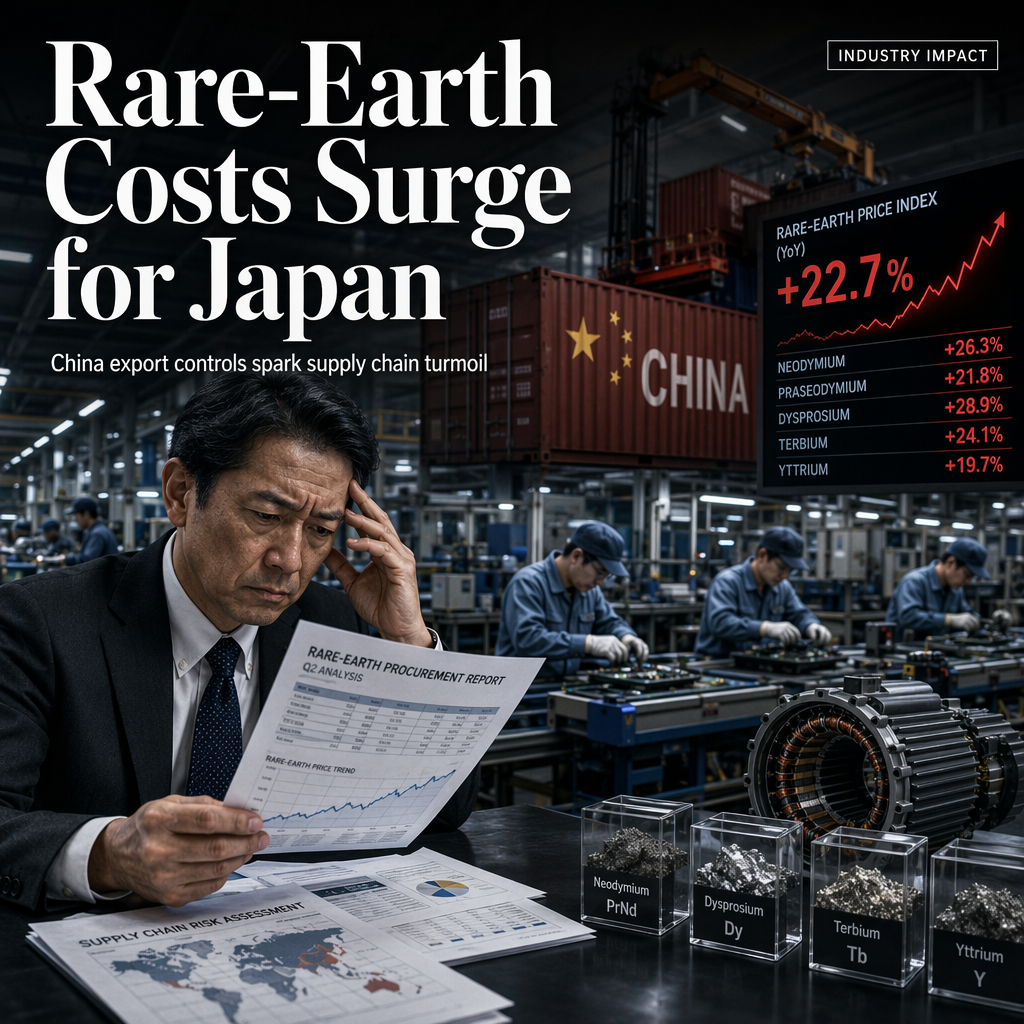
Japanese companies have experienced a significant increase in rare-earth procurement costs, with a private-sector survey revealing a surge of over 20% compared to the previous year [1]. This escalation is directly linked to China's tightening of export controls, as 61% of the rare earths imported by Japanese firms originate from China [1]. The survey further indicates that 1 out of 10 Japanese companies has been unable to pass on these extra costs to customers, resulting in mounting pressure on profit margins [1].
The increased costs are particularly impactful for industries reliant on rare earths, such as electronics, automotive, and renewable energy [1]. Some manufacturers have responded by reconsidering their supply chain strategies and seeking alternative sources, though China remains the dominant supplier [1]. While certain companies have managed to offset the higher costs through price increases or internal efficiencies, a significant portion continues to absorb the additional expenses, eroding profitability [1].
Industry sentiment is cautious, with concerns about further price spikes if China imposes additional restrictions or global demand intensifies [1]. The survey highlights the need for Japanese firms to diversify their sourcing and invest in domestic or alternative supply chains to mitigate risk [1]. A senior executive at a leading Japanese electronics manufacturer stated, "The situation is becoming increasingly difficult. We are closely monitoring price levels and are looking for opportunities to secure more stable and diversified supply" [1].
Technical analysis from the survey suggests that the support level for cost increases is around 20%, with resistance expected if prices climb further due to supply constraints [1]. Companies are evaluating long-term contracts and hedging strategies to stabilize procurement costs amid ongoing market volatility [1]. Overall, the survey underscores the strategic importance of rare earths and the challenges Japanese firms face as geopolitical tensions and supply chain disruptions continue to impact commodity prices [1].
CONCLUSION
Japanese companies are grappling with a sharp rise in rare-earth costs, driven by China's export restrictions and supply chain disruptions. The inability to fully pass on these costs is eroding profitability, prompting firms to seek alternative sourcing and risk mitigation strategies. Industry sentiment remains cautious, with ongoing concerns about further price increases and supply volatility.