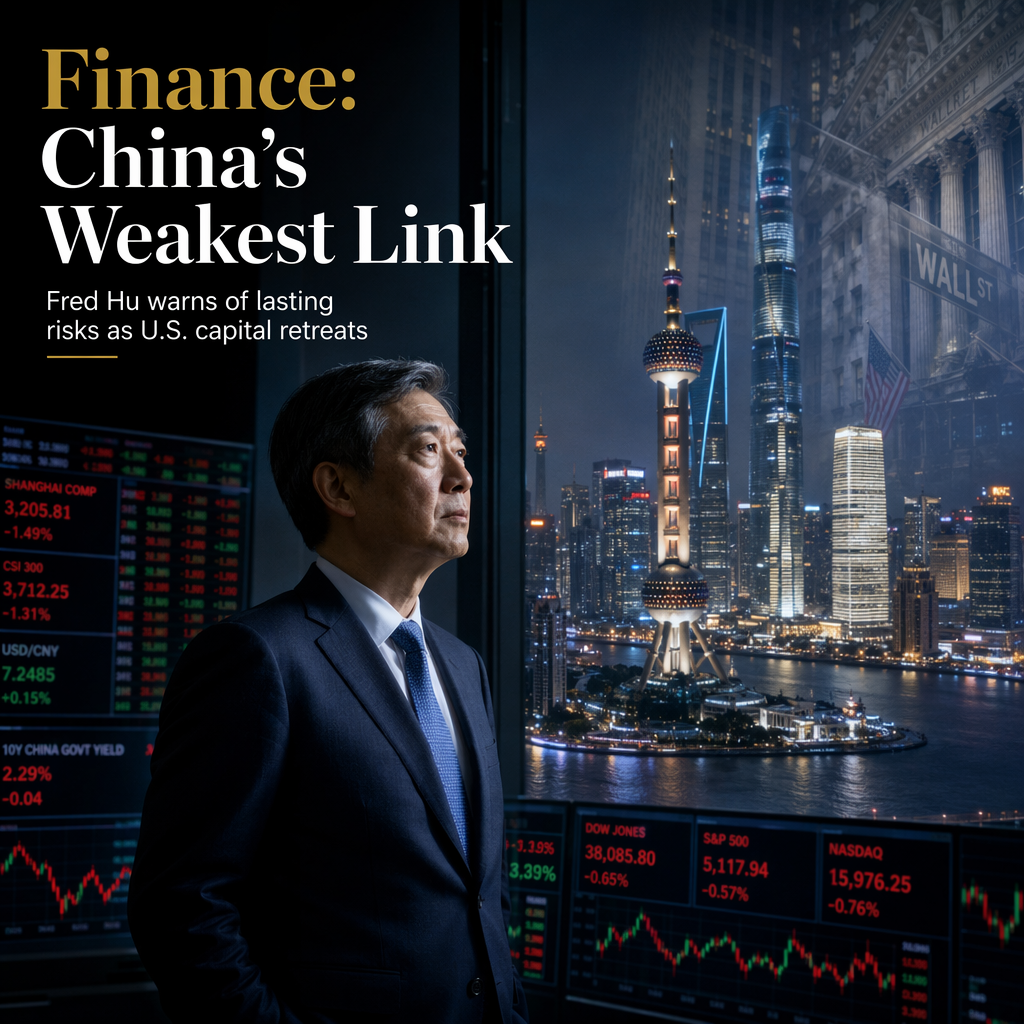
Fred Hu, founder and chairman of Primavera Capital, stated that finance, not artificial intelligence, semiconductors, or tariffs, is China's biggest vulnerability in its ongoing rivalry with the United States [1]. Hu, a former Goldman Sachs executive, emphasized that while major U.S. private equity firms like Blackstone can operate without China, Chinese private equity funds remain deeply reliant on U.S. capital pools for fundraising [1]. He described finance as China's 'short plank,' especially as Washington and Beijing increasingly sever investment ties [1].
Hu highlighted that the U.S. stock market is valued at approximately $75 trillion, compared to about $22 trillion for China and Hong Kong combined, underscoring the disparity in available capital [1]. He noted that American pension funds provide a deep pool for private funds, whereas Chinese state funds are smaller and fragmented, with Beijing maintaining strict control over household savings that could otherwise be used to fill the gap left by declining U.S. investment [1].
Recent regulatory actions have intensified the financial decoupling. Chinese regulators are planning to restrict private tech firms from accepting U.S. capital without government approval, following Beijing's reversal of Meta Platform's acquisition of startup Manus [1]. Meanwhile, Washington has barred U.S. pension funds and college endowments from investing in Chinese firms developing sensitive technologies, and listings by Chinese firms in the U.S. have become politically contentious [1].
Hu warned that financial decoupling could come at a significant cost, as American private equity funds have largely weathered the rivalry, but Chinese peers are being squeezed from both ends [1]. Primavera Capital, which manages about $20 billion in assets, has invested in major Chinese tech and consumer companies such as Alibaba, ByteDance, Yum China, and Didi Chuxing [1].
CONCLUSION
Fred Hu’s remarks underscore that finance, rather than technology, is China’s primary vulnerability in the face of escalating U.S.-China decoupling. The growing restrictions on cross-border capital flows and the relative weakness of China’s financial system could have lasting implications for Chinese private equity and tech investment.