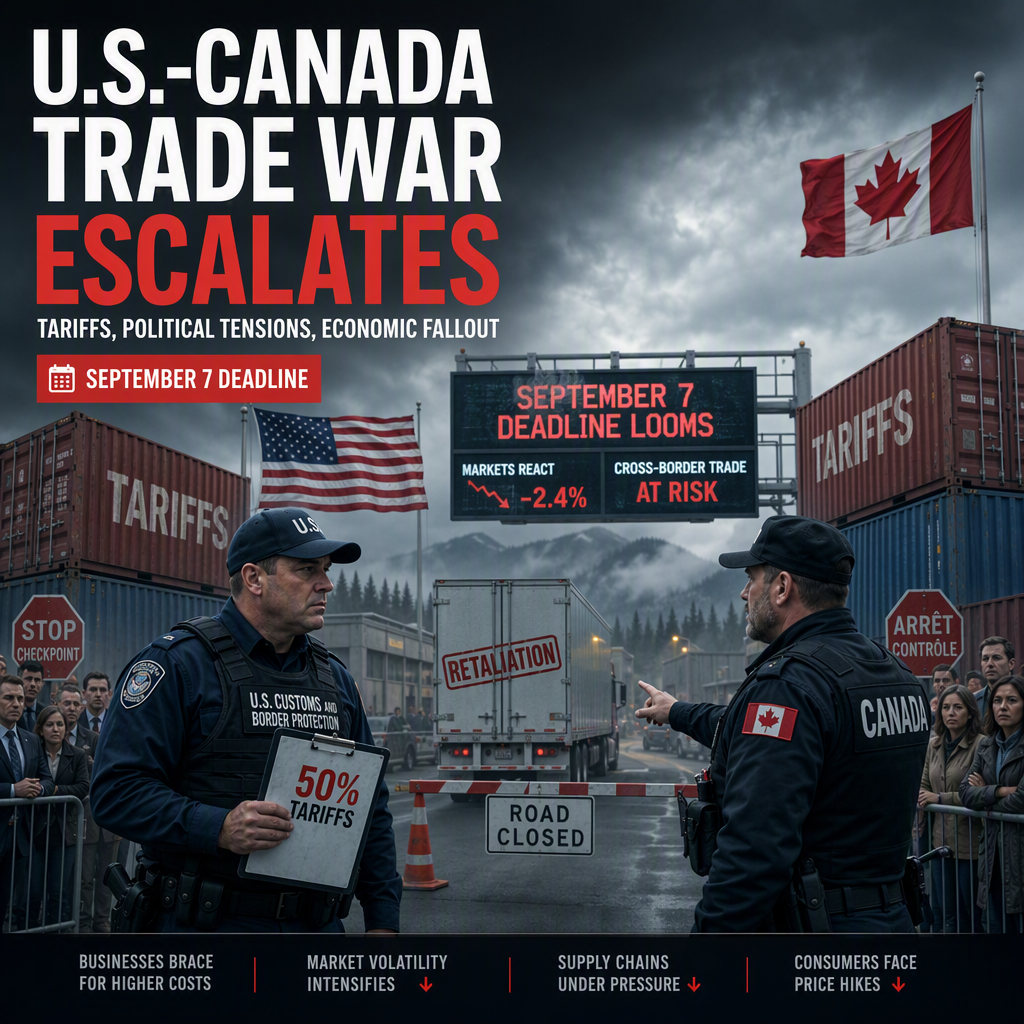
The United States and Canada are embroiled in an escalating trade dispute, with a September 7 deadline looming for a new trade deal. If an agreement is not reached, crippling sanctions are set to take effect on both sides, raising concerns about significant economic repercussions for businesses and consumers, particularly in northern border states [1][3]. The U.S. imposed 50% tariffs on a range of goods in late August after trade talks broke down, prompting Canada to retaliate with its own tariffs. Canadian officials accused the U.S. of making unreasonable demands, while U.S. representatives claimed Canada requested last-minute changes before the deal was to take effect [3].
Public opinion on the trade war is markedly different between the two countries. In Canada, the dispute is seen as an existential crisis, dominating national headlines and fueling unity around Prime Minister Mark Carney. Canadian grocery stores and pharmacies have initiated boycotts of American products, a move not mirrored in the U.S., where the issue receives minimal media attention [1]. Carney has blamed the Trump administration for the breakdown in talks, accusing the White House of "doing memes" and "throwing shade" against Canada [3]. Meanwhile, Commerce Secretary Howard Lutnick criticized Ottawa for "playing politics" and using the U.S. for political gain [3].
On Capitol Hill, U.S. Trade Representative Jamieson Greer met with House Republicans to address concerns about the tariffs and their impact on the midterm elections. Lawmakers expressed worries about the cost of living and the potential harm to businesses and consumers, especially in regions dependent on cross-border trade. The Trump administration's plan to lower tariffs on 300,000 metric tons of imported beef has also sparked backlash among cattle ranchers, traditionally strong allies of the president [3]. Most Republicans placed responsibility on Canada to de-escalate the situation, echoing the White House's stance [3].
The trade war is occurring against a backdrop of broader geopolitical tensions, including upcoming high-stakes meetings between President Trump and Chinese President Xi Jinping. While the U.S.-China relationship is also fraught with trade and political challenges, the immediate focus for American lawmakers and businesses remains the dispute with Canada and its implications for the midterm elections [2][3].
CONCLUSION
The escalating U.S.-Canada trade war is generating significant concern among lawmakers, businesses, and consumers, with both sides imposing retaliatory tariffs and blaming each other for the breakdown in negotiations. The dispute is seen as a major crisis in Canada, while Americans are less engaged, despite potential economic fallout. With the September 7 deadline approaching and no ongoing talks reported, market uncertainty remains high.