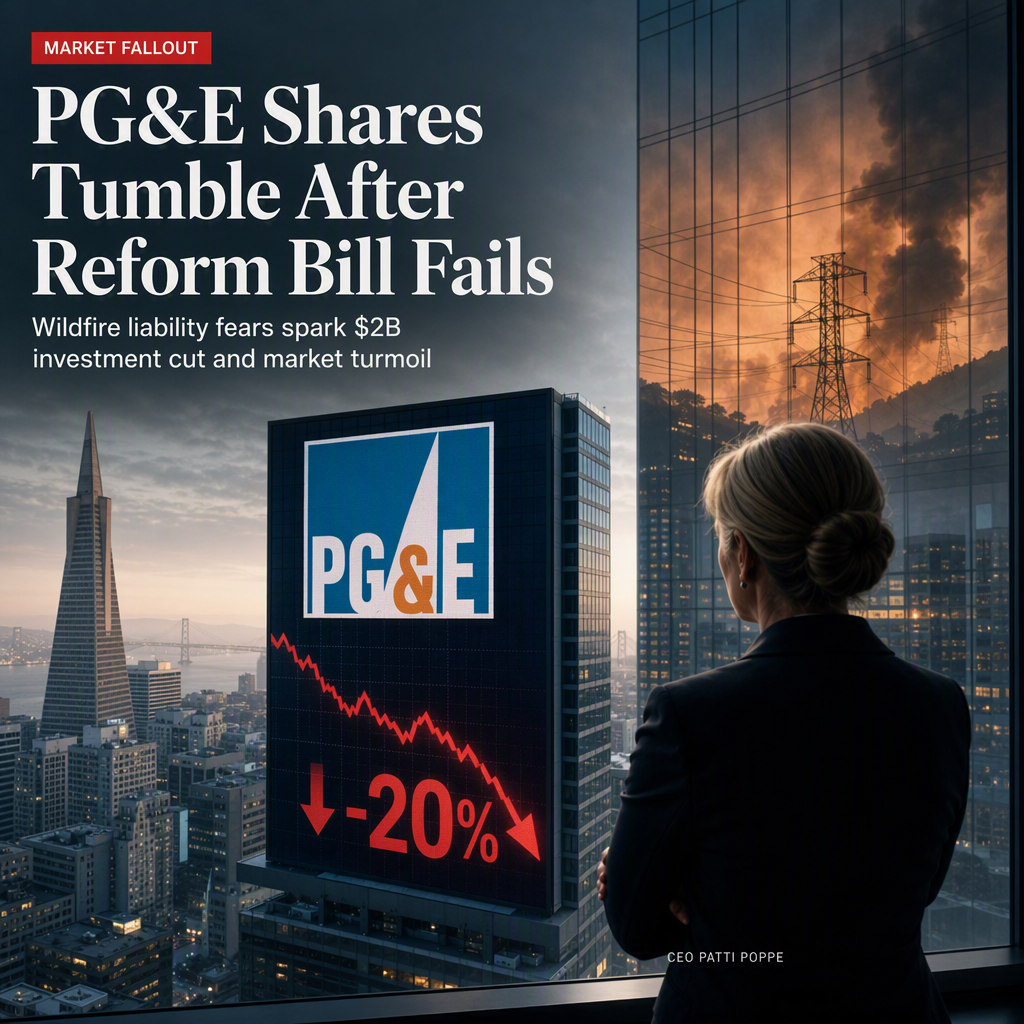
PG&E CEO Patti Poppe expressed hope that California lawmakers could still revive wildfire liability reform after a legislative proposal failed, causing a sharp decline in utility stocks. Poppe stated that the reform could lower PG&E’s borrowing costs, help restore its investment-grade credit rating, and unlock billions of dollars in investment for the company [1]. Shares of PG&E and Edison International dropped 20% and 21%, respectively, this week following the legislature's failure to advance a bill that would have limited the financial liability of utilities for wildfires started by their equipment [1].
Consumer advocacy groups, including those representing wildfire victims, have criticized attempts to shield utilities from liability, arguing that utilities must do more to prevent fires. The previous year’s deadly Eaton fire near Los Angeles was attributed to an idle transmission tower owned by Edison, according to Los Angeles County fire officials [1].
Speaker of the Assembly Robert Rivas stated that the current proposal did not provide adequate relief, accountability, or meaningful reform for Californians, emphasizing that the legislature had spent hundreds of hours negotiating with stakeholders but found the bill insufficient [1]. Despite the setback, Poppe indicated that the legislature could return for a special session to address the issue, expressing confidence in the leadership of Governor Gavin Newsom and Speaker Rivas to find a solution [1].
In response to the ongoing uncertainty, PG&E announced a strategic review and reduced its 2027 capital spending plan by $2 billion, bringing planned investment down to $11.4 billion. Poppe warned that this reduction would delay housing starts and renewable-energy projects in California [1]. The unresolved wildfire liability risk continues to complicate PG&E’s efforts to regain an investment-grade credit rating, as higher perceived risk leads to increased financing costs and deters some investors [1].
CONCLUSION
The failure of California's wildfire liability reform bill has had a significant negative impact on PG&E and Edison International shares, with both companies experiencing steep declines. PG&E's CEO remains hopeful for legislative action, but the company is already scaling back investments due to ongoing liability risks. The market remains cautious as uncertainty over future reforms persists.