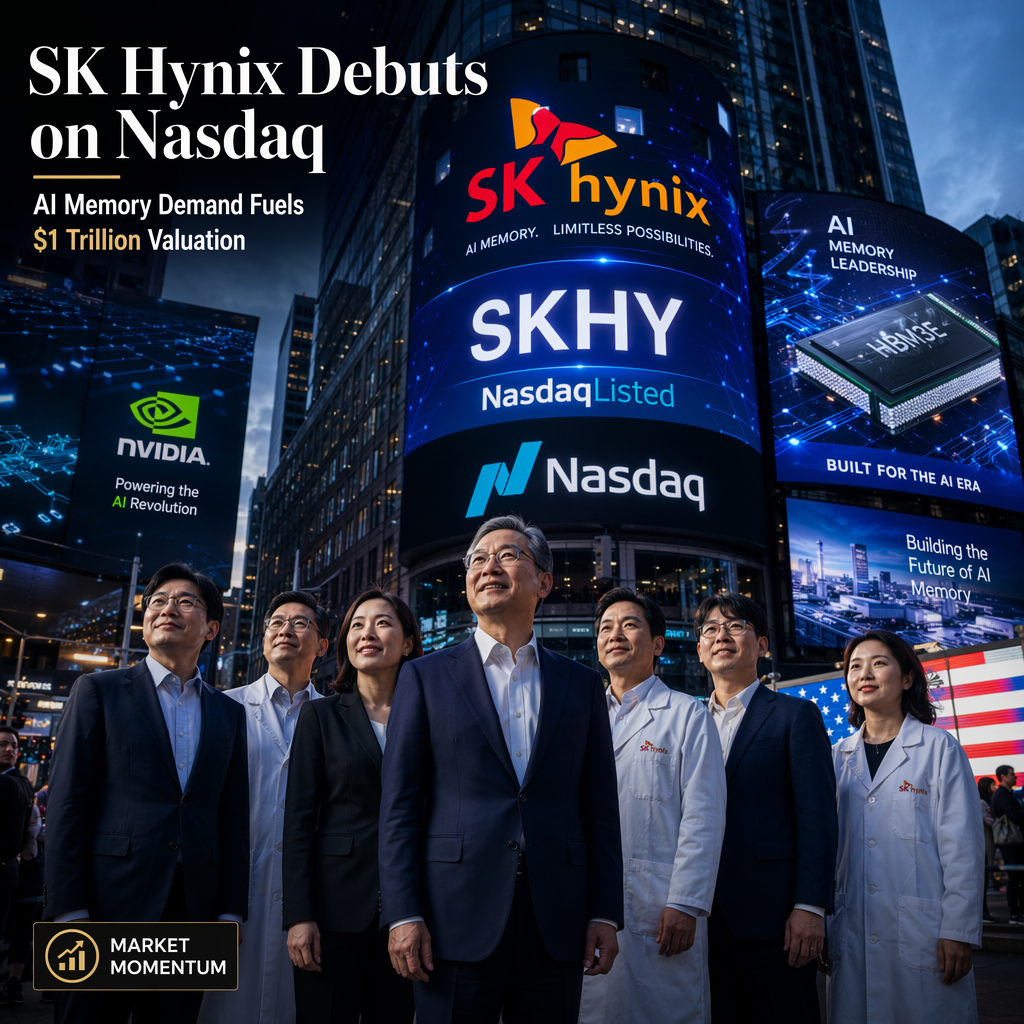
South Korea's SK Hynix, now valued at approximately $1 trillion, is set to debut on the Nasdaq, offering U.S. investors direct access to the global memory boom for the first time through American depositary receipts (ADRs) under the ticker symbol SKHY (initially SKHYV) [1]. The company's stock price has surged more than sevenfold over the past year, driven by a global memory crunch and surging demand for artificial intelligence (AI) applications, which has led to severe chip shortages and record-high prices [1].
SK Hynix is recognized as the leader in high-bandwidth memory (HBM), a critical component in AI chips, and is projected by analysts to capture more than half of the HBM market this year [1]. The company has established a multiyear partnership with Nvidia, the world's most valuable company and the largest buyer of HBM, as highlighted by Nvidia CEO Jensen Huang's visit to SK Hynix in Seoul in June [1]. TrendForce analyst Ellie Wang noted that SK Hynix is positioned as one of the biggest beneficiaries of the rapid growth in AI infrastructure [1].
To support its expansion, SK Hynix plans to raise around $29 billion through its Nasdaq listing, with proceeds earmarked for new factories and equipment [1]. The company is constructing a $4 billion advanced packaging facility in West Lafayette, Indiana, scheduled for completion in 2028, and is also expanding its Solidigm business near Sacramento, California [1]. SK Hynix expects to receive up to $458 million in funding from the U.S. CHIPS and Science Act to support its U.S. buildout [1].
SK Hynix is the second most valuable company in South Korea, trailing only Samsung, and is one of three primary global makers of computer memory alongside Micron and Samsung, supplying major technology firms such as Apple and Dell [1].
CONCLUSION
SK Hynix's Nasdaq debut marks a significant milestone for the company as it capitalizes on unprecedented demand for AI memory chips and pursues aggressive U.S. expansion. With a $1 trillion valuation and strong partnerships, SK Hynix is poised to remain a key player in the evolving semiconductor landscape.