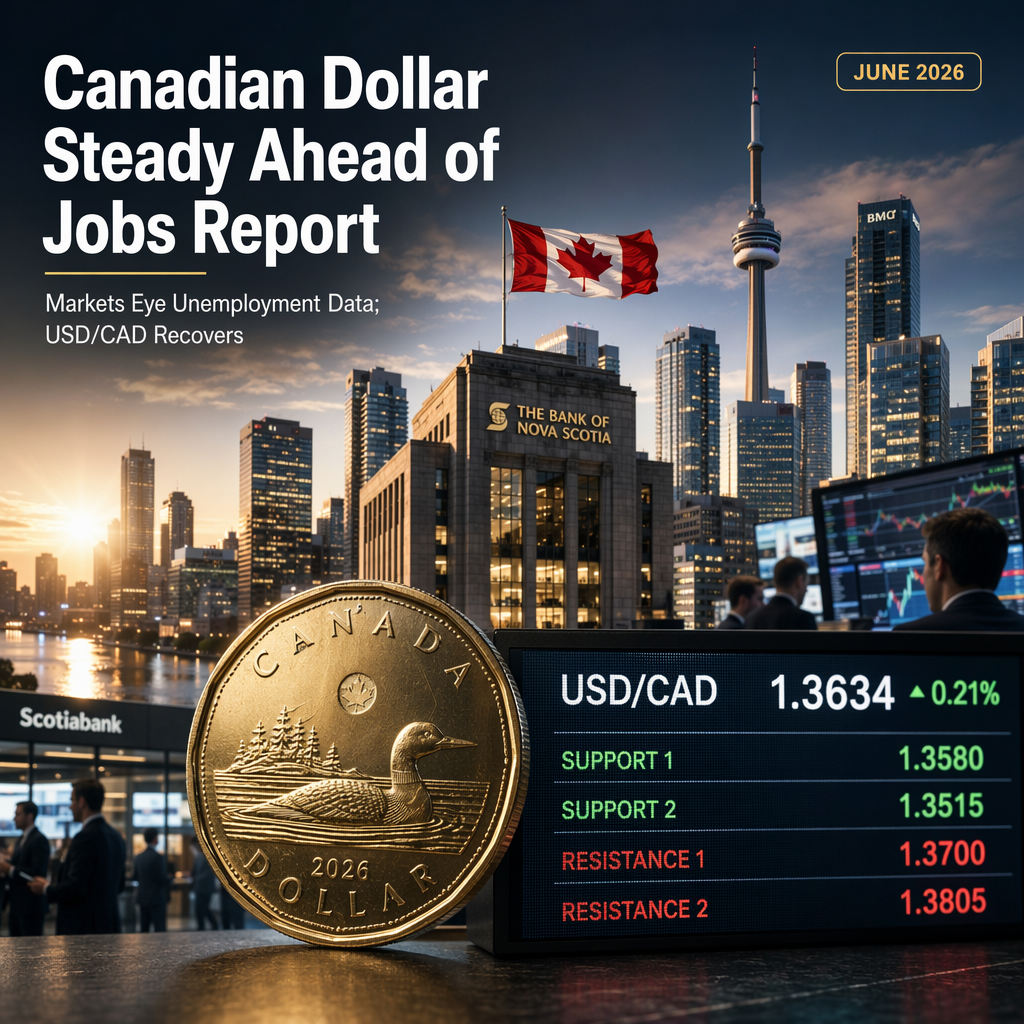
The Canadian Dollar's outlook is being shaped by anticipation of the June jobs report, with ING's Francesco Pesole highlighting expectations for a sharp slowdown in hiring to 10,000, following May's significant gain of 88,000 jobs. The unemployment rate is projected to remain unchanged at 6.6%, while permanent employees’ hourly wages are expected to rise from 3.2% to 3.6% [1][2]. The Bank of Canada (BoC) is seen as unlikely to make a hawkish policy shift in the near term, given benign inflation and risks related to the United States-Mexico-Canada Agreement (USMCA). ING does not expect USD/CAD to fall below 1.40 in the coming months, citing ongoing USMCA-related risk premium and only modest support from oil prices [1].
In the currency markets, the USD/CAD pair has staged a modest recovery from a three-week low of 1.4135, trading around 1.4160 during the early European session. This movement comes as traders await the Canadian employment data for further direction. A weaker tone in crude oil prices has weighed on the commodity-linked Canadian Dollar, while the US Dollar has found support amid expectations of at least one interest rate hike by the US Federal Reserve in 2026 and renewed geopolitical concerns in the Middle East [2].
From a technical perspective, USD/CAD is trading below the 100-period Simple Moving Average (SMA) on the 4-hour chart, with momentum indicators such as the MACD and RSI suggesting subdued upside momentum and a bias toward the downside. Key resistance is seen at the 1.4190 level, with support at 1.4100 and 1.4000. Analysts note that any further recovery in USD/CAD could be viewed as a selling opportunity, with upside likely to be limited unless there is a clear break above resistance [2].
Looking ahead, the market's focus remains on the Canadian jobs data, with the next unemployment rate release scheduled for July 10, 2026, at 12:30. The consensus and previous reading for the unemployment rate are both 6.6% [2]. ING analysts caution that unless oil prices rally to previous highs, the inflation outlook will remain too benign for the BoC to consider rate hikes, especially with downside risks to jobs and economic activity [1].
CONCLUSION
The Canadian Dollar is trading in a narrow range as markets await the June jobs report, with expectations for a slowdown in hiring and stable unemployment. Both fundamental and technical factors suggest limited upside for the CAD, while the USD/CAD pair remains sensitive to oil prices and US monetary policy expectations. The Bank of Canada is expected to maintain a cautious stance, with no major policy shifts anticipated in the near term.