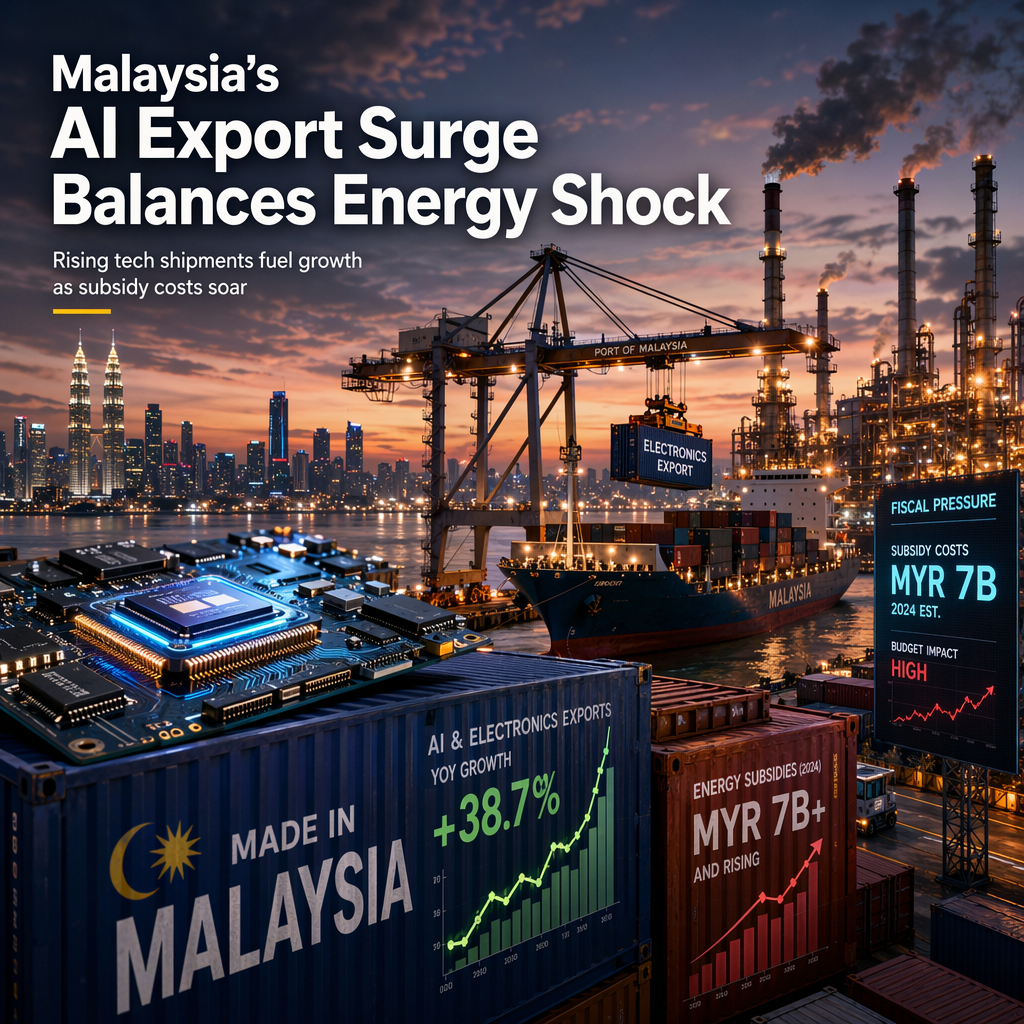
HSBC strategists report that Malaysia has demonstrated notable resilience to elevated oil prices, attributing this to its position as a net energy exporter and a key beneficiary of the ongoing Artificial Intelligence (AI) hardware cycle [1]. Despite the global backdrop of the Middle East conflict, which has heightened downside risks to growth and upside risks to inflation, Malaysia's economy has outperformed regional peers, maintaining robust growth and export performance [1].
In the first quarter of 2026, Malaysia's Gross Domestic Product (GDP) grew by 5.4% year-on-year, with manufacturing and services sectors showing sustained strength that offset a slowdown in construction growth from double-digit to single-digit rates [1]. Electronics exports, driven by the AI tech cycle, surged by 30% year-on-year on a three-month moving average basis [1]. HSBC has kept its GDP growth forecasts unchanged at 4.5% for 2026 and 4.7% for 2027, while Bank Negara Malaysia (BNM) has raised its 2026 growth forecast range from 4–4.5% to 4–5% [1].
However, the positive economic momentum comes with significant fiscal challenges. The monthly subsidy bill for energy has increased tenfold, rising from MYR700 million to MYR7 billion due to the conflict, placing considerable pressure on Malaysia's fiscal position and raising questions about the future of the RON95 petrol subsidy policy [1]. HSBC has also raised its inflation projections and expects BNM to keep interest rates unchanged through 2027 [1].
CONCLUSION
Malaysia's strong export performance, fueled by the AI hardware cycle, is helping to offset risks from elevated energy prices. However, surging energy subsidy costs are straining fiscal resources, prompting concerns about future subsidy policies. HSBC maintains a positive growth outlook but anticipates inflationary pressures and stable interest rates ahead.