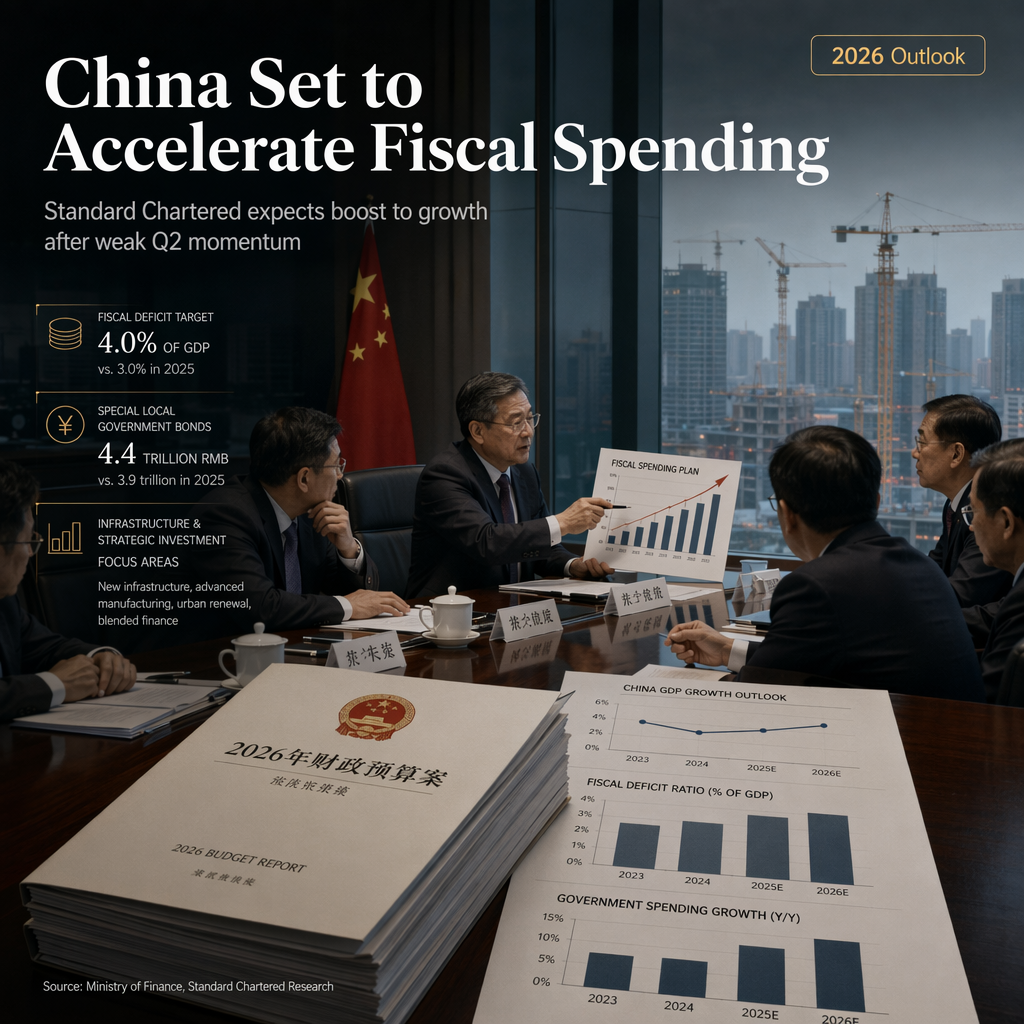
Standard Chartered economists Hunter Chan and Shuang Ding report that China's fiscal spending has underperformed so far in 2026, which has weighed on economic growth despite stronger-than-expected data in the first quarter [1]. General public budget spending grew only 0.8% year-on-year in the first five months of 2026, significantly below the budgeted annual growth of 4.4% [1]. In contrast, revenues grew 4% year-on-year in the same period, outpacing the planned annual pace of 2.2% [1]. Government funds spending dropped 4.3% year-on-year in the first five months of 2026, largely due to a nearly 20% year-on-year decline in revenue as land sales contracted further [1].
The economists highlight that growth momentum weakened in April and May following a robust first quarter, with the decline in fiscal spending during these months contributing to the downturn [1]. Specifically, the broad deficit, which combines the general public budget and government funds budget, was CNY 393 billion smaller year-on-year in April-May, compared to being CNY 258 billion larger in Q1 [1].
Looking ahead, Standard Chartered expects the Chinese government to accelerate budget implementation to boost domestic demand, as Q2 GDP growth is likely to fall below 4.5% year-on-year [1]. The budget approved in March leaves room for a sizeable deficit expansion, which, if fully utilized, could lead to a rebound in broad spending growth for the remainder of the year [1]. The economists estimate that the broad deficit in June-December could exceed the comparable 2025 outcome by CNY 1.7 trillion [1].
CONCLUSION
China's fiscal spending has lagged behind plans in early 2026, contributing to weaker growth momentum in Q2. However, Standard Chartered expects the government to accelerate spending in the coming months, potentially boosting domestic demand and supporting GDP growth if the available deficit room is fully utilized.