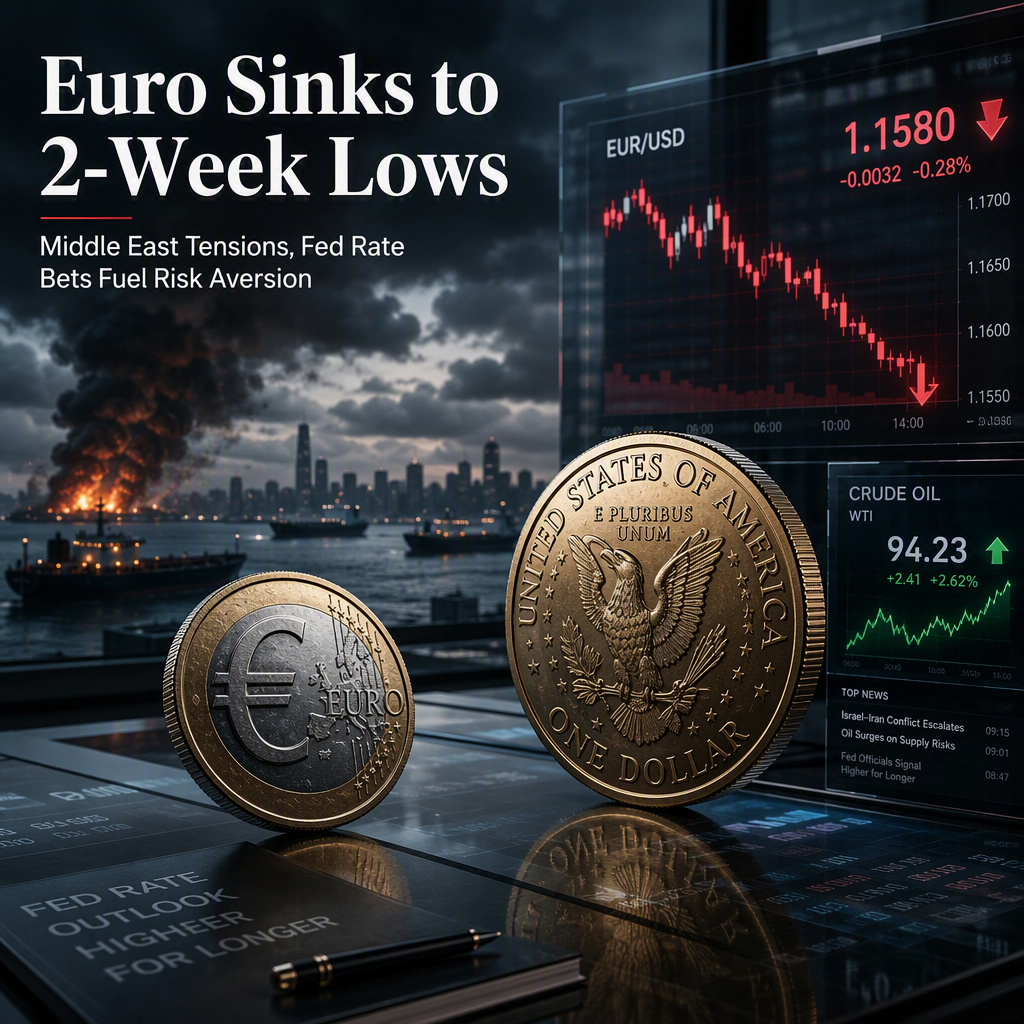
The Euro (EUR) has declined against the US Dollar (USD) for the second consecutive day, reaching two-week lows as risk aversion intensifies due to escalating tensions in the Middle East and increased speculation of Federal Reserve (Fed) interest rate hikes [1]. The EUR/USD pair is currently trading at 1.1580, after being rejected at the 1.1620 level on Tuesday [1]. Geopolitical uncertainty has been heightened by reciprocal attacks between the US and Iran, including US military strikes on Islamic Revolutionary Guard Corps (IRGC) targets in Iran and subsequent attacks on US bases in Bahrain, Jordan, and Iraq. Tehran has accused the US of killing 18 civilians during a wedding celebration on Tuesday [1].
These developments have pushed Brent Oil prices to $94.00, marking a nearly 7% increase for the week. The surge in energy costs poses a significant challenge for Eurozone economies, potentially dampening already fragile growth prospects [1]. In the US, macroeconomic data released on Tuesday was disappointing: the ISM Manufacturing PMI slowed more than expected in August, with the prices paid sub-index remaining flat and the employment gauge retreating from July’s high. Additionally, US JOLTS Job Openings increased below expectations in July [1]. Despite these weak data points, market expectations for a Fed rate hike remain robust, with the CME Group’s FedWatch Tool indicating a 68% probability of a quarter-point rate hike at the September meeting, nearly double last week’s 36% chance [1].
In the Eurozone, Spanish unemployment rose well beyond expectations in August, and Italy’s Producer Prices Index accelerated in July. European Central Bank (ECB) Committee member Joachim Nagel stated that markets see over a 95% chance of a September rate hike, but this has had no visible impact on the Euro, as the outcome appears to be already priced in [1].
Overall, the combination of geopolitical risks, surging energy prices, and diverging monetary policy expectations has led to increased demand for the US Dollar and pressure on the Euro. The market is closely watching upcoming central bank decisions and geopolitical developments for further direction [1].
CONCLUSION
The Euro's decline reflects heightened risk aversion and strong expectations for US Fed tightening, despite disappointing US economic data. Surging oil prices and weak Eurozone data further weigh on the currency. Market sentiment remains negative for the Euro, with investors favoring the US Dollar amid ongoing geopolitical uncertainty and central bank rate hike expectations.