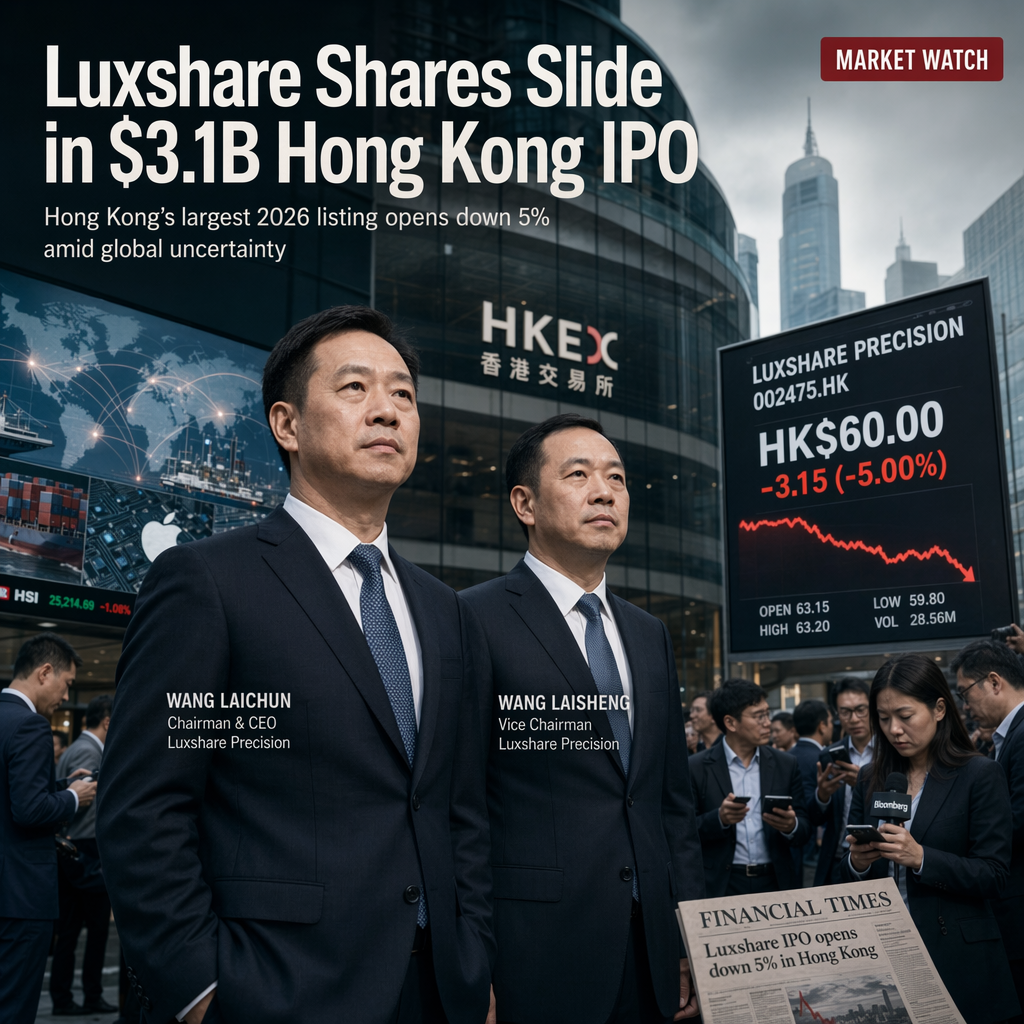
Luxshare Precision Industry, Apple's largest supplier in China, began trading on the Hong Kong Stock Exchange on Thursday after raising approximately $3.1 billion in the city's biggest initial public offering (IPO) of 2026 [1][2]. The company priced its shares at 63.28 Hong Kong dollars each, raising HK$24.27 billion ($3.09 billion) [2]. In early trading, Luxshare's shares slipped over 5%, opening at HK$60, reflecting cautious investor sentiment amid broader concerns about global supply chain disruptions and ongoing geopolitical tensions [1][2]. Technical charts indicated short-term pressure and heavy institutional participation, with analysts advising traders to monitor support levels and watch for potential rebounds as volatility in Asian equities persists [1].
Luxshare, already listed in Shenzhen since 2010, closed at 62.47 yuan on Wednesday, down 1.28% [2]. The company reported revenue of 332.34 billion yuan in 2025, up from 268.79 billion yuan in 2024, with consumer electronics accounting for 79.5% of revenue, automotive electronics 11.8%, and communications and data centers 7.4% [2]. Apple accounts for approximately 70% of Luxshare's revenue, according to PitchBook [2].
The listing is seen as a significant milestone for Hong Kong's capital markets, underscoring the city's continued prominence as a destination for Chinese technology companies seeking international capital despite external volatility such as the Iran war and regional crackdowns [1]. Luxshare's debut adds to a wave of high-profile Hong Kong IPOs this week, including autonomous-driving startup Momenta and semiconductor foundry Nexchip [2].
Looking ahead, Luxshare indicated it may evaluate further acquisitions and strategic partnerships to enhance its capabilities, having recently increased its controlling stake in German automotive cable and harness specialist Leoni AG to 74.9% as of April 2026 [2]. The company remains family-controlled, led by CEO Wang Laichun and vice chairman Wang Laisheng [2].
CONCLUSION
Luxshare's Hong Kong debut, the largest IPO in the city for 2026, was met with a share price decline of over 5% amid cautious market sentiment and global uncertainties. Despite the initial drop, analysts note strong institutional participation and see potential for stabilization as investor appetite for tech hardware remains robust. The listing reinforces Hong Kong's role as a key hub for Chinese tech capital raising.