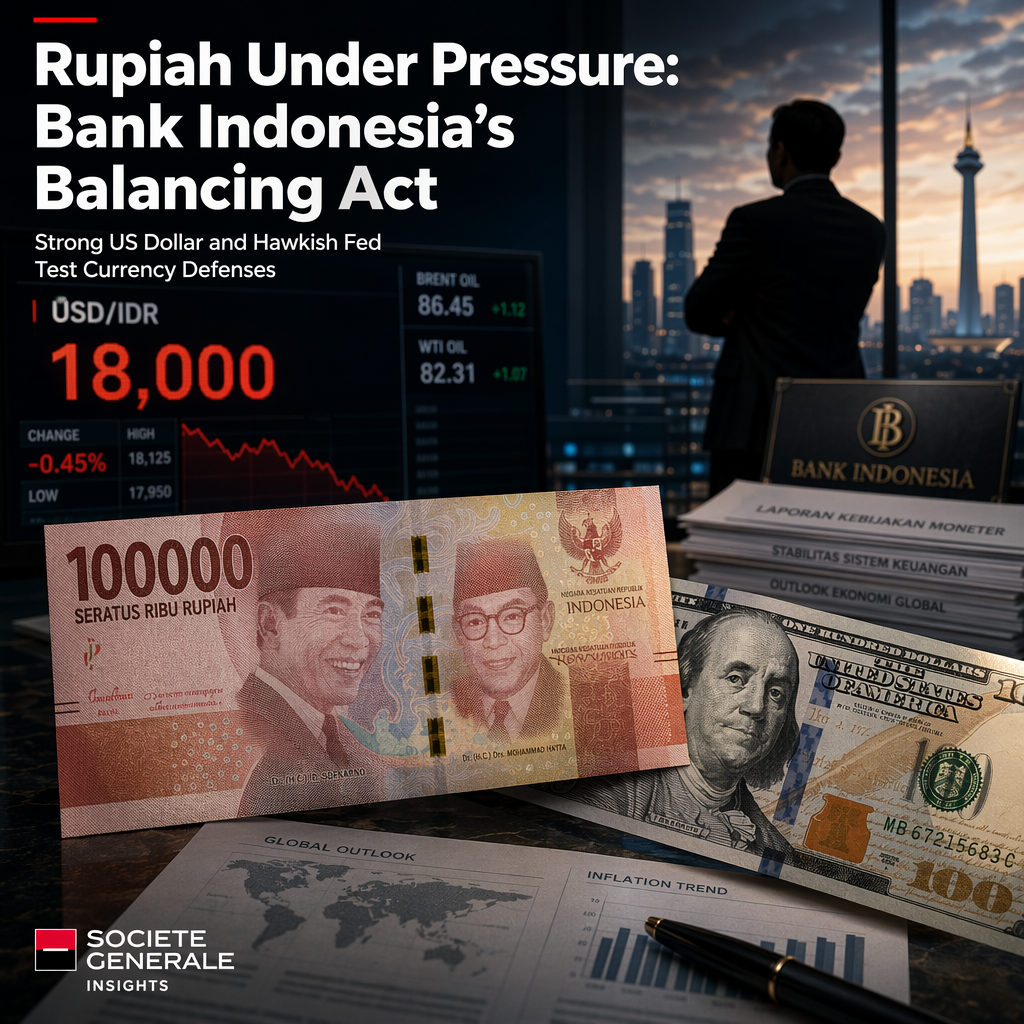
Societe Generale reports that the Indonesian Rupiah (IDR) is under pressure due to a stronger US Dollar (USD) and hawkish pricing from the Federal Reserve (Fed), with particular stress observed around the USD/IDR 18,000 level in early July [1]. Bank Indonesia (BI) is maintaining a hawkish policy bias, emphasizing its readiness to intervene if currency weakness becomes disorderly or threatens inflation expectations [1]. The report highlights that BI still has room to manage depreciation pressures through non-rate instruments, but if the currency continues to weaken despite intervention, BI may need to raise rates to stabilize expectations, rebuild carry, and limit portfolio outflows [1].
Societe Generale notes that BI has already implemented significant tightening in a short period, and the macroeconomic trade-off is becoming more apparent. Consumer confidence in Indonesia eased to 117.8 in June from 120.9 in May, though it remains in optimistic territory [1]. The report also warns that a renewed rise in US yields, a more hawkish Fed, higher oil prices, or a deterioration in Indonesia’s external balance could force BI to prioritize currency stability over economic growth [1].
No specific market reactions or analyst forecasts beyond Societe Generale's commentary are mentioned in the article. The overall tone suggests caution, with ongoing risks to the Rupiah and the potential for further policy tightening if external pressures persist [1].
CONCLUSION
The Indonesian Rupiah remains vulnerable to external pressures, particularly from a stronger US Dollar and hawkish Fed signals. Bank Indonesia is prepared to act to maintain currency stability, potentially through further tightening if necessary, but faces a challenging macroeconomic trade-off.